Book Appointment Now

Six cost blocks make up PCBA cost — bare board, components, SMT placement, through-hole, test and one-time NRE — plus the variables behind quote spread.
PCBA Cost Structure: What Drives an Assembly Quote, Block by Block
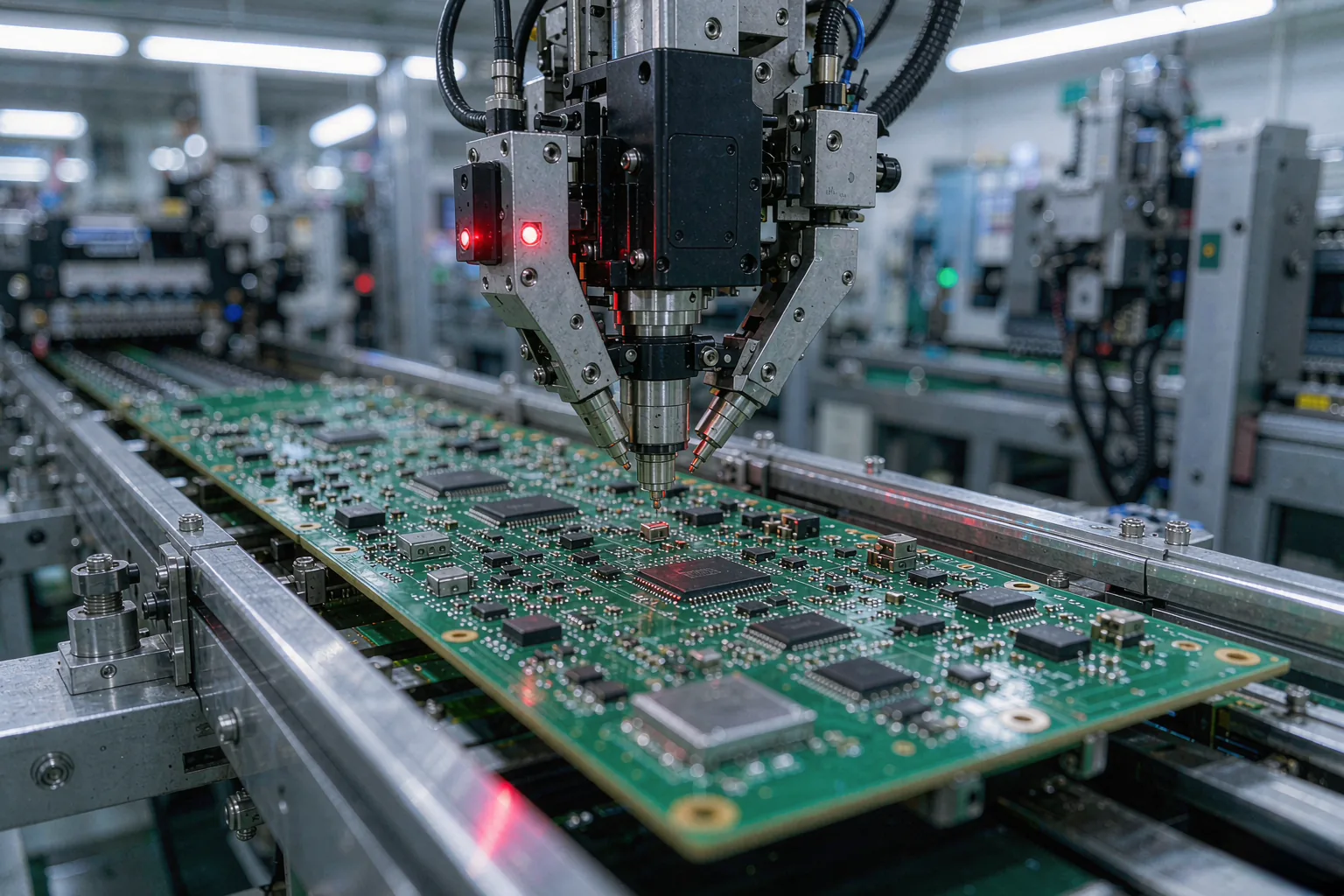
Two suppliers quote the same board and the numbers are nowhere near each other — that is the normal starting point for understanding PCBA cost, not a sign that someone is cheating. An assembly quote is a stack of six cost blocks priced by different logic: the bare board by geometry and layer count, the components by the BOM and the sourcing channel, placement by solder joints, test by scope, and a set of one-time engineering charges that amortise down as volume grows.
This article disassembles each block: what it is priced on, how big a share of the total it typically holds, what moves it, and why the same six blocks produce such different totals at sample and at volume. The goal is practical — by the end you should be able to read any PCBA quote, see which block each line belongs to, and know exactly which variables to align before you ask two suppliers for comparable numbers.
Table of Contents
- Why Two PCBA Quotes for the Same Board Rarely Match
- The Six Cost Blocks Behind PCBA Cost
- Block 1: Bare Board Cost Inside the Assembly Quote
- Block 2: Component Cost and the Turnkey vs Consigned Choice
- Block 3: SMT Placement Cost Is Priced per Joint
- Block 4: Through-Hole, Wave and Selective Soldering
- Block 5: Test, Coating and Final Assembly
- Block 6: One-Time NRE — the Fees That Amortise Down
- How PCBA Cost per Unit Falls from Sample to Volume
- Six Variables to Align Before You Request a Quote
- How to Compare Two Quotes Line by Line
- Planning Lead Time: Fabrication and Sourcing in Parallel
- FAQ
- Send the BOM and Gerber for a Block-by-Block Quote
Why Two PCBA Quotes for the Same Board Rarely Match
The most common reason two quotes diverge is scope, not margin. One supplier prices turnkey sourcing with branded parts from authorised channels; the other assumes you will consign components and only charges for assembly. One includes X-ray inspection of hidden BGA joints; the other assumes AOI is enough. One quotes the stencil and test fixtures as separate one-time lines; the other buries them in the unit price and earns it back only if you reorder. None of these assumptions is wrong — they are just different, and they are invisible until the quote is itemised.
That is why the useful unit of comparison is not the total but the block. When a quote is broken into the six blocks below, each line can be challenged on its own logic, and the spread between two suppliers stops being a mystery and becomes a set of specific, negotiable questions.
The Six Cost Blocks Behind PCBA Cost
Industry practice splits every assembly quote into six blocks. The shares below are the ranges seen across public quoting guides and everyday RFQs — they vary by product, but they are stable enough to serve as a sanity check. A quote where components hold 70% of the total is normal for a board full of branded ICs; a quote where placement holds 30% is normal for a dense board with thousands of joints and few expensive parts.
| Cost block | Priced on | Typical share of total | What moves it |
|---|---|---|---|
| Bare board | Per unit or per area, by layer count and process | 15–30% | Layers, thickness, copper weight, surface finish, panel utilisation |
| Components (BOM) | Line by line from the BOM | 50–80% | Brand and sourcing channel, stock availability, distributor minimums, end-of-life parts |
| SMT placement | Per solder joint | 10–30% | Joint count, package sizes, single- or double-sided assembly |
| Through-hole and soldering | Per joint or per hour | Scales with THT count | Wave vs selective vs hand soldering, connector count |
| Test and finishing | Per test item | Project-based | X-ray, ICT, functional test, conformal coating, final assembly |
| One-time NRE | Per model | Highest at sample stage | Stencil, placement program, first article, test fixtures |
Read the fourth column as your negotiation checklist. Every factor listed there is something you control or can at least ask about — and a quote that does not let you see the blocks cannot be challenged at all. If a supplier sends one number with no breakdown, the follow-up question is simply: which of the six blocks does it include, and which are extra?
Block 1: Bare Board Cost Inside the Assembly Quote
The bare board inside a PCBA quote follows exactly the same pricing logic as a standalone fabrication quote: layer count, board thickness, copper weight, surface finish and — critically — panel utilisation, meaning how many boards fit on a standard production panel. A design that scores a high panel count spreads the same fabrication overhead over more units; an odd-shaped board or an unlucky dimension can quietly double the effective per-unit board price without any change in the board itself.
Because this block is priced like bare PCB fabrication, all the usual cost-driver reasoning applies: the difference between a 4-layer and an 8-layer board is a step change, not a slope, and the finish choice shifts both the unit price and the shelf life. For the detailed breakdown of what drives fabrication pricing on a conventional multilayer build, see the 4-layer PCB cost driver analysis and the general cost-per-square-meter breakdown; for what a high-layer-count build looks like in practice, the 8-layer security system PCB page shows a typical volume configuration.
Block 2: Component Cost and the Turnkey vs Consigned Choice
Component supply is the largest and least standardised block — often more than half the total — and the first structural decision is who buys the parts. In a turnkey quote, the assembler sources everything: the price includes their purchasing effort, their channel margins, and their risk buffer for stock and lead-time movements. In a consigned arrangement, you ship the parts to the line and pay only for placement, which makes the assembly quote cleaner but transfers sourcing risk, incoming inspection and storage back to you.
| Aspect | Turnkey (supplier buys) | Consigned (you supply) |
|---|---|---|
| Sourcing effort and channel margin | Included in the quote | On your side |
| Price visibility per part | Often a lump BOM line; ask for per-line pricing | Full visibility, you own the BOM cost |
| Shortage and substitution risk | Supplier manages, usually with a brand-range clause | You manage shortages, alternates and EOL parts |
| Incoming quality responsibility | Supplier inspects what it buys | You guarantee what arrives at the line |
| Best suited for | Teams without sourcing bandwidth or regional channel access | Teams with negotiated component pricing or existing stock |
Whatever the model, insist on the same two clauses. First, brand range: the quote should state which manufacturers or authorised channels a line item may be filled from, because a generic “equivalent” part can change the behaviour of an analogue circuit. Second, price validity: component markets move, so the quote should state how long BOM pricing holds and how substitution is agreed — a quote silent on both is the main source of surprise increases after the order. Distributor minimum order quantities deserve a specific look too: on small batches, the excess you buy to satisfy a minimum can rival the value of the parts actually mounted.
Block 3: SMT Placement Cost Is Priced per Joint
Placement is quoted per solder joint, so the raw arithmetic is joint count times joint rate. The rate is not flat, though. Simple two-pad passives cost the least; micro-packages such as 01005 and 0201 carry a premium because they demand tighter feeder setup, slower placement speeds and stricter paste printing; and leadless packages — QFN, and BGA families priced per ball — cost several times a passive because each ball is a joint that must be inspected and, for hidden ones, X-rayed.
The process behind the rate is described step by step in the SMT assembly process walkthrough. Two structural facts matter for cost. Double-sided assembly runs the entire print-place-reflow sequence twice, so the placement block roughly doubles even though the board is the same. And every production changeover — moving from one model to another — consumes machine time that gets amortised across the batch, which is why small, mixed batches pay a disproportionate share of setup.
Block 4: Through-Hole, Wave and Selective Soldering
Mixed-technology boards — SMT on both sides with connectors or power components through-hole — add a second soldering process after reflow. Wave soldering is the economical choice when the through-hole side is open and shielded areas allow it; selective soldering costs more per joint but handles dense boards where a wave would re-melt nearby SMT joints; hand soldering is reserved for the few joints neither machine process can reach and is priced by the hour.
The design lever here is reducing the through-hole population that actually needs the second process. Every connector that can move to a press-fit or SMT equivalent, and every through-hole part that has a workable surface-mount alternative, removes joints from the most labour-sensitive block on the quote. When the through-hole count cannot shrink, grouping those parts so the wave or selective nozzle handles them in one organised pass is the cheaper arrangement than scattering them across the board.
Block 5: Test, Coating and Final Assembly
Test is the most frequently under-scoped block, because part of it hides inside placement. AOI after reflow is standard and usually included; what is not included by default is everything past it. X-ray inspection for hidden BGA and QFN joints, in-circuit testing against a bed-of-nails fixture, functional testing with your test procedure, conformal coating, and final mechanical assembly into an enclosure — each is a distinct capability with its own fixture and its own per-unit time.
The acceptance criteria those tests enforce should be written into the RFQ, not assumed. Alignment with the IPC acceptance classes gives both sides a common vocabulary for what “inspected” means, and the IPC standards framework is the reference behind it. A quote that prices assembly without the test scope will look cheaper than a complete one — and quietly transfers the risk of escaped defects back to your product line, which is the most expensive place for it to land.
Block 6: One-Time NRE — the Fees That Amortise Down
The last block is everything paid once per model: the solder paste stencil, the placement program and its verification, the first-article inspection, and any test fixtures the agreed scope requires. None of these scale with quantity — they cost the same whether the order is ten units or ten thousand — so their share of the per-unit price depends entirely on how many units share them.
Two practical rules follow. First, ask whether NRE is quoted as separate lines or folded into the unit price; folded pricing looks friendlier but makes reorder economics opaque. Second, ask what carries over on a repeat order: an unchanged revision and the same panel arrangement reuse the existing stencil and programs, so a repeat quote should contain little or no new NRE — while a layout revision that changes the panel or the stencil apertures starts that block over. This is also the mechanism behind the sample-to-volume price drop analysed next.
How PCBA Cost per Unit Falls from Sample to Volume
Put the six blocks together across order sizes and the pattern is consistent. At sample quantities, the fixed NRE block is divided by a handful of units, so it dominates the per-unit total; at volume, it becomes negligible and the component block takes over as the largest share. In practice, volume unit prices commonly land at one-fifth to one-third of the sample price — not because anything got cheaper per operation, but because the same one-time engineering is now spread across a thousand units instead of ten.
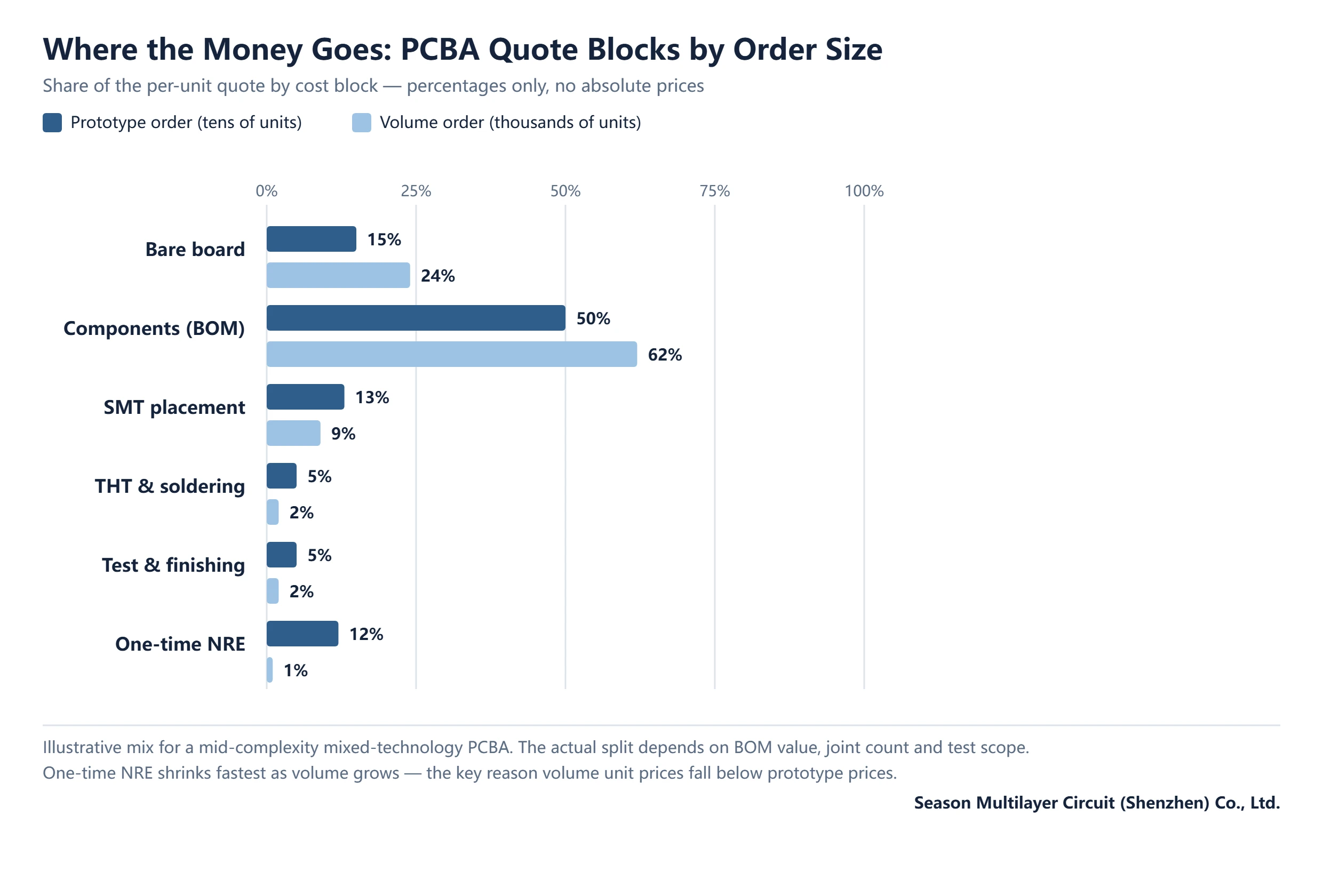
The chart shows the shift in shares for an illustrative mid-complexity build: NRE falls from a visible slice of the sample price to almost nothing at volume, while components and the bare board absorb the share. Two buying implications follow. A sample-stage quote tells you almost nothing about your volume price except the component block — so negotiate volume pricing on BOM and board separately from the NRE. And any way the design can reduce NRE scope — standard panel arrangement, reusing a fixture from a sibling product — moves the sample-to-volume curve more than almost any unit-price argument.
Six Variables to Align Before You Request a Quote
Comparable quotes come from comparable inputs. Before sending an RFQ to two suppliers, write these six down explicitly — they are the variables that most reliably explain why otherwise identical boards price differently.
| Variable | Effect on PCBA cost | What to specify |
|---|---|---|
| Joint count and part count | Placement block scales with both, roughly linearly | BOM with reference designators; centroid file for placement |
| Package mix | Fine-pitch, micro-package and leadless parts carry joint-rate premiums | Package column populated, not left blank; flag 01005/0201 and BGA/QFN |
| Panel utilisation | Spreads board cost and changeover time over more units | Preferred panel dimensions or let the supplier propose options |
| Single or double-sided placement | Double-sided runs the print-place-reflow sequence twice | State which components mount on which side |
| Order quantity and batch structure | NRE amortisation and changeover cost both depend on it | Total quantity plus how it splits into batches and revisions |
| Test scope | X-ray, ICT, functional test and coating are separate line items | List required inspections and the acceptance class per test |
None of these is exotic — they are all fields on a well-formed RFQ. The discipline is simply supplying them the same way to every supplier, so the quotes that come back answer the same question.
How to Compare Two Quotes Line by Line
With the blocks in hand, comparison becomes a short checklist rather than a judgement call. Work through it in order — the early items decide whether the later ones are even meaningful.
- Confirm both quotes assume the same sourcing model — turnkey or consigned — and the same quantity and batch structure
- Check that all six blocks appear, or get explicit written confirmation of which are folded into the unit price
- Compare the BOM line by line: same brands and channels, same substitution policy, same validity period
- Compare test scope item by item — a missing X-ray or functional test line is a scope gap, not a saving
- Ask for NRE as separate one-time lines and confirm what carries over on a repeat order
- Check the surface finish and mask requirements match what the bare-board block was priced on
- Only then compare totals — at that point any remaining difference is a real, discussable number
The same discipline works in reverse when a quote arrives unusually low. Find the block that is thinner than the others, ask what it excludes, and you will usually find the scope gap that explains the price — before it explains a production delay instead. For the supplier-side qualities worth auditing beyond price, the PCBA supplier selection checklist covers capability, channels and factory audit points in detail.
Planning Lead Time: Fabrication and Sourcing in Parallel
PCBA lead time is two schedules stacked, and only the first is the fabricator’s. Board fabrication runs on its own process clock — the sequence is described end to end in the PCB manufacturing process overview. Component sourcing runs in parallel: stock parts arrive in days, while parts on allocation can set the pace of the whole project. Assembly itself — placement, AOI, the agreed test scope — adds its own window on top, and the batch structure you chose in the RFQ determines how many changeovers sit inside it.
The planning consequence is simple: quote the two schedules together, not sequentially. A supplier who confirms sourcing lead times at quotation time — flagging which BOM lines are long-lead before the order — gives you a project plan; a supplier who quotes only the assembly window leaves the longest and least predictable block unpriced in schedule terms. The lead-time explainer breaks down what drives each stage and where the schedule risk concentrates.
Frequently Asked Questions
How is PCBA cost calculated?
Add six blocks: bare board, components, SMT placement, through-hole soldering, test and finishing, plus one-time NRE divided by the order quantity. Components usually hold more than half the total, and the NRE block is the reason a sample-stage per-unit price is several times the volume price. A quotable breakdown itemises all six rather than quoting one merged number.
Why is the sample PCBA price several times the volume price?
Stencils, placement programs, first-article inspection and test fixtures are one-time charges per model. Divided across ten units they dominate the per-unit total; divided across thousands they nearly vanish. That amortisation alone commonly brings volume unit prices to one-fifth to one-third of the sample price, before any volume discount on parts.
What does SMT placement cost depend on?
Solder joint count times the joint rate. The rate rises for micro-packages like 01005 and 0201, and leadless devices such as QFN and BGA are priced per ball at several times the passive rate. Double-sided assembly roughly doubles the placement block because print, placement and reflow all run twice.
Do stencil and program fees repeat on every order?
No. On a repeat order with an unchanged revision and the same panel arrangement, the stencil and programs carry over, so a new NRE block should be minimal. A layout revision that changes the panel or the stencil apertures starts the block over. Ask the supplier to state what carries over as part of the quote.
Why do component costs differ so much between quotes?
Because the BOM block is more than half the total and depends on brand, sourcing channel, stock availability and distributor minimum order quantities. Quotes that do not state the brand range per line item and the price validity period leave those variables open — which is where post-order increases usually come from.
How much more does double-sided assembly cost?
The placement block roughly doubles, because the board runs solder paste printing, placement and reflow twice — plus a flip and a second thermal pass to manage. The precise increase depends on how the joints distribute between the two sides, so it is quoted per design rather than as a flat percentage.
Which test items should a PCBA quote include?
AOI after reflow is the baseline and usually included. Beyond that, X-ray for hidden BGA and QFN joints, ICT with a bed-of-nails fixture, functional testing against your procedure, and conformal coating are separate capabilities priced per item. Specify the required tests and the acceptance class in the RFQ, so quotes are comparable and nothing critical is silently excluded.
Send the BOM and Gerber for a Block-by-Block Quote
A comparable quote starts with comparable inputs. Send the BOM, Gerber data, centroid file and test requirements in one package, and the engineering team will return a quote itemised by cost block — sourcing model stated, NRE separated, test scope explicit — together with confirmed sourcing lead times flagged per BOM line.
Start from the PCB manufacturing services overview or request pricing directly on the instant quote page; either route reaches the same engineering review, and the quote you get back is built to be compared line by line.