Book Appointment Now

Instant PCB Price Calculator for 6–20 Layer Boards
Get a free instant PCB price estimate in seconds. This online PCB price calculator covers 6–20 layer boards and six HDI structures using the parameters you already know — layer count, board size, quantity, copper weight, minimum hole size and surface finish — and shows prototype and volume pricing side by side in USD. Every figure is an indicative calculation; the confirmed quotation is issued by our engineers after they review your fabrication data.
What the PCB price calculator covers
The calculator prices the process routes the factory actually runs, so each option below maps to real capability rather than to a simplified price tier. Solder mask and silkscreen colours are selectable alongside the finish. If a combination falls outside the configured ranges, the form routes you to a manual quotation instead of returning a figure it cannot stand behind.
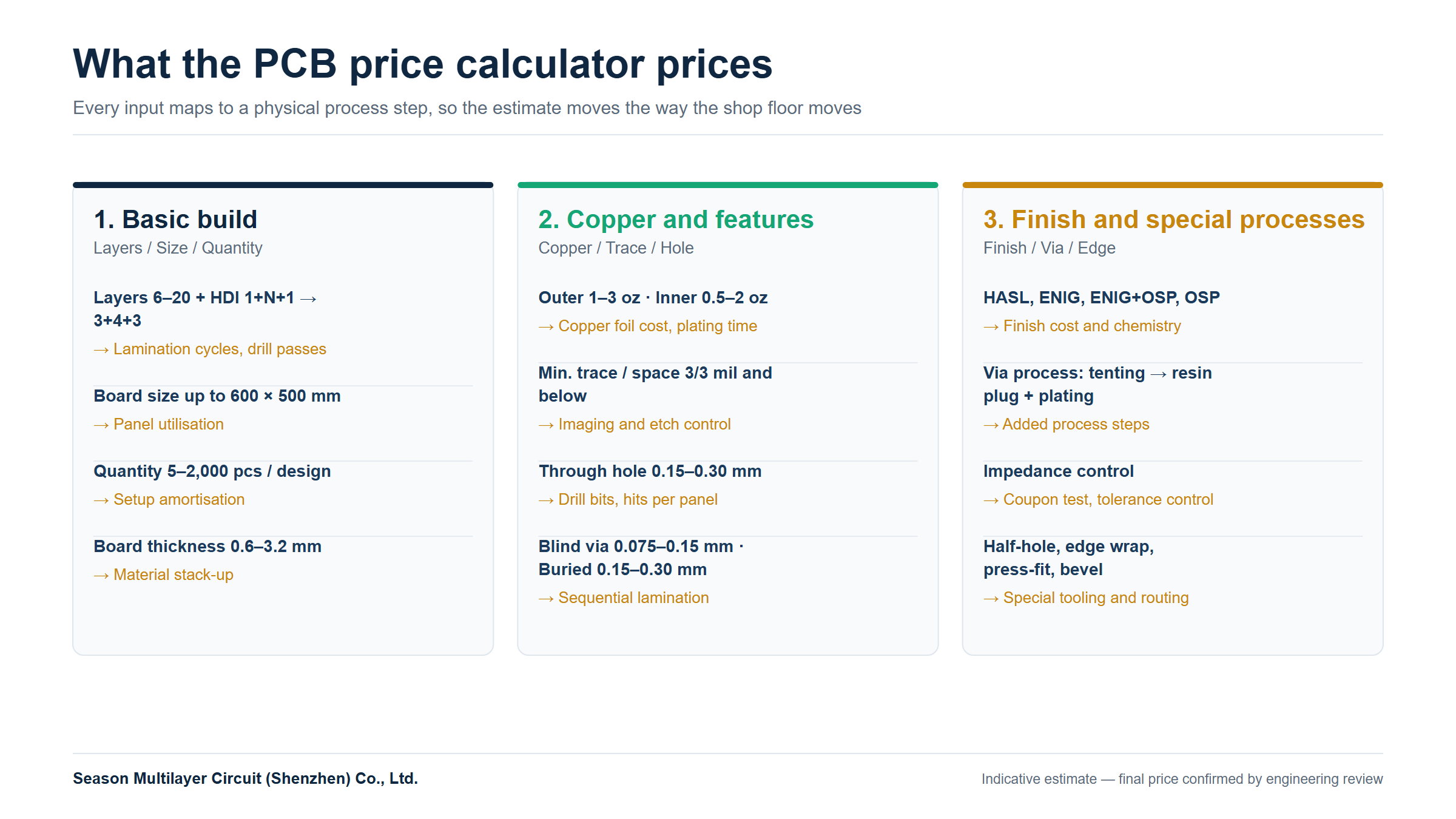
| Parameter | Range in this calculator |
|---|---|
| Layers | 6, 8, 10, 12, 14, 16, 18, 20, plus HDI builds from 1+2+1 up to 3+4+3 |
| Board size | Up to 600 × 500 mm single board |
| Quantity | 5 – 2,000 pcs per design, with custom quantities supported |
| Designs per panel | Multiple different boards combined within one file |
| Board thickness | 0.6 – 3.2 mm |
| Copper weight | Outer 1 – 3 oz, inner 0.5 – 2 oz |
| Min. trace / space | 3/3 mil and below |
| Min. through hole | 0.15 – 0.30 mm |
| Min. blind / buried via | Blind 0.075 – 0.15 mm, buried 0.15 – 0.30 mm |
| Surface finish | HASL lead, HASL lead-free, ENIG, ENIG+OSP, OSP |
| Via process | Tenting (covered), opened window, ink plugging, resin plug + plating |
| Special processes | Impedance control, via in pad, gold finger bevel, castellated half-holes, edge wrap, press-fit holes |
How the instant PCB quote is calculated
Every input above maps to a physical process step rather than to a pricing tier. Layer count and structure decide how many lamination cycles and drilling passes the panel goes through; a tighter hole class adds drill control, and an extra lamination cycle is priced where the HDI structure demands one. Board size and quantity decide panel utilisation. Laminate grade, copper weight and surface finish decide material cost, while via technology, impedance control and the special processes decide how much process control and inspection the job carries.
Because the inputs are the cost drivers, the estimate moves the way the shop floor moves. Using the panel better makes each board cheaper, while tighter minimum holes or a controlled-impedance requirement add control that has to be paid for on every unit rather than once. Our breakdown of the components of a PCB price shows which of those terms dominates at which order size, and PCB cost per square meter explains why a per-area figure is the wrong number to scale from.
Prototype and volume quantities price differently
| Cost element | Prototype quantity | Volume quantity |
|---|---|---|
| Engineering and tooling | Carried by very few boards | Spread across the whole run |
| Panel utilisation | Frequently the dominant term | Improves as boards nest together |
| Setup and first-article checks | Proportionally large | Amortised to a small share |
| Laminate grade | The cheapest grade that passes | Chosen for the application |
| Process options — fine line, HDI, impedance | Priced as capability | Priced as capability |
The same design can quote very differently at five pieces and at five hundred, which is why the calculator shows both columns for every configuration. Run the prototype quantity to validate a design, then re-run the volume quantity once the design is stable — the movement between the two columns is the useful number, not either column on its own.
Where the automatic estimate stops
The estimate works from the parameters you enter; engineering review works from the data you send. It cannot see a stackup that will not build, a clearance violation, or a drill span that needs more lamination cycles than the layer count implies. That is why the figure is presented as indicative and why the confirmed quotation is issued after review. Our quote checklist lists what to verify before submitting, how to read a factory’s real capability covers the process limits that decide whether a design quotes at the tier you expect, and PCB materials and laminates sets out how Tg, halogen-free grades and low-loss laminates differ.
Lead time, confidentiality and how to order
Standard fabrication schedules by layer count and process class are set out on our PCB lead time page, and the schedule for your specific build is confirmed with the quotation before any order is placed — the calculator prices the board, not the calendar.
Design files sent for review are used only to prepare your quotation and build your order, and we are happy to sign an NDA before you send anything. Acceptance criteria are referenced to IPC standards where the drawing calls for a class, and production runs under the factory’s ISO-certified quality system.
Send the fabrication package — Gerber and drill data in the format your CAD tool exports, following the Gerber layer format specification, together with the proposed stackup, target impedances and quantity. The review returns a confirmed quotation against real process data. How that package becomes a first article is walked through in our PCB prototyping process guide. Season Multilayer Circuit (Shenzhen) builds 2–30 layer boards across HDI, rigid-flex, high-frequency and heavy-copper classes; the manufacturing capability page sets out the tolerances.
Request a confirmed PCB quotation
Generate the quote text above, paste it into the message field below together with your Gerber files or stackup notes, and our engineers will return a confirmed quotation. If you would rather talk it through first, the contact page lists every way to reach the team.
Instant PCB quote FAQ
Gerber and drill data, the proposed stackup with dielectric thicknesses, target impedances with their tolerances, surface finish, copper weight and the quantity you need. If any of those are still open, submit what you have and note the gaps — the review flags them rather than guessing.
Yes. The calculator is free, needs no account, and you can run as many estimates as you like. Nothing is submitted until you choose to send the package for a confirmed quotation.
Yes. HDI structures are configured as their own tiers — 1+N+1, 2+N+2 and deeper builds up to 3+4+3 — separately from conventional layer counts, and impedance control is priced as a process item at the tolerance you specify. A tier that has not been configured returns a prompt for a manual quotation instead of a misleading figure.
The estimate is built from the same cost drivers the shop floor prices with — panel utilisation, lamination cycles, drilling, finish chemistry — so it is normally close for boards inside the configured ranges. It becomes a confirmed figure only after engineering review of your actual fabrication data, and the review tells you which term moved if the number changes.
Because the estimate works from the parameters you enter, while the review works from the data you send. A Gerber set that implies a different panelisation, a different hole technology or an extra lamination cycle will move the number, and the review tells you which term moved.
The calculator prices bare-board fabrication — the board as a manufactured item. Assembly carries its own inputs and its own review, so a PCBA requirement should go through the manufacturing services enquiry rather than the instant estimate.
Standard schedules by layer count and process class are on the PCB lead time page, and the schedule for your specific build is confirmed with the quotation before any order is placed.
Yes. Files sent for review are used only to prepare your quotation and build your order, and we are happy to sign an NDA before you send anything.
Yes. The quantity buttons cover common order sizes from 5 to 2,000 pieces, and a custom quantity field accepts any figure — the calculator prices whatever you enter.
The form routes you to a manual quotation rather than show a figure it cannot stand behind. Structures outside the configured tiers, unusual materials and mixed-technology builds are all normal candidates for manual review — start from the contact page and send the package.