Book Appointment Now

A five-step checklist for choosing a PCBA assembly supplier: cooperation models, SMT process checks, IPC-A-610 acceptance and the RFQ data set.
How to Choose a PCBA Assembly Supplier: Capability and Audit Checklist

Outsourcing SMT placement, through-hole soldering and final assembly means handing over the two things that decide whether your product ships: quality and schedule. Yet most sourcing teams still shortlist a PCBA assembly supplier by comparing quote totals, which is the one number that tells you the least about how a factory actually runs. A low quote from a line that cannot hold fine-pitch BGA placement, or that skips X-ray inspection on hidden joints, gets expensive the first time a batch fails.
This guide to how to choose a PCBA assembly supplier breaks the decision into five verifiable dimensions — cooperation model, placement and soldering capability, outgoing inspection, prototype-to-volume handover, and the RFQ data set — and turns each into questions you can ask in a ten-minute call or a factory audit. Use it as a working PCBA supplier checklist to screen out mismatched factories before price ever enters the conversation.
Each of the five checks below gets its own section in this guide, with the questions and the documents that turn a sales conversation into verifiable evidence.
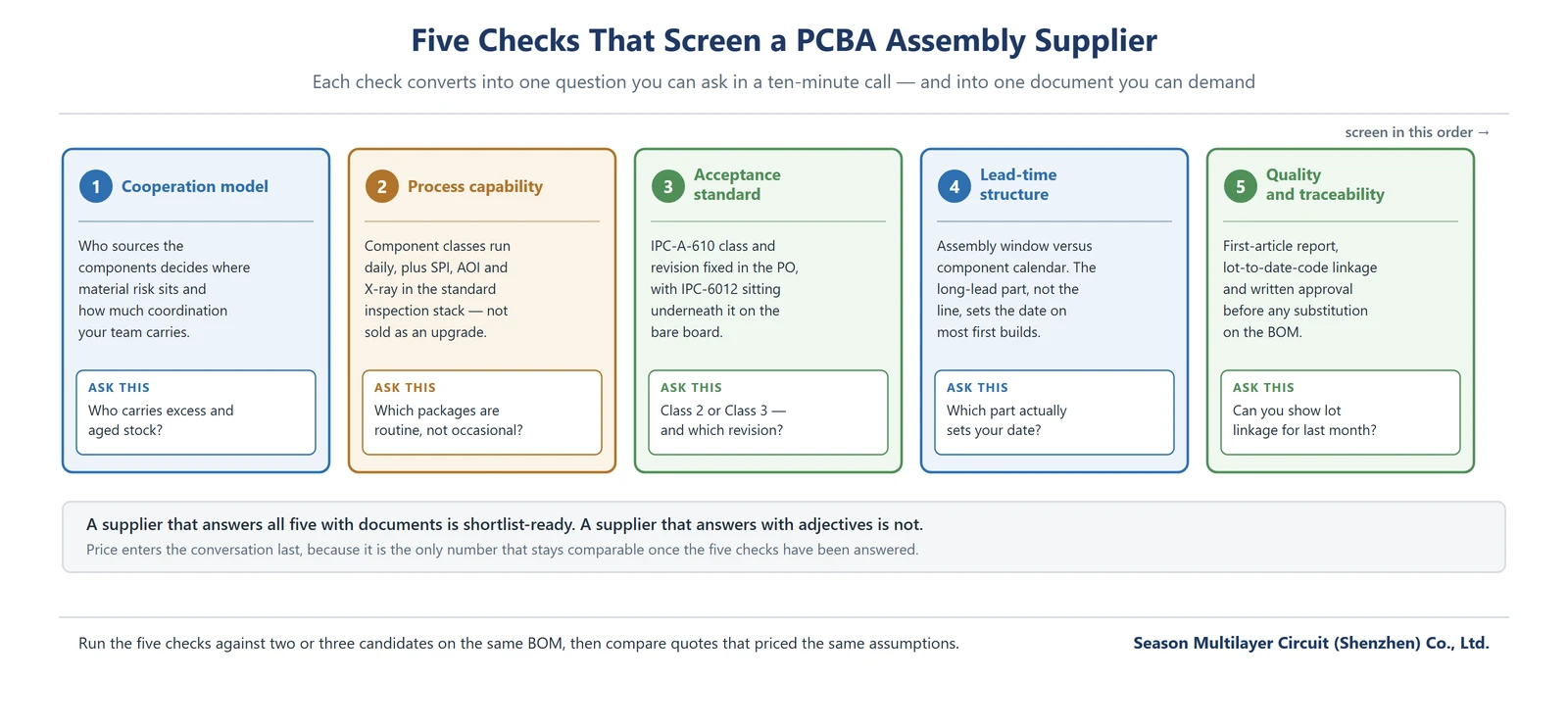
Table of Contents
- Start With the Cooperation Model, Not the Quote
- What a PCBA Assembly Supplier Actually Controls
- Four Process Checks That Separate Real SMT Lines
- Set the IPC-A-610 Acceptance Class in Writing
- The Standards Stack: IPC-6012, J-STD-001 and IPC-A-610
- Prototype-to-Volume Lead Time Is Really a Materials Problem
- Quality System, Inspection Reports and Traceability
- MSL, ESD and Component Handling: The Failures That Surface Later
- Turnkey Component Sourcing: How to Keep BOM Control
- The RFQ Package: Send It Complete, Once
- Red Flags When Screening a PCBA Assembly Supplier
- Frequently Asked Questions
- Get Your PCBA Package Reviewed Before You Commit
Start With the Cooperation Model, Not the Quote
The first decision is not which factory but which commercial model. Who sources the components determines how quotes are structured, where quality responsibility sits, and how much day-to-day coordination your team carries. Most sourcing teams frame the choice as consignment vs turnkey assembly, as if only two arrangements existed — the table below adds the third option and shows what each one makes you responsible for.
| Model | Who sources components | Best fit | Responsibility profile |
|---|---|---|---|
| Consignment (labour-only) | You supply every component; the supplier provides stencil, placement, soldering and test | Frozen BOMs with mature sourcing channels in place | You own component quality and shortages; supplier owns workmanship |
| Turnkey (full-kill) | Supplier procures against your BOM and assembles | Many line items, small batch quantities, thin purchasing resources | Supplier owns sourcing quality and schedule; you approve substitutions |
| One-stop PCB + PCBA | Same company fabricates the bare board and assembles it | Prototype loops where fast iteration matters most | Fabrication and assembly share one engineering file set, so board-level issues are located without leaving the building |
Material risk is where the models differ most and where buyers look least. Under consignment, excess and aged stock are your inventory; under turnkey, the supplier buys but your engineering decisions still drive the spend, which is why substitution approval, date-code limits and price-escalation terms belong in the contract rather than in an email thread. Weighing consignment vs turnkey assembly is therefore a question of who can absorb a wrong reel — not of which line item looks cheaper on the quote.
The one-stop model deserves a closer look during prototyping. When the fabricator and the assembly line share the same stackup, impedance and Gerber data, a yield problem can be traced to its layer of origin in hours instead of a week of cross-supplier emails. If your product is still moving through board revisions, evaluate whether your bare-board vendor can also act as your PCBA assembly supplier — the PCB manufacturing and assembly services page shows how a combined flow is typically structured. For pure board selection criteria, the separate multilayer PCB manufacturer checklist covers fabrication-side qualification in depth.
What a PCBA Assembly Supplier Actually Controls
Before comparing factories, be precise about what you are buying. A PCBA assembly supplier controls stencil cut, solder paste print, placement accuracy, the reflow (and wave or selective-solder) thermal profile, post-process inspection, and any test you contract for. Everything upstream — board design, component availability, your test coverage — only converts reliably into good units if these six steps are measured and documented.
That is why two quotes for the same BOM can deliver very different boards: each PCBA assembly supplier prices the process behind the machine hours differently. The quote buys machine hours; the supplier’s process discipline decides how many of those hours produce sellable boards. The next two sections, the process and acceptance checks on this PCBA supplier checklist, are designed to expose that discipline — or its absence — before you commit a batch.
Four Process Checks That Separate Real SMT Lines
Every PCBA assembly supplier says it runs SMT lines. The differences are in component classes handled routinely and in inspection depth. Ask the four questions below and push for specifics rather than yes/no answers — ten minutes of structured questioning reveals more than a brochure.
| Check | Industry benchmark | What to ask |
|---|---|---|
| Placement accuracy | The finest chip components and the tightest BGA pitches the line runs as routine daily work | Are my smallest packages a daily case or an exception? Which feeder and vision systems run them? |
| Soldering methods | Reflow for SMD; wave or selective soldering for through-hole and mixed technology | How are odd-form and hand-solder operations qualified and recorded? |
| Inspection stack | SPI plus AOI plus X-ray plus 100% electrical test as standard configuration | Which reports ship with the goods — AOI maps, X-ray shots, test logs? |
| Acceptance standard | Workmanship graded to IPC-A-610 Class 2 or Class 3 | Which class is quoted, and is it written into the order? |
Treat missing inspection steps as a finding, not a style difference. A line without solder paste inspection (SPI) discovers printing defects after reflow, when rework is expensive; a line without X-ray cannot see solder voids under a BGA at all. If your board carries fine-pitch or bottom-termination packages, inspection depth should weigh as heavily as placement speed in your decision — a capable PCBA assembly supplier will volunteer its inspection records before you ask.
Set the IPC-A-610 Acceptance Class in Writing
The acceptance class is the single most frequently missed negotiation point. Workmanship criteria — solder fillet sizes, hole wall coverage, marker legibility — are graded under IPC-A-610, and Class 2 (dedicated service electronic products) allows more than Class 3 (high-reliability products). Consumer-grade volume boards are commonly quoted at Class 2; industrial, instrumentation and automotive-adjacent programs typically demand Class 3.
The class you specify changes both the allow/repair criteria inspectors apply and the cost of meeting them, so agree it at quotation stage — not after the first discrepancy report. If your program later migrates from Class 2 to Class 3, expect re-qualification: criteria that passed at Class 2 may sit outside Class 3 limits. Write the class, the revision level, and who arbitrates disputes into the purchase order, and expect a capable PCBA assembly supplier to have quoted it that way from the start.
The Standards Stack: IPC-6012, J-STD-001 and IPC-A-610
Acceptance class is only the top of a three-layer standards stack, and knowing which document governs which stage tells you exactly what to ask a PCBA assembly supplier for. IPC-6012 qualifies the bare board: hole wall plating, copper thickness, annular ring and dielectric spacing. J-STD-001 governs the soldering process itself, from materials and equipment to reflow profiles and operator certification. IPC-A-610 sits on top as the visual acceptance criteria an inspector applies to the finished assembly. If a quote mentions only IPC-A-610, the two layers underneath it are unverified.
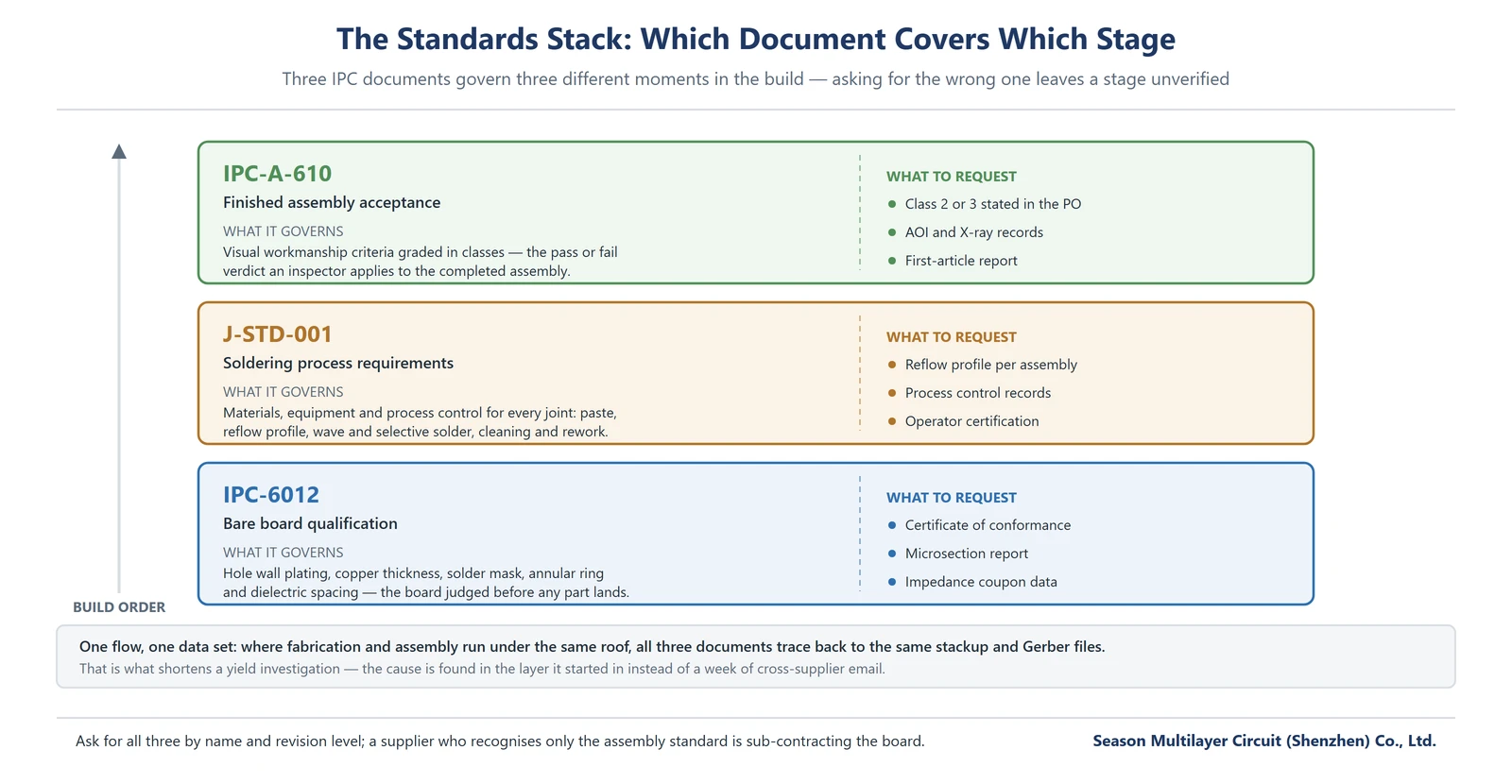
The practical test is what each layer produces in paperwork. A PCBA assembly supplier running all three will hand over a certificate of conformance and microsection data for the board, reflow profiles and process control records for the soldering, and class-stated AOI and first-article reports for the assembly. Where fabrication and assembly run under the same roof, all three trace back to the same stackup and Gerber set, which is why a yield investigation ends in hours instead of a week of cross-supplier email. Our guide to IPC-A-600 Class 3 requirements covers the acceptance side of the bare board in detail.
Ask for all three documents by name and revision level, and note which one each quote is silent about. A supplier who recognises only the assembly standard is usually sub-contracting the board — and the two standards that govern it will then be verified by nobody.
Prototype-to-Volume Lead Time Is Really a Materials Problem
Assembly lead time has two halves. The assembly half — stencil, programming, placement, soldering, test — is comparatively predictable. The materials half fluctuates with component sourcing and dominates real-world schedules, especially on first builds. Plan around the structure below rather than a single headline number, and ask each PCBA assembly supplier to quote the two halves separately.
| Phase | Typical industry range | Handover focus |
|---|---|---|
| Prototype build | Roughly 3–7 days including standard-part sourcing | Stencil, placement program and process dossier created and archived together |
| Small batch | Roughly 7–12 days | Same data set reused to prove first-pass yield and process stability |
| Volume | Reviewed order by order against quantity and component lead times | Long-lead parts locked early so the line never waits on reels |
Boards carrying specified connectors or long-lead integrated circuits move on the component calendar, full stop. This is where turnkey PCBA assembly earns its margin: a supplier buying against your BOM can buffer commonly used reels and sequence purchases across customers. Whatever model you choose, get the schedule promise as a dated commitment confirmed at engineering review — and treat verbal assurances as placeholders until they appear in the order confirmation.
Quality System, Inspection Reports and Traceability
Certification paperwork is easy to claim and easy to verify. At minimum a qualified supplier should hold ISO 9001:2015; programs feeding automotive customers add IATF 16949 registration, verified on the certificate scope rather than taken from a badge; export products touching safety regimes should be assembled with UL-recognized components and RoHS/REACH-compliant materials. Ask for certificate scans with scope and validity dates — a marketing badge without a scope statement is not evidence.
Outgoing quality from a PCBA assembly supplier rests on the inspection stack from the previous section plus two documents you should require by default: a first-article inspection report on every new revision, and batch traceability linking each finished board to component date codes, process parameters and operators. For higher-reliability orders, add functional test and burn-in to the quote explicitly — these are priced services, not free extras, and leaving them implicit is how they silently disappear.
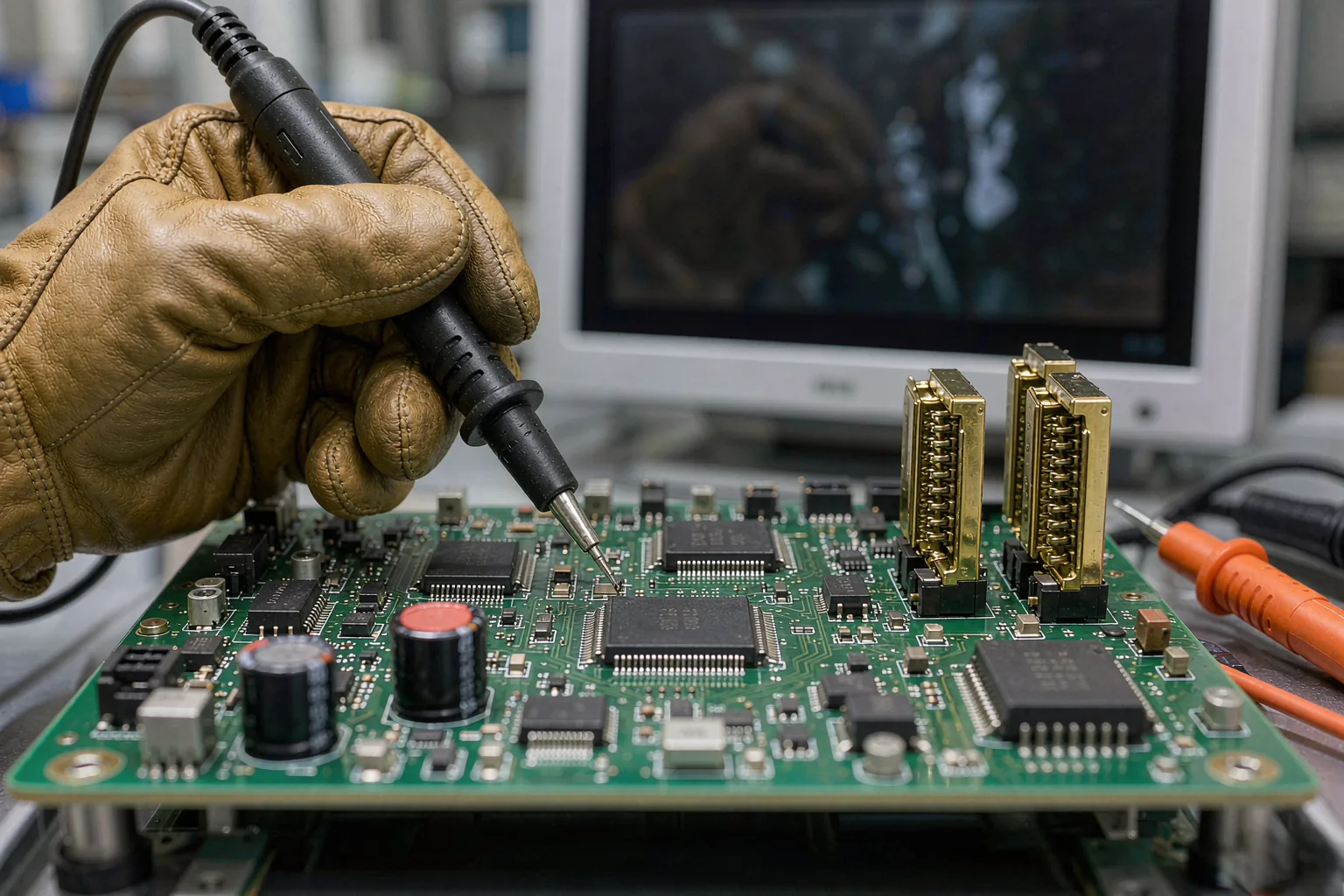
A low-cost audit technique works better than most questionnaires: place a small trial order with two or three candidate factories using the identical BOM and Gerber set, then compare first-pass yield, AOI escape reports and cosmetic consistency side by side. Real process discipline shows up in the paperwork that accompanies the boards, not in the sales deck that preceded them.
MSL, ESD and Component Handling: The Failures That Surface Later
Moisture sensitivity is where turnkey PCBA assembly fails months after delivery, not at delivery. Every moulded component — BGAs, QFPs, connectors — absorbs humidity while it waits, and each carries an MSL rating that defines how long it may sit outside dry pack before it must be baked or scrapped. A PCBA assembly supplier should store components in dry cabinets with humidity logging, track floor-life from the moment a bag is opened, and bake parts whose clock has run out before they reach the reflow oven. None of this is visible on the finished board, which is exactly why it is worth asking about directly.
ESD control is the same story one level down. Static damage rarely kills a part outright; it weakens it, and the failure surfaces as an early-life field return that no outgoing test catches. Ask what the floor looks like: grounded wrist straps and work surfaces, shielding bags or conductive bins for every move between storage and the line, and ionised air where operators handle bare boards. Batch traceability should close the loop — when a field failure does occur, the supplier should be able to name the component lots and the operators on that shift from records, not from memory.
Turnkey Component Sourcing: How to Keep BOM Control
In consignment vs turnkey assembly the boundary is rarely all-or-nothing: turnkey sourcing transfers purchasing work, not ownership of component quality. Keep control with four contract-level rules. First, require sourcing from original manufacturers or authorized distributors, with certificates of conformance available on request. Second, flag critical line items — power parts, connectors, anything safety-related — for named-supplier or original-channel-only treatment. Third, require written approval before any substitution, including “equivalent” parts, because a pin-compatible foot print is not always an electrical equivalent. Fourth, define acceptable date codes so you never receive aged stock on a moisture-sensitive package.
On receipt, reconcile quantity, manufacturer part number and reference designator against the BOM before the line starts. Reputable suppliers support this with incoming inspection records and per-batch traceability. These rules cost nothing to write down and remove most of the classic turnkey PCBA assembly disputes before they can start.
The RFQ Package: Send It Complete, Once
The RFQ data set is the last item on a PCBA supplier checklist, and the one that prices everything before it. A complete RFQ shortens engineering review dramatically, because the reviewer answers questions instead of chasing files. Send the following as one package:
- BOM with brand, manufacturer part number and reference designators, ideally as a controlled export from your CAD tool
- Gerber data for the bare board (RS-274X; if you are unsure about your export settings, the Gerber format specification maintained by Ucamco explains the extensions)
- Centroid (pick-and-place) file with component X/Y coordinates and rotation
- Assembly drawing plus special process requirements — conformal coating, potting, odd-form hand work
- Test requirements: electrical test only, or functional test and burn-in additions
- Build quantity per release and the delivery schedule you need
With the data set complete, many suppliers return a formal quote within one working day of engineering review, and the quote itself becomes comparable across factories because every bidder priced the same assumptions — including the sourcing scope, since turnkey PCBA assembly prices component risk while consignment prices labour only. For combined board fabrication and assembly, the instant PCB quote page shows which files the review team needs and in what formats.
Red Flags When Screening a PCBA Assembly Supplier
Some findings should end the conversation with a PCBA assembly supplier regardless of price. Treat the following as screening failures rather than negotiation points:
- No written acceptance class in the quote — you cannot inspect to an undefined standard
- Reluctance to share certificate scans or report samples from comparable builds
- No SPI or X-ray on a BGA-heavy BOM, justified as “not needed for this quantity”
- Quoted lead times that never mention component sourcing at all
- Substitution-friendly sourcing with no written approval step
Conversely, a PCBA assembly supplier that walks you through its yield data, explains where its process limits are, and tells you which of your packages it would rather not place is demonstrating exactly the engineering honesty you are buying. Boards that pair dense fine-pitch assembly with demanding stackups — for example the builds described on the 10-layer HDI industrial control PCB page or the 8-layer intelligent terminal PCB page — benefit most from a fabrication partner that also understands assembly constraints, because DFM feedback arrives while the design can still change cheaply.
Frequently Asked Questions
What are the three cooperation models with a PCBA assembly supplier?
Consignment: you supply all components and the supplier places and solders them. Turnkey: the supplier procures against your BOM and assembles. One-stop: the same company fabricates the bare board and assembles it, sharing one engineering data set. Many line items with small batch quantities usually favour turnkey; frozen BOMs with mature sourcing favour consignment. Weighing consignment vs turnkey assembly is a materials-risk question before it is a price question.
What should a PCBA RFQ package contain?
BOM with brands, manufacturer part numbers and reference designators; Gerber data; a centroid pick-and-place file; the assembly drawing with any special process requirements; test requirements; and build quantities with the required schedule. A complete package lets engineering review answer real questions instead of chasing files, and keeps quotes comparable across suppliers.
How long does PCBA prototyping take?
Industry practice for a routine prototype build is roughly 3–7 days including standard component sourcing; small batches typically run 7–12 days. Boards with specified connectors or long-lead integrated circuits move on the component calendar, so confirm sourcing time at quotation rather than assuming the assembly window alone.
Which IPC-A-610 acceptance class should I specify?
Class 2 suits most dedicated-service and consumer products and is the common default quote. Class 3 applies where high reliability matters — industrial instrumentation, infrastructure, and programs feeding automotive customers. Decide by end-use environment and consequence of failure, and fix the class and its revision level in the purchase order at quotation stage.
How do I verify a supplier’s placement capability?
Ask which component classes the line runs daily — the finest chip components and the tightest BGA pitches are the usual high-precision benchmarks — and request sample AOI and X-ray reports from comparable builds. Check that solder paste inspection precedes reflow. For automotive-adjacent programs, ask for the IATF 16949 certificate and check its scope.
How is component quality controlled in turnkey PCBA assembly?
Through contract rules, not trust: sourcing from original manufacturers or authorized channels, certificates of conformance on request, named suppliers for critical line items, written approval before any substitution, defined date-code limits, and incoming reconciliation of part numbers and reference designators against the BOM. Batch traceability should link every finished board back to component lots.
How can I evaluate a PCBA supplier without an on-site audit?
Place a small trial order with two or three candidates using the identical BOM and Gerber set, then compare first-pass yield, AOI escape reports, cosmetic consistency and the paperwork that shipped with each batch. The comparison reveals process discipline more reliably than questionnaires, and the trial data carries directly into your production sourcing decision.
Get Your PCBA Package Reviewed Before You Commit
This is how to choose a PCBA assembly supplier with evidence instead of adjectives: send your BOM and Gerber set for engineering review before you shortlist, and the review covers fabrication and assembly as one flow — placement classes, inspection stack, acceptance grade and a dated schedule confirmed at engineering review. Bare-board fabrication supports 2–30 layer mass production as part of the 998 PCB Group‘s 3,000,000 m² annual capacity across three plants, and assembly runs SMT, through-hole and turnkey sourcing against the same data set. A complete RFQ package gets a structured review response the same working day.