Book Appointment Now

TU-883 laminate (ThunderClad 2) is TUC's very-low-loss, halogen-free FR-4-process-compatible material. Specs, applications and RFQ callouts, per the datasheet.
TU-883 Laminate (ThunderClad 2): 7 Proven Dk and Df Selection Rules
Quotes for high-speed boards increasingly arrive with unfamiliar grade names in the stackup line, and TU-883 laminate — sold by Taiwan Union Technology Corporation (TUC) under the ThunderClad 2 family — is one of the grades buyers meet most often on accelerator, switch and radio-frequency backplane builds. Sourcing teams usually know the brand; far fewer know what the datasheet actually guarantees or how it behaves on a production floor.
This guide summarizes the published TU-883 datasheet specifications — Dk 3.39 and Df 0.0045 at 10 GHz, IPC-4101/134 listing, halogen-free chemistry — and translates them into selection decisions: where the material fits on the loss ladder, how it processes on standard FR-4 equipment, and what to write in the RFQ so the stackup survives engineering review. All figures below are taken from the manufacturer’s datasheet rather than secondary sources.
Table of Contents
- What Is TU-883 Laminate?
- TU-883 Laminate Key Specifications
- How TU-883 Compares Across Loss Classes
- Where ThunderClad 2 Is Used
- Processing TU-883 on Standard FR-4 Lines
- Design Considerations: Impedance, Stackup and Reliability
- When to Step Beyond TU-883
- Specifying TU-883 in an RFQ
- Sourcing TU-883 for Prototypes and Production
- FAQ
- Get Your TU-883 Laminate Stackup Reviewed
What Is TU-883 Laminate?
TU-883 is TUC’s very-low-loss core laminate, reinforced with woven E-glass and built on a high-performance resin system engineered for low dielectric constant and dissipation factor. The datasheet revision covering current production pairs the TU-883 core with TU-883P prepreg under the ThunderClad 2 Sp designation. It is certified against IPC-4101/134, holds UL recognition under file E189572 with a 94 V-0 flammability rating, and is formulated halogen-free.
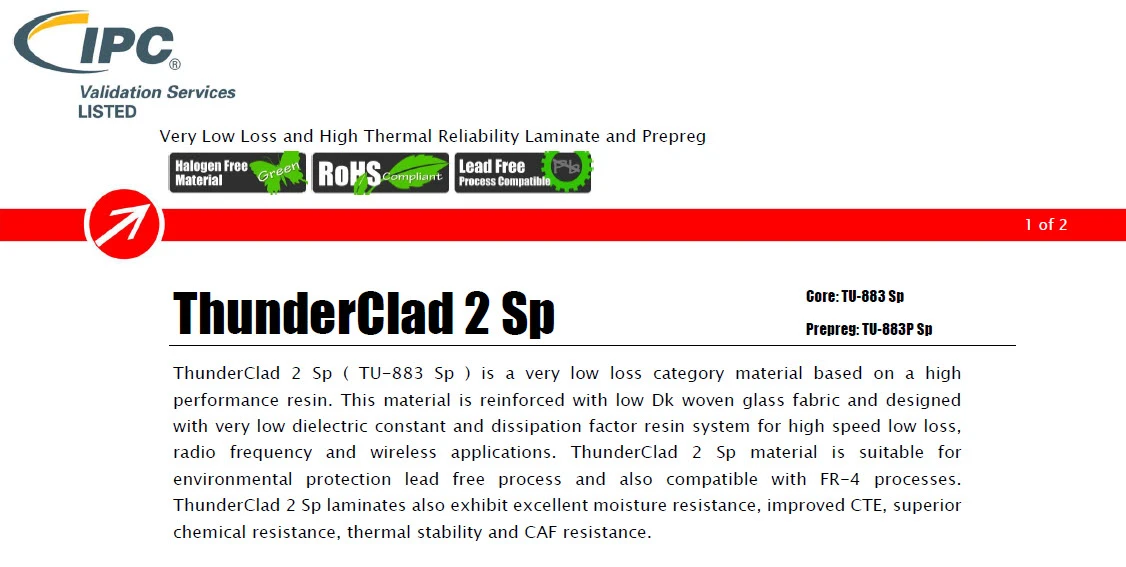
Two points in that opening datasheet paragraph deserve attention. First, the material is explicitly compatible with FR-4 processes, which keeps it manufacturable on conventional multilayer lines — a point that decides supplier eligibility more than the loss numbers do. Second, the halogen-free formulation satisfies the environmental requirements that data-center and telecom customers increasingly write into specifications, without a separate material substitution.
TU-883 Laminate Key Specifications
The electrical headline numbers are a dielectric constant of 3.39 and a dissipation factor of 0.0045, both at 10 GHz. For impedance modelling the TU-883 datasheet also publishes a lower effective value — 2.83 — used for simulation, which is the number your fabricator will model against. Thermal and reliability properties are equally part of the selection case: a glass transition temperature of 220 °C by DMA (170 °C by TMA) and a decomposition temperature of 420 °C give the material generous headroom through lead-free reflow cycles.
| Property | Typical value | Test condition / note |
|---|---|---|
| Dielectric constant (Dk) | 3.39 | 10 GHz, conditioned lot; 2.83 for impedance simulation |
| Dissipation factor (Df) | 0.0045 | 10 GHz, conditioned lot |
| Tg (DMA / TMA) | 220 °C / 170 °C | Glass transition by two methods |
| Decomposition temperature (Td) | 420 °C | TGA |
| Z-axis CTE | 2.5% | 50–260 °C |
| T-260 / T-288 / T-300 | > 60 min each | Time to delamination |
| Water absorption | 0.08% | E-1/105 conditioning |
| Flammability | 94 V-0 | UL E189572 |
| Maximum operating temperature | 160 °C | UL-recognized MOT |
| Copper cladding | 1/3 to 5 oz | Laminate thickness 0.05–1.58 mm |
The moisture number is quietly important. At 0.08% water absorption, the electrical properties barely drift in humid environments, which is why the material holds its loss performance in outdoor radio units as well as in climate-controlled server rooms.
How TU-883 Compares Across Loss Classes
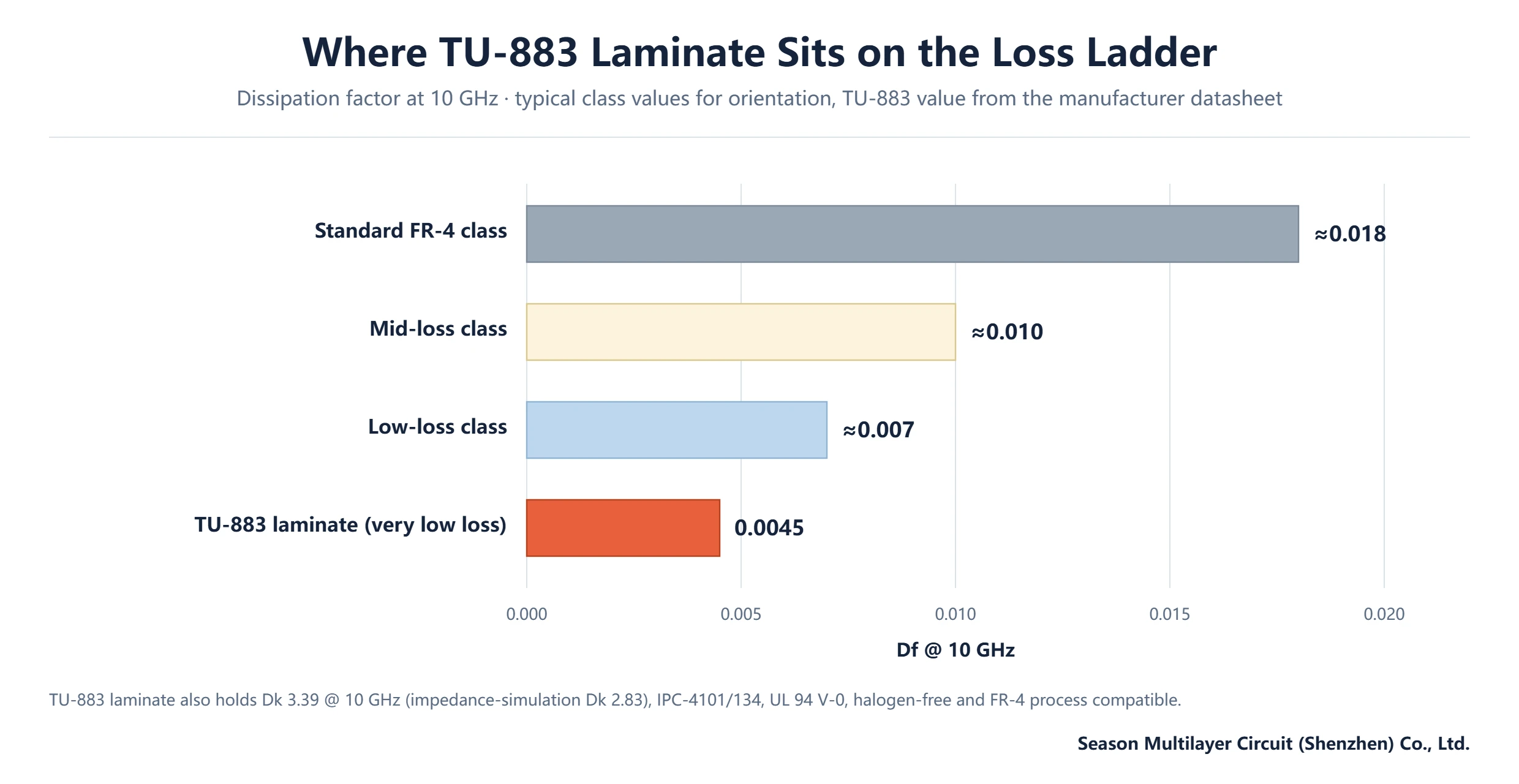
Laminates are usually bought by class band rather than by brand, so the practical question is where the 0.0045 Df figure lands. The chart below places the datasheet value against the common class bands; the class values are typical industry orientations rather than any single product’s spec.
| Class band | Typical Df @ 10 GHz | Typical application |
|---|---|---|
| Standard-loss FR-4 grade | ≈0.018 | Management, storage and power boards |
| Mid-loss grade | ≈0.010 | 25G-class lanes, slower fabric legs |
| Low-loss grade | ≈0.007 | PCIe Gen4-class interconnect |
| Very-low-loss grade (TU-883) | 0.0045 | PCIe Gen5-class and 56G PAM4 lanes |
Reading the ladder from the buyer’s side: stepping down from standard FR-4 to a very low loss laminate class is what unlocks the tightest loss budgets, but it also multiplies the raw laminate cost. The step from low-loss to very-low-loss is smaller in absolute Df yet decisive for channels running PAM4 signalling, where the error-correction budget cannot absorb marginal attenuation. Our laminate selection guide shows how to phrase the class requirement with brand alternates in an RFQ, and the materials and laminates overview maps the full grade family.
Where ThunderClad 2 Is Used
The datasheet names the intended deployment set directly: radio-frequency backplanes, high-performance-computing line cards, storage servers, telecom equipment, base stations and office routers. The common thread is long, loss-budgeted channels — exactly the geometry where a 0.0045 Df pays for itself.
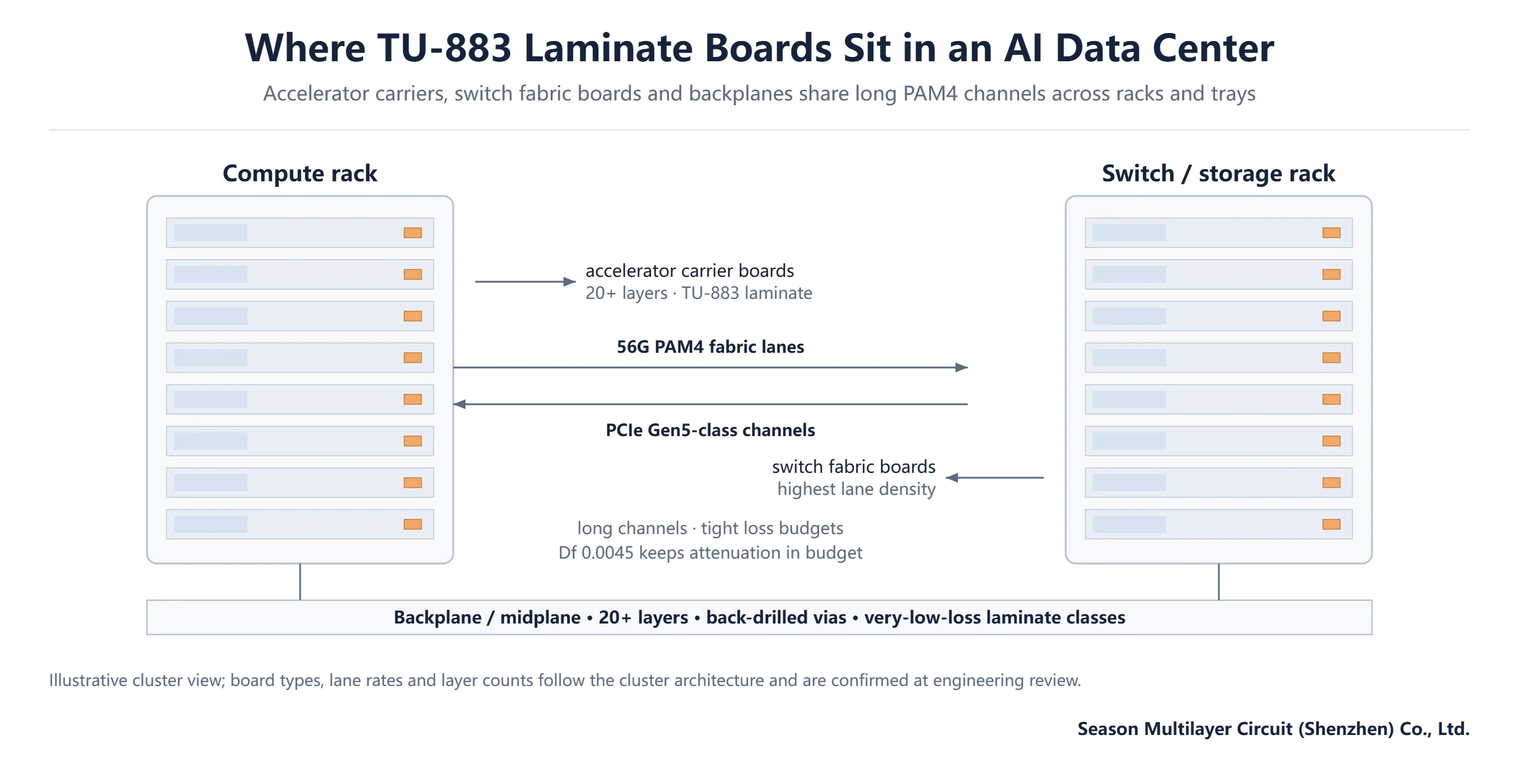
In practice the material shows up most in accelerator carrier boards, switch fabric boards and backplanes inside AI clusters, where many PAM4 lanes cross long distances between trays. For a worked example of how these interconnect requirements translate into a finished stackup, our AI server PCB guide walks through layer counts, via structures and cost drivers end to end.
Processing TU-883 on Standard FR-4 Lines
The datasheet’s process claim — compatible with modified FR-4 processes and with lead-free reflow — is the material’s quiet advantage. Drilling, desmear, plating and lamination run inside the windows a conventional multilayer line already uses, so a fabricator does not need a dedicated low-loss process cell to accept the job. For buyers, that means more eligible suppliers and shorter qualification paths than for materials that demand specialized presses or plasma desmear.
Drill behaviour and chemical resistance are worth verifying on a first article, as with any resin system, but the published thermal margins — Td at 420 °C and delamination times above 60 minutes at 260, 288 and 300 °C — leave ample room for the repeated thermal excursions of assembly and rework. The material also tolerates the standard surface-finish portfolio, so ENIG, OSP and immersion tin selections do not force a stackup change. The same compatibility shows up in quoting: fabricators that already run mid-loss grades such as TU-872 SLK can quote the build without a new qualification cycle, because lamination pressure, drill stacks and desmear chemistry stay inside windows they already run — only etch compensation shifts, driven by the lower Dk rather than by the resin system.
Design Considerations: Impedance, Stackup and Reliability
Three design details decide whether a ThunderClad 2 build meets its loss and impedance targets in production. First, impedance modelling: use the simulation Dk of 2.83, not the 3.39 conditioned-lot measurement, or the controlled-impedance coupon will disagree with your field solver — our impedance measurement guide explains how coupon readings are reconciled with model values.
Second, prepreg selection: the datasheet offers glass styles 106, 1080, 3313 and 2116, and the choice between thin, resin-rich glasses and thicker structural ones trades impedance control against layer registration. Third, reliability mechanics: the optimized z-axis CTE of 2.5% across 50–260 °C reduces strain on plated through-holes during thermal cycling, and the resin-to-glass interface engineering suppresses conductive anodic filament growth, the insulation failure mode that dense high-voltage boards fear most. Conventional via treatments stay available as well: back-drilling on the long stubs that PAM4 channels cannot tolerate, and resin plugging where high-aspect-ratio holes need a flat cap. These are process decisions rather than material decisions, and the engineering review confirms which of them the channel budget actually needs.
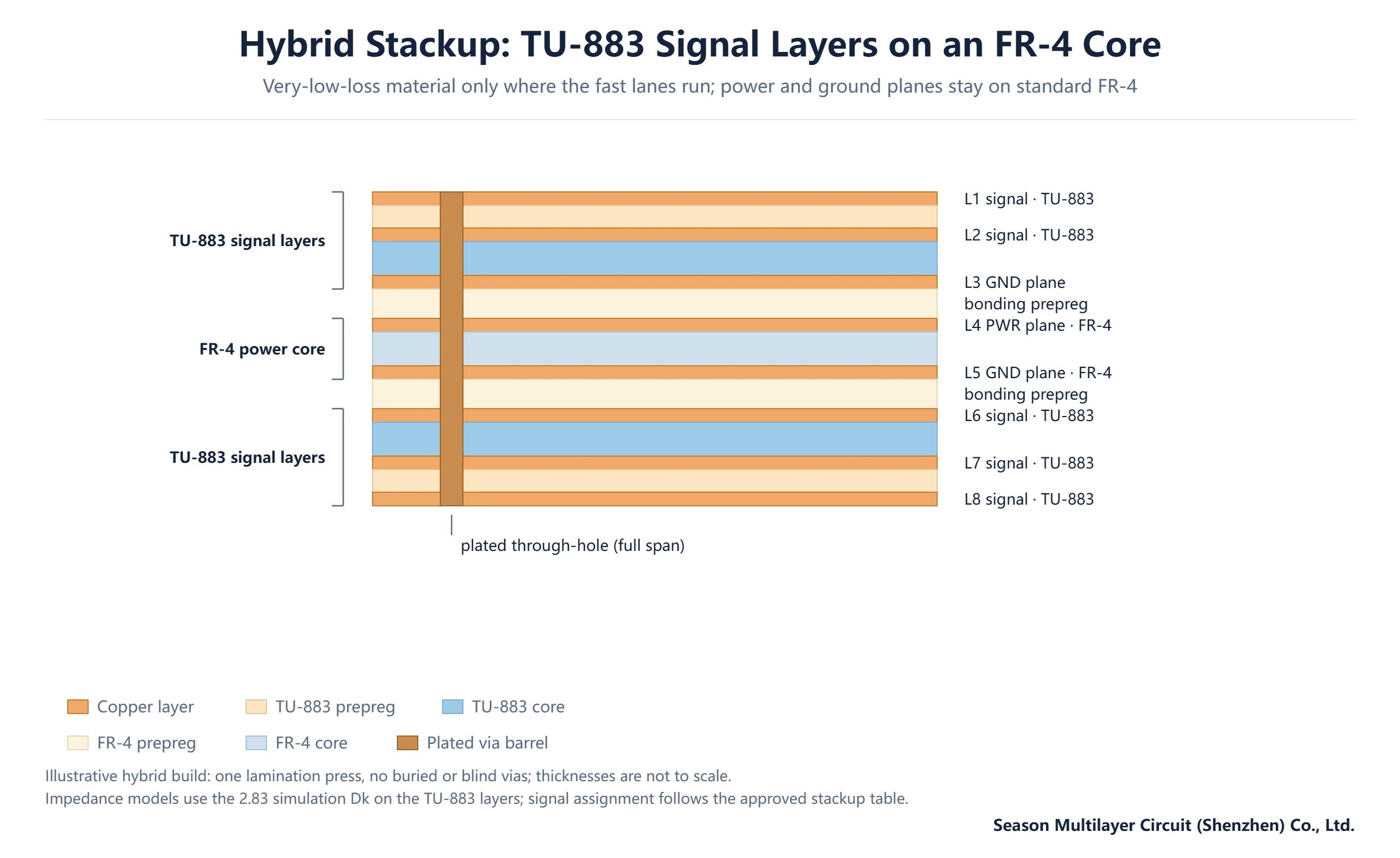
Many production stackups do not use the material everywhere. A common hybrid places very-low-loss outer regions on standard FR-4 cores where lanes are slow, which recovers cost without touching the critical channels — our hybrid stackup guide covers the registration and lamination considerations of mixed-dielectric builds.
When to Step Beyond TU-883
A 0.0045 Df comfortably covers PCIe Gen5-class lanes and 56G PAM4 channels with sensible geometry. It does not automatically cover the next tier: 112G and 224G PAM4 signalling compresses the channel loss budget to the point where materials in the ultra-low-loss class, with Df below roughly 0.003, become the working specification. Stepping up that class raises the laminate premium again, so the decision should follow the channel budget rather than habit.
The practical method is arithmetic, not instinct: total insertion loss is the trace length times the per-unit-loss of the dielectric plus conductor effects. If your longest lane closes its eye diagram with margin on a very low loss laminate such as TU-883, there is no engineering reason to pay for the class above it; if the budget is already negative, stepping up the material is usually cheaper than shortening every lane. For the board-level context, see the loss-class table in our AI server PCB guide.
Specifying TU-883 in an RFQ
A material callout that survives engineering review states the intent and leaves alternates open. The following items close the usual back-and-forth:
- Name the target as “very-low-loss class, Df ≤ 0.005 at 10 GHz, IPC-4101/134” and list TU-883 laminate as the preferred brand with alternates welcome — this keeps quoting competitive when stock is tight.
- State the copper weight per layer and the target finished thickness; the datasheet supports 1/3 to 5 oz cladding and laminate thickness from 0.05 to 1.58 mm.
- Call out the prepreg glass styles you assumed (106, 1080, 3313 or 2116) so the fabricator can confirm availability before the impedance model is run.
- Attach the impedance table with the per-lane tolerance band, and confirm that impedance modelling uses the 2.83 simulation Dk.
- For hybrid builds, mark which layers carry the low-loss material and which run on standard FR-4, so lamination and registration are planned correctly.
Packages written this way move from quote request to engineering response in one pass, because every number the fabricator needs is either stated or referenced. The high-frequency material selection guide adds the Dk and Df trade-off detail if your design sits between classes. When you pick the glass styles, match them to the layer spacing the impedance table assumes: 106 and 1080 cloths fill the thin signal-to-plane gaps that tight differential targets need, while 3313 and 2116 build the thicker dielectric sections with fewer plies. State the copper weight per layer in the same pass — the datasheet covers 1/3 to 5 oz cladding and laminate thickness from 0.05 to 1.58 mm in sheet or panel form, with prepreg available in roll or panel — so availability is confirmed once, before the impedance model is run, instead of mid-way through quoting.
Sourcing TU-883 for Prototypes and Production
Because the material processes like FR-4, the practical sourcing question is procurement and stock rather than process capability. Season Multilayer Circuit sources major very-low-loss grades including TU-883 for both prototype and volume builds; availability of a specific grade and thickness is confirmed at engineering review before the stackup is frozen, which protects the schedule from mid-project material substitutions.
Small prototype quantities are routinely accommodated alongside volume runs, so the stackup validated on the first article carries through to mass production unchanged. For the capability envelope — layer counts, line and space, laser microvias and back-drilling that pair naturally with this material class — see the manufacturing services page or send the stackup intent directly for review.
Frequently Asked Questions
What is TU-883 laminate?
TU-883 is Taiwan Union Technology Corporation’s very-low-loss core laminate, marketed in the ThunderClad 2 family and paired in current datasheet revisions with TU-883P prepreg under the ThunderClad 2 Sp designation. It is certified to IPC-4101/134, UL-recognized under file E189572 with a 94 V-0 rating, and formulated halogen-free.
What are the key specifications of TU-883 laminate?
Per the manufacturer datasheet: dielectric constant 3.39 and dissipation factor 0.0045 at 10 GHz (2.83 simulation Dk for impedance modelling), Tg of 220 °C by DMA and 170 °C by TMA, decomposition temperature 420 °C, z-axis CTE 2.5%, water absorption 0.08%, and copper cladding from 1/3 to 5 oz.
Is TU-883 compatible with standard FR-4 processing?
Yes. The datasheet states compatibility with modified FR-4 processes and lead-free reflow, so drilling, desmear, plating and lamination run within conventional multilayer line windows. This is a practical advantage over low-loss materials that require dedicated process cells, because it widens the pool of fabricators able to quote and build the job.
Is TU-883 laminate halogen-free?
Yes, the formulation is halogen-free alongside its 94 V-0 flammability rating, and the datasheet carries the corresponding environmental badges with RoHS and lead-free process compatibility. That combination lets one material satisfy both the electrical specification and the environmental requirements many telecom and data-center customers write into their standards.
What applications is TU-883 laminate designed for?
The datasheet names radio-frequency backplanes, high-performance-computing line cards, storage servers, telecom equipment, base stations and office routers. In production it appears most in accelerator carrier boards, switch fabric boards and backplanes inside AI clusters, where long PAM4 lanes need the 0.0045 dissipation factor to close the channel budget.
How does TU-883 compare with ultra-low-loss materials?
TU-883 sits in the very-low-loss class and covers PCIe Gen5-class and 56G PAM4 lanes comfortably. Ultra-low-loss grades, with Df below roughly 0.003, are the working specification for 112G and 224G PAM4 signalling where the loss budget becomes the binding constraint. The decision should follow a per-lane insertion-loss calculation, since stepping up the class raises laminate cost again.
Can prototypes be built on TU-883 laminate?
Yes. Small prototype quantities are routinely built alongside volume runs, with grade and thickness availability confirmed at engineering review before the stackup is frozen. Because the material processes like FR-4, the prototype stackup validates on conventional equipment and carries into mass production without a process change.
What is the difference between TU-883 and TU-883P?
TU-883 is the core laminate and TU-883P is the matching prepreg; the current datasheet revision pairs the two under the ThunderClad 2 Sp designation. Both halves of the system share the same very-low-loss resin class and halogen-free chemistry, so a full stackup is normally specified with core and prepreg together rather than mixing the system with a generic FR-4 prepreg on the signal layers. Specifying both halves from the same datasheet revision also keeps the material callout unambiguous at the fabricator, which matters when stock rotates between revisions.
Which glass styles and copper weights are available?
The datasheet lists 106, 1080, 3313 and 2116 glass styles, with other prepreg grades available on request. Copper cladding runs from 1/3 to 5 oz for double-sided and built-up laminates, and laminate thickness spans 0.05 to 1.58 mm in sheet or panel form. Prepreg ships in roll or panel form, so both prototype panels and volume production layouts can be planned around the same material callout. If your impedance table assumes an unusual style, mark it as an alternate in the RFQ so the fabricator can quote the closest available option without a new round of questions.
Get Your TU-883 Laminate Stackup Reviewed
Submit your stackup intent and impedance table for an engineering review: the review confirms the glass-style selection, the simulation Dk used for modelling, and whether the channel budget actually needs the very-low-loss class — or a hybrid with standard FR-4 cores — before any material is ordered. Grade availability for your target thickness is confirmed in the same pass.
Tel: (+86) 18681528532 (WhatsApp)
E-mail: roc@season-pcb.com