Book Appointment Now

A buyer's guide to the halogen-free PCB laminate decision: what the claim actually measures, the S1150G values to check, and when standard FR-4 is the better call.
Halogen-Free PCB Laminate: S1150G Specs and When to Specify It
Most requests for a halogen-free PCB laminate arrive as a one-line note on the drawing – “halogen-free” – with no indication of what the fabricator is supposed to verify or why the requirement appeared. That gap causes real friction in quoting: a shop either prices a grade it cannot source in the requested thickness, or the program discovers during qualification that the laminate and the prepreg come from different systems and will not press together reliably. This guide uses S1150G, the halogen-free mid-Tg FR-4 grade we run most often, as the working example. It covers what the claim actually measures, the datasheet numbers worth checking before you commit, how the material changes the build, and three gates that decide whether a halogen-free PCB laminate belongs on your drawing at all. Every value quoted here follows the grade datasheet, and the final material call is confirmed at engineering review.
Table of Contents
- What a Halogen-Free PCB Laminate Claim Actually Measures
- S1150G at a Glance: The Numbers to Verify
- How a Halogen-Free PCB Laminate Changes the Build
- Halogen-Free vs Brominated FR-4: What Really Differs
- Thermal Envelope: Tg 155, Td 355 and the Delamination Clocks
- Electrical Insulation and CAF Behaviour in Humid Service
- When to Specify It: Three Gates and the Evidence
- Slash Sheets, Yellow Cards and Prepreg Pairing
- Cost Logic Without a Price List
- Where the Grade Fits: Applications and Product Matches
- FAQ
- Get Your Halogen-Free Stackup Reviewed Before It Is Quoted
What a Halogen-Free PCB Laminate Claim Actually Measures
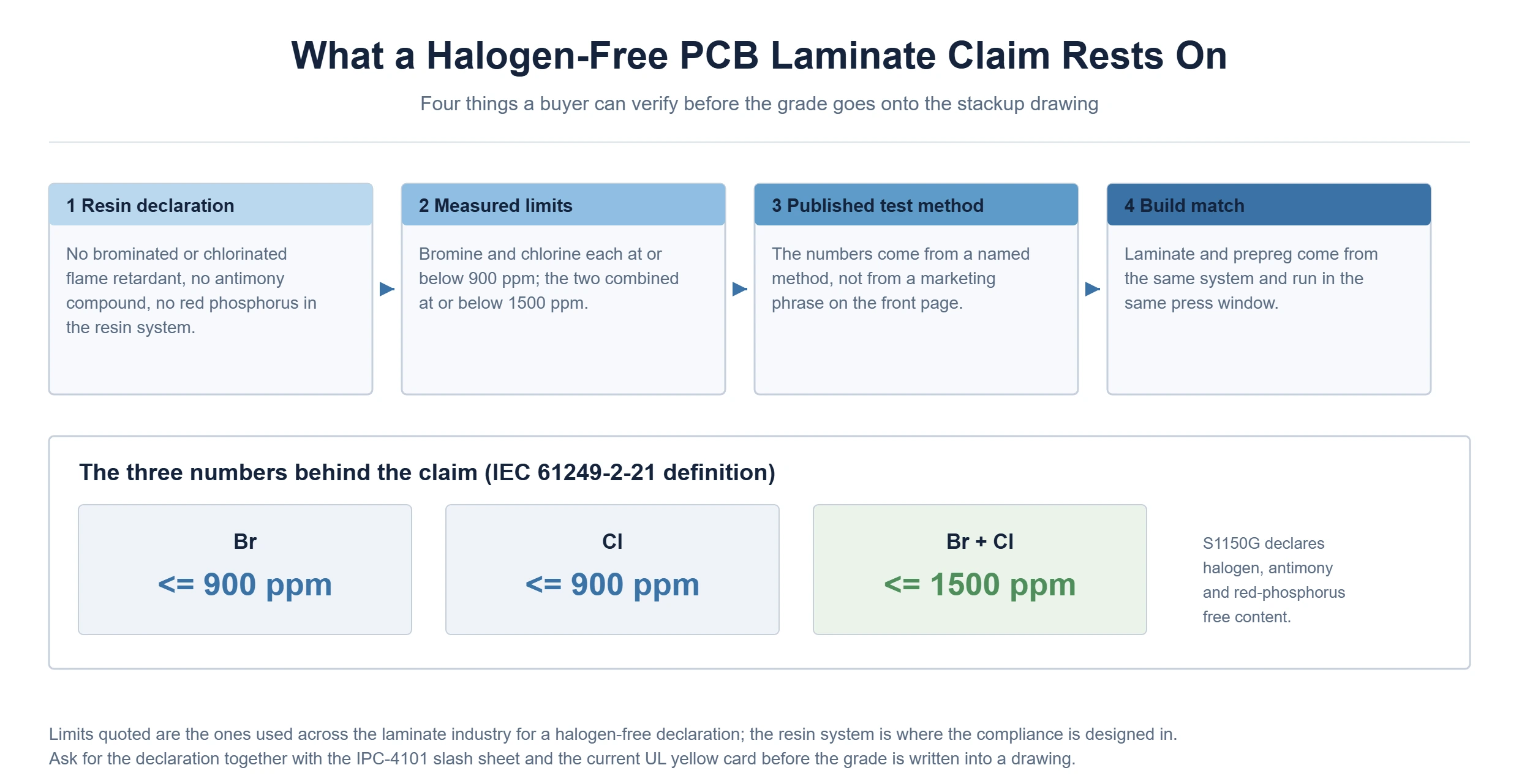
A halogen-free PCB laminate is defined by measured residue, not by marketing language. The industry definition, written down in IEC 61249-2-21, sets limits on bromine and chlorine content: no more than 900 ppm of each, and no more than 1500 ppm combined. Behind those numbers sits a formulation choice – the resin system is built without brominated or chlorinated flame retardants, without antimony trioxide and without red phosphorus, the three ingredients that conventional FR-4 chemistry uses to reach a V-0 flammability rating.
The reason buyers care sits at the end of the product’s life. In uncontrolled incineration, halogenated flame retardants can produce corrosive and dioxin-class by-products, which is why waste regulations and several customer specifications increasingly name halogen limits for the substrate. A halogen-free declaration is therefore an environmental document, not a performance upgrade: nothing about the 900 ppm figure tells you how the board survives reflow, and treating it as a quality badge is the most common specification mistake we see.
S1150G at a Glance: The Numbers to Verify
S1150G is a halogen-free mid-Tg FR-4 grade, typically supplied with copper foil from 12 µm to 105 µm and laminate thickness from 0.05 mm to 3.5 mm. The table below collects the values a buyer should be able to confirm from the current datasheet, quoted with the test method attached, because the method choice moves some figures by a few percent.
| Property | Typical value | Test basis | What it tells you |
|---|---|---|---|
| Tg, glass transition | 155 °C (DSC) | IPC-TM-650 2.4.25 | Mid-Tg positioning, roughly 15–25 °C above the standard tier |
| Td, 5% mass loss | 355 °C | IPC-TM-650 2.4.24.6 | Headroom above lead-free reflow peaks |
| T260 / T288 | 60 / 45 min | IPC-TM-650 2.4.24.1 | Delamination time while held at 260 °C and 288 °C |
| Z-axis CTE | 40 / 230 ppm/°C | IPC-TM-650 2.4.24 | Below and above Tg; 2.8% total from 50 °C to 260 °C |
| Dk / Df at 1 GHz | 4.5 / 0.011 | IPC-TM-650 2.5.5.9 | Digital and industrial signal rates, not a low-loss grade |
| Flexural strength | 630 / 480 MPa (LW/CW) | IPC-TM-650 2.4.4 | Handling and machining robustness |
| Water absorption | 0.10% | IPC-TM-650 2.6.2.1 | Stable dielectrics in humid service after a proper bake |
| Flammability | UL 94 V-0 | UL 94 | Halogen-free system behind the rating |
| Slash sheet | IPC-4101/128 | IPC-4101 | Basis for sourcing and incoming inspection |
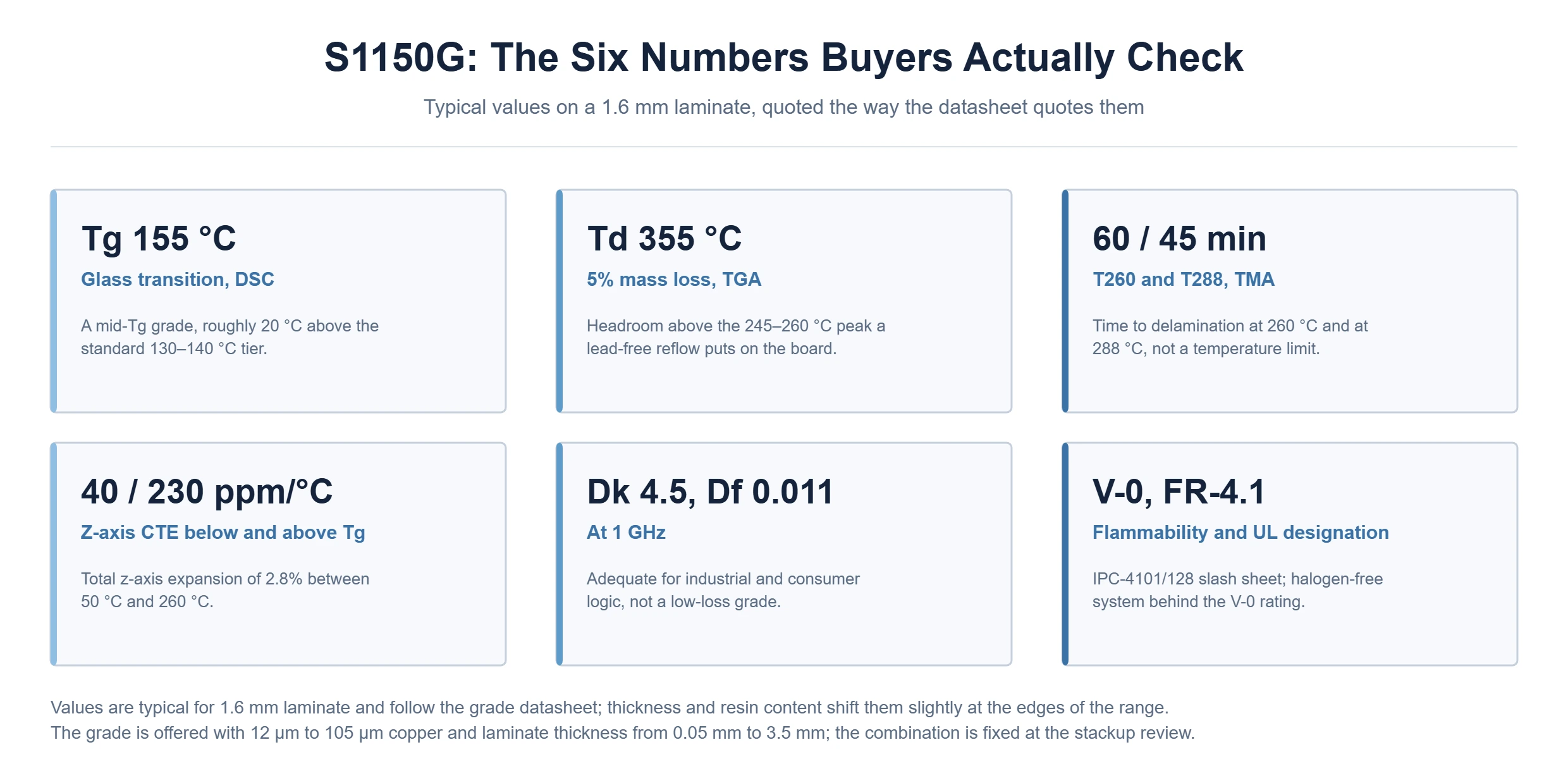
Two of these numbers get checked less often than they should. The first is T288: at 45 minutes it is respectable for a mid-Tg grade, but a thick board with a high layer count spends longer at reflow temperature in the barrel, so the time limit matters more than the Tg figure. The second is the pairing of Dk and Df at 1 GHz – adequate for logic and industrial interfaces, but a design that needs controlled impedance below a few ohms of loss per inch should be looking at dedicated low-loss materials instead.
How a Halogen-Free PCB Laminate Changes the Build
On the production floor, a qualified halogen-free system behaves much like the FR-4 it replaces: same mechanical drilling, same imaging, same plating chemistry. The differences concentrate in two places. First, the resin chemistry is different, so the press window and the desmear parameters are set for that system rather than copied from a brominated grade. Second, moisture behaviour needs respect: the bake before assembly is a documented step, because a halogen-free resin that goes into reflow with absorbed water is the classic recipe for delamination complaints that get blamed on the material.
The single most important build rule is pairing. The laminate and the prepreg must come from the same system and run in the same press window – mixing a halogen-free core with a conventional prepreg defeats the environmental purpose, because the halogen content of the finished board is the sum of all its layers, and it also creates a bonding risk between chemistries. Our guide to prepreg glass styles and selection covers how that pairing is chosen in practice.
Halogen-Free vs Brominated FR-4: What Really Differs
The comparison buyers actually need is not “green versus toxic” – it is a set of specific trade-offs. The table below sets a standard brominated FR-4 against a halogen-free grade of the S1150G type, on the aspects that move designs and budgets.
| Aspect | Brominated FR-4, standard | Halogen-free FR-4, S1150G type |
|---|---|---|
| Flame retardant chemistry | Brominated epoxy, long-established | Phosphorus–nitrogen system, no bromine, chlorine, antimony or red phosphorus |
| Tg tier | 130–150 °C typical | 155 °C by DSC on this grade |
| T260 / T288 margin | Grade-dependent, often shorter at T288 | 60 / 45 min on this grade |
| End-of-life behaviour | Halogenated by-products possible in uncontrolled burning | No dioxin-class by-products expected |
| Second-source cover | Widest availability, many equivalent grades | Fewer qualified equivalents, plan the AVL early |
| Cost position | Lowest | A visible premium, driven by resin chemistry and volume |
| Process window | The reference everyone qualifies against | Equivalent once laminate and prepreg are qualified as a pair |
| Natural home ground | Cost-driven consumer and industrial builds | Programs with a named halogen clause |
Read as a decision, the table says this: a halogen-free PCB laminate buys a documented environmental position and, on this grade, a slightly better thermal margin – and it charges a premium plus a qualification effort for the privilege. Programs without a named requirement usually stay on the brominated grade and spend the money elsewhere.
Thermal Envelope: Tg 155, Td 355 and the Delamination Clocks
Three different limits hide behind the word “thermal” on a laminate datasheet, and confusing them is how bad material choices get made. Tg, 155 °C here, is where the resin softens and the z-axis expansion rate jumps from 40 ppm/°C to 230 ppm/°C. Td, 355 °C, is where the resin actually decomposes – a very different event from softening, and the reason a board can survive reflow easily while still failing a long bake. The T260 and T288 figures are clocks, not temperatures: the material survives 60 minutes at 260 °C and 45 minutes at 288 °C before delaminating, which is what predicts through-hole survival across multiple reflow passes.
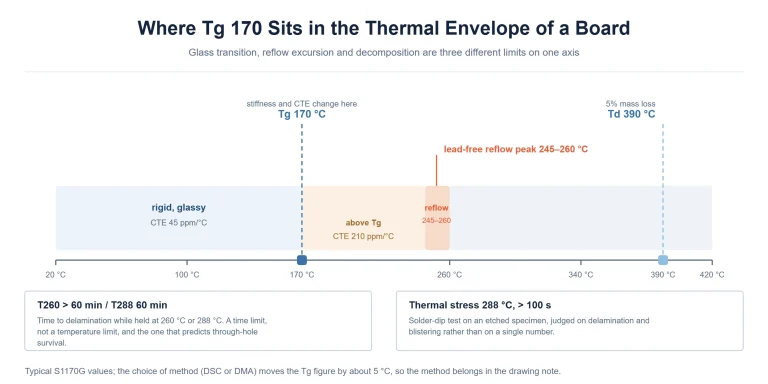
For a lead-free assembly profile with peaks of 245–260 °C, the numbers work out with usable margin: the reflow peak sits well below Td, and the excursion above Tg lasts minutes, not the hour the T260 figure budgets for. Where the margin narrows is thick, high-layer-count boards that see several reflow cycles plus rework. That is the case for stepping up to a Tg 170 system, which our companion article on the Tg 170 PCB laminate for multilayer builds covers in detail. How the press cycle itself is organised sits in our lamination process explainer.
Electrical Insulation and CAF Behaviour in Humid Service
Electrically, S1150G behaves like a competent mid-Tg FR-4: volume resistivity of 1.15×10⁸ MΩ·cm and surface resistivity of 9.61×10⁶ MΩ after moisture conditioning, with Dk of 4.5 and Df of 0.011 at 1 GHz. None of those figures will excite a signal-integrity engineer working above 10 Gbps, and none of them should worry one below that. The grade’s quiet strength is elsewhere: the resin system is formulated for CAF resistance, the slow copper migration along glass bundles that turns into shorts on dense boards after years in humid, biased service.
CAF resistance is why this grade appears on industrial controllers, metering hardware and outdoor telecom equipment rather than on glossy datasheet front pages. Combined with 0.10% water absorption, it gives a predictable insulation behaviour in condensing environments – the failure mode that actually kills fielded industrial boards. Where the design also runs high voltages across tight creepage gaps, surface tracking becomes the next limit, and our article on high-CTI material selection walks through that companion decision.
When to Specify It: Three Gates and the Evidence
Deciding whether a halogen-free PCB laminate belongs on a given drawing is easier as three independent gates, each with a different owner. Gate one is compliance: a market rule, a customer specification or an end-product declaration names a halogen limit. If nobody can quote the clause, the requirement is a preference, and preferences cost money. Gate two is reliability history: condensation, bias voltage and a measured CAF or leakage record on the current grade – evidence that a material change will actually move a field-failure number.
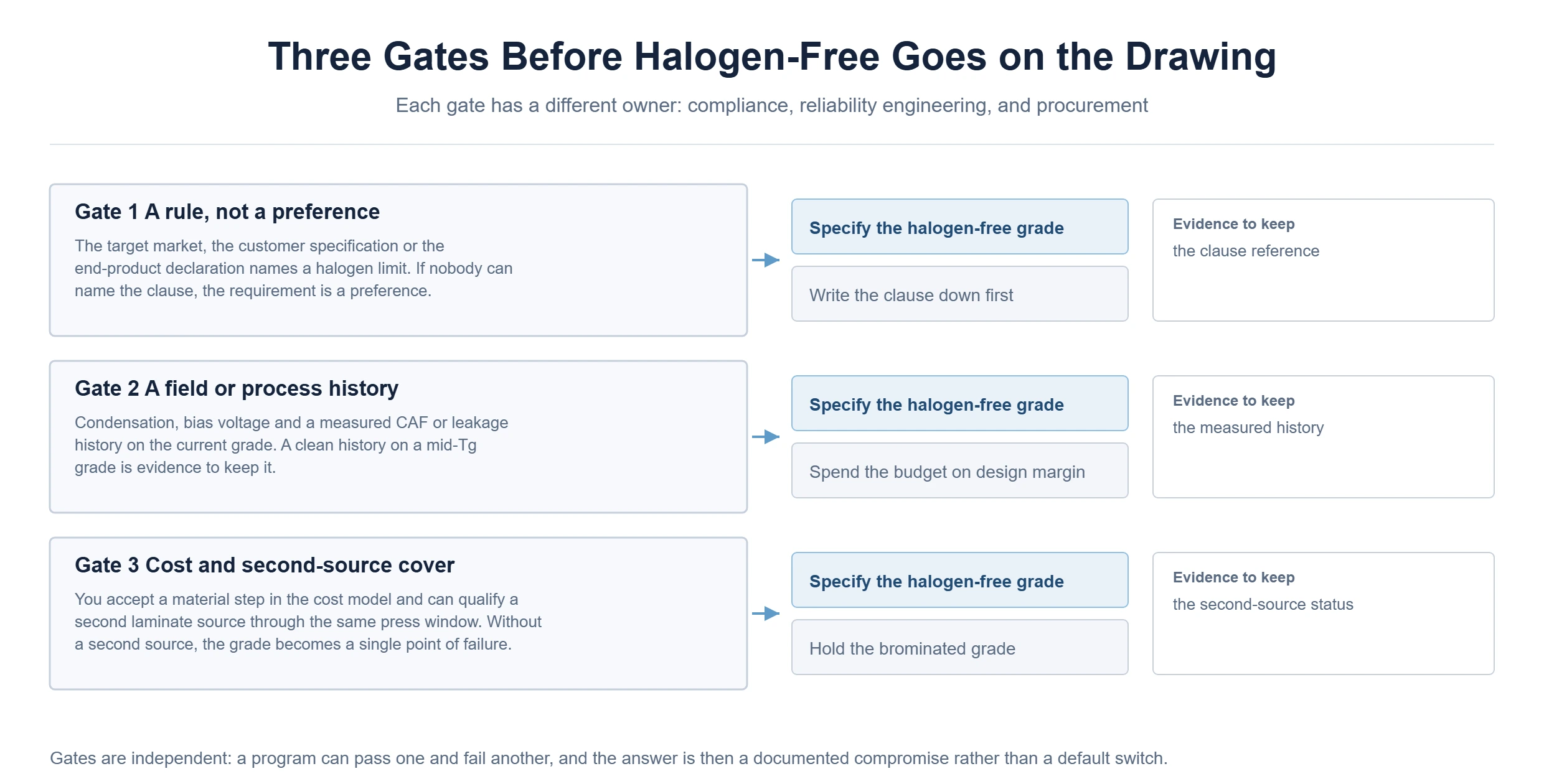
Gate three is procurement: accepting a material premium in the cost model and qualifying a second laminate source through the same press window, so the grade does not become a single point of failure. The evidence to keep from each gate is short and concrete – the clause reference, the measured history, the second-source status – and it is exactly what a fabricator needs to quote the grade accurately instead of padding the number. A program can pass one gate and fail another; the right answer then is a documented compromise, not a default switch.
- Passing all three gates: specify the halogen-free grade with the clause referenced on the drawing.
- Passing gate one only: specify it, but budget for the qualification effort and the premium.
- Passing no gate: stay on the brominated mid-Tg grade and record why, so the decision survives the next platform review.
Slash Sheets, Yellow Cards and Prepreg Pairing
A halogen-free declaration is only as trustworthy as the paperwork behind it, and three documents carry it. The IPC-4101/128 slash sheet defines the material class and its tested property envelope; the IPC-4101 specification framework is the shared vocabulary between buyer and fabricator. The UL yellow card, maintained by UL Solutions, documents the V-0 flammability rating on the actual foil and thickness combinations. The declaration itself – the halogen, antimony and red-phosphorus statement – comes from the laminate maker and should be dated and version-numbered like any other compliance document.
The fourth document is the one buyers forget: the prepreg datasheet for the same system, with its flow and press window matched to the core. Incoming inspection at the laminate level catches most surprises – resin content, volatility, and the halogen spot-check on arrival – and the whole material dossier belongs in the AVL entry, not in an email thread. For the broader material landscape, our PCB materials and laminates guide maps where each grade family sits.
Cost Logic Without a Price List
Material pricing moves on three levers, and none of them is the halogen content alone. Resin chemistry costs more than the brominated equivalent, that is the base premium. Volume matters more than most buyers expect: a grade ordered in container quantities prices very differently from one pulled for a single prototype lot, and the spread between the two can exceed the chemistry premium itself. Third, specification discipline: a drawing that pins the grade, the thickness and the copper foil in one line gets an accurate price; a drawing that says “halogen-free FR-4” invites the fabricator to protect itself with the most conservative option in stock.
The practical approach is to keep the cost comparison relative and honest: same stackup, quoted both ways, with the qualification effort shown as its own line. On a four-to-eight-layer industrial build the premium is a small fraction of the board cost; on a dense multilayer it grows with the laminate area. Where the premium lands in your cost model is a quotation question, and we confirm it per stackup rather than publishing figures that go stale with resin markets.
Where the Grade Fits: Applications and Product Matches
In production, the halogen-free mid-Tg grade earns its slot on industrial and telecom hardware first. Controllers, drives, metering and base-station boards live in humid, biased environments where the CAF-resistant resin pays off, and their customers increasingly ask for environmental declarations by name. Automotive body and comfort electronics follow the same logic – long service life, defined temperature zones and an industry that has adopted structured multilayer prototypes around IATF 16949 quality systems. Consumer products specify the grade when an end-product eco declaration demands it, not before.
| Application | Why the halogen-free grade helps | Typical build on this grade |
|---|---|---|
| Industrial control and metering | Condensing humidity, long service life, CAF resistance | 6–10 layer FR-4 multilayer |
| Telecom and networking hardware | Environmental declarations plus high reliability | 8–14 layer multilayer |
| Automotive body and comfort electronics | Defined thermal zones and documentation discipline | 6-layer multilayer, ENIG or OSP finish |
| Consumer devices | End-product eco declarations | 4–8 layer builds, cost-sensitive |
| Power and high-voltage boards | Insulation stability, with CTI checked separately | 4–6 layer, wider creepage gaps |
Two product pages show the builds in production form: our 10-layer HDI industrial control PCB and the 8-layer intelligent terminal PCB. Either can be quoted on a halogen-free laminate where the program carries a named requirement, and the choice is settled at stackup review with the whole material dossier on the table.
Frequently Asked Questions
What does halogen-free actually mean on a laminate datasheet?
It means the cured laminate contains no more than 900 ppm of bromine and 900 ppm of chlorine – 1500 ppm combined – per the IEC 61249-2-21 definition, and the resin is formulated without brominated flame retardants, antimony compounds or red phosphorus. On S1150G that declaration sits alongside the IPC-4101/128 slash sheet and a UL 94 V-0 rating, so the environmental claim and the flammability claim are documented separately.
What Tg does the S1150G laminate have?
155 °C measured by DSC, around 160 °C by DMA. It is a mid-Tg grade: enough margin above the 130–140 °C tier for lead-free assembly, but not a high-temperature grade. If your build runs thick, high layer count or several reflow passes, the Tg 170 class is the natural step up, and the choice between them is a stackup-review decision rather than a datasheet preference.
Is a halogen-free PCB laminate a drop-in replacement for standard FR-4?
Mechanically and electrically, close enough that the same stackup usually works. It is not a drop-in administratively: the laminate and prepreg must be qualified as one system, the press window is set for that chemistry, and a documented bake before assembly becomes part of the process. Treat it as a material change with a qualification package, not as a swap on the purchasing line.
Does a halogen-free PCB laminate always cost more?
In practice yes, a visible premium over the equivalent brominated grade, driven by resin chemistry and thinner order volumes. The size of that premium depends on thickness, copper foil and quantity far more than on the halogen content itself, which is why we quote it per stackup rather than as a fixed percentage. The honest comparison is the same stackup priced both ways, with qualification effort shown separately.
Do I still need UL recognition on the finished board?
Yes – the laminate yellow card covers the material’s flammability, while recognition of the finished board is a separate document with its own file number. Both should be current when the order is placed, and a halogen-free declaration does not substitute for either. If your end product carries a safety listing, name the finished-board recognition requirement in the drawing so the fabricator can confirm it before quoting.
Which applications genuinely require a halogen-free laminate?
Only those where a named clause demands it: a market regulation, a customer specification or an end-product environmental declaration. Beyond that, the grade is chosen for its reliability profile – CAF resistance and stable insulation in humid service – rather than for the halogen figure itself. If no one on the program can quote the clause, the requirement is a preference and the standard mid-Tg grade is usually the better spend.
Can I pair a halogen-free laminate with standard prepreg?
No. The halogen content of the finished board is the sum of all its layers, so one conventional prepreg undoes the declaration – and more practically, mixing resin systems creates a bonding and press-window risk that shows up as delamination at reflow. Laminate and prepreg must come from the same system, which is why the prepreg datasheet belongs in the qualification package next to the core datasheet.
Get Your Halogen-Free Stackup Reviewed Before It Is Quoted
Send us your Gerber data, the stackup intent and – if you have one – the clause that drives the halogen-free requirement. Our engineering team will confirm the laminate and prepreg pairing, the press window and the bake step for your thickness and layer count, and come back with a manufacturable material recommendation. Start through our PCB manufacturing services page, or browse the PCB materials and laminates guide to see how this grade sits in the wider material set.