Book Appointment Now

A buyer's guide to the Tg 170 PCB laminate decision: the S1170G values that matter, how z-axis expansion drives reliability, and when Tg 150 is enough.
Tg 170 PCB Laminate: S1170G Specs for Multilayer Reliability
Glass transition temperature is the most quoted – and most misused – number on a laminate datasheet. Programs step up to a Tg 170 PCB laminate because a stackup got thicker, a reflow count went up, or a field-failure report blamed the resin, and then discover that Tg alone decides none of those outcomes on its own. Td, the delamination clocks and the z-axis expansion rate all sit on the same page, and each one bites a different build. This guide uses S1170G, the grade we book most often for demanding multilayer work, as the working example. It separates the three thermal limits buyers tend to merge into one, shows where the 45 ppm/°C resin actually spends its margin during reflow, and walks through a five-step qualification check. The goal is a defensible answer to the real question: does this stackup need a Tg 170 PCB laminate, or is a mid-Tg grade doing the same job for less?
Table of Contents
- What a Tg 170 PCB Laminate Actually Buys on a Multilayer Board
- S1170G Datasheet Values That Matter
- Tg, Td and the Delamination Clocks: Three Different Limits
- Z-Axis Expansion: Where Tg Becomes a Soldering Problem
- Reflow Margin, Moisture and the Bake Before Assembly
- Choosing Between Tg 150, Tg 170 and Tg 180 Grades
- When a Tg 170 PCB Laminate Is the Wrong Spend
- Qualifying the Grade: Five Checks Before It Is Booked
- Layer Count, Press Cycles and Thick-Board Behaviour
- Cost Logic and Sourcing Discipline
- FAQ
- Get Your Tg Tier and Stackup Reviewed Together
What a Tg 170 PCB Laminate Actually Buys on a Multilayer Board
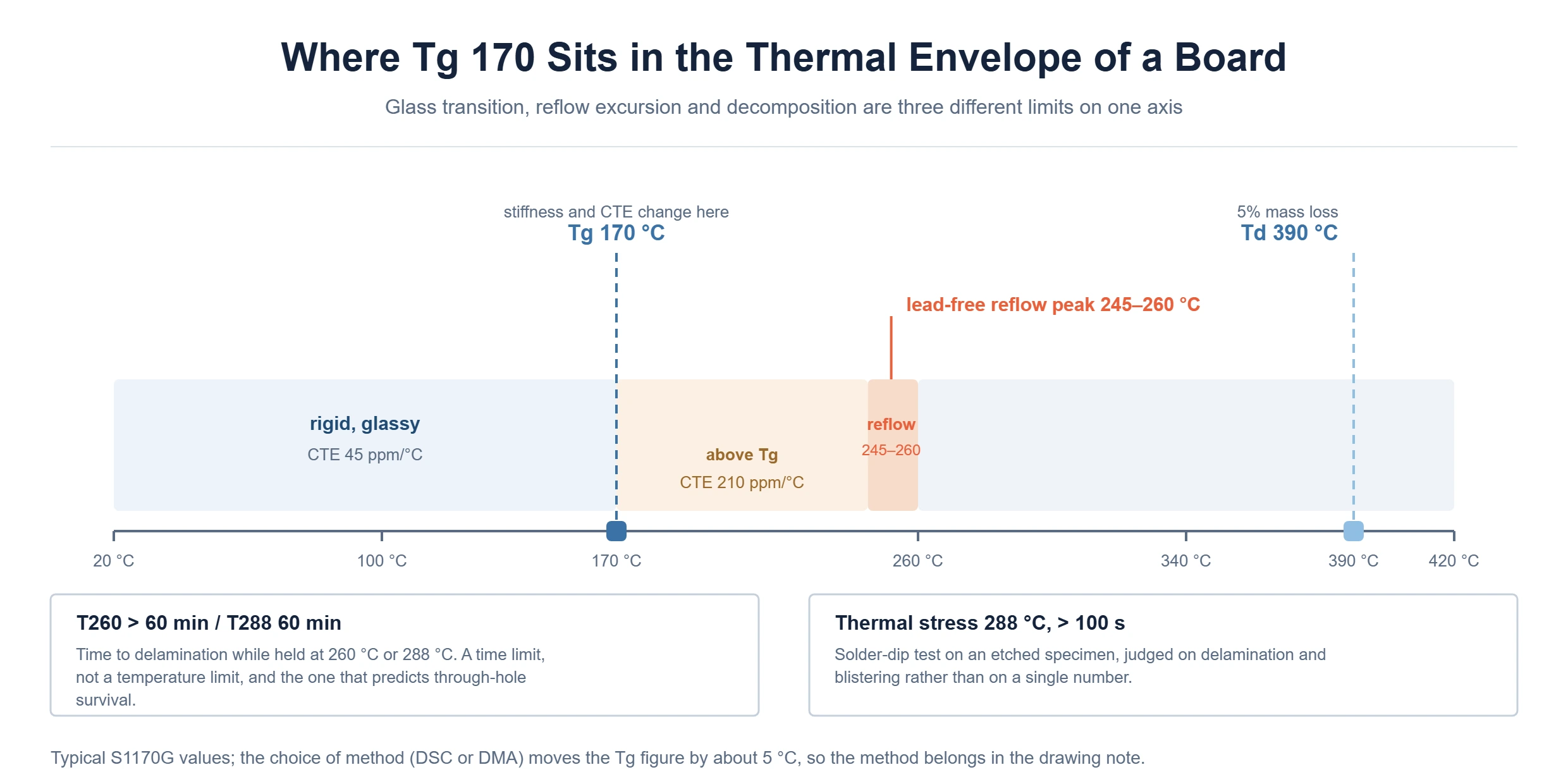
Below its glass transition temperature a laminate resin is stiff and expands slowly; above it, the resin softens and the z-axis expansion rate roughly quadruples. On S1170G the transition is specified at a minimum of 170 °C, with typical measurements of 175 °C by DSC and 180 °C by DMA. What that buys is not temperature resistance in the everyday sense – the reflow peak of 245–260 °C sits far above any Tg tier – but a longer stretch of low-expansion behaviour between the board’s operating temperature and the resin’s transition.
That extra stretch matters where thermal stress accumulates: thick boards with many plated through-holes, assemblies that pass through reflow two or three times, products that run hot in the field, and any combination of the three. On a 1.6 mm board the difference between resin tiers is measured in tens of micrometres of z-axis movement; on a 3 mm backplane with thousands of barrels it becomes a yield question. The grade decision therefore follows the stackup, not a datasheet preference.
S1170G Datasheet Values That Matter
S1170G is a Tg 170 FR-4 system qualified to IPC-4101/130, supplied with the usual copper foil and thickness range of a production FR-4 grade. The table below collects the values worth verifying, each with its test method attached, because the method choice moves the Tg figure by about 5 °C and belongs in the drawing note.
| Property | Typical value | Test basis | What it tells you |
|---|---|---|---|
| Tg, glass transition | 175 °C (DSC) / 180 °C (DMA), spec minimum 170 °C | IPC-TM-650 2.4.25 / 2.4.24.4 | Long low-expansion window above the operating range |
| Td, 5% mass loss | 390 °C | IPC-TM-650 2.4.24.6 | Decomposition headroom above reflow and rework |
| T260 / T288 | >60 / 60 min | IPC-TM-650 2.4.24.1 | Delamination clocks at reflow-class temperatures |
| Z-axis CTE | 45 / 210 ppm/°C | IPC-TM-650 2.4.24 | Below and above Tg; 2.3% total from 50 °C to 260 °C |
| Dk / Df at 1 GHz | 4.4 / 0.010 | IPC-TM-650 2.5.5.9 | Digital signal rates; no low-loss pretensions |
| Flexural strength | 550 / 450 MPa (LW/CW) | IPC-TM-650 2.4.4 | Handling and machining robustness |
| Water absorption | 0.12% | IPC-TM-650 2.6.2.1 | Predictable dielectrics after a proper bake |
| Flammability | UL 94 V-0 (UL ANSI FR-15.1) | UL 94 | Documented flammability on the material |
| Slash sheet | IPC-4101/130 | IPC-4101 | Basis for sourcing and incoming inspection |
Two entries deserve a second look. The T288 figure of 60 minutes is unusually strong for an FR-4 class – it is the number that predicts barrel survival across multiple reflow cycles – and the 390 °C Td leaves a wide gap between where the resin softens and where it actually decomposes. A resin that softens well before it burns is forgiving in rework, which is one of the unglamorous reasons this grade shows up on boards that get repaired in the field. The V-0 rating behind that flammability row is documented on the material’s yellow card, maintained by UL Solutions, and it should be current on the foil and thickness combination you order.
Tg, Td and the Delamination Clocks: Three Different Limits
The single most useful mental model for laminate thermal data is that Tg, Td and the delamination clocks measure three unrelated events. Tg is a stiffness change, reversible and harmless by itself. Td is chemical decomposition, permanent and cumulative. The T260 and T288 clocks measure how long the laminate holds together at reflow-class temperatures before interlaminar bonds fail – and on the same datasheet, T260 above 60 minutes with T288 at 60 minutes says the resin system tolerates long excursions, which is what a thick board spends during its second and third reflow pass.
| Limit | S1170G value | What it measures | Where it bites |
|---|---|---|---|
| Tg | 170 °C minimum (175 DSC / 180 DMA) | Resin softens, expansion rate jumps | Board temperature in service, near-Tg operation |
| Td | 390 °C | 5% mass loss, decomposition onset | Long bakes, repeated reflow, rework |
| T260 / T288 | >60 / 60 min | Time to delamination at 260 °C / 288 °C | Barrel survival across reflow cycles |
| Thermal stress | >100 s at 288 °C, no delamination | Solder-dip screening on etched specimens | Incoming qualification, batch checks |
Specifying by only one of these limits is how material problems slip through review. A board that operates at 125 °C for years cares mostly about Tg and the expansion slope below it; a board that sees three reflow cycles cares mostly about the clocks; a board that gets reworked cares about the gap between Tg and Td. The five-step qualification check later in this article exists precisely to keep all three in view.
Z-Axis Expansion: Where Tg Becomes a Soldering Problem
The z-axis numbers are where a Tg 170 PCB laminate either earns its premium or gets specified for no reason. Below Tg the resin expands at 45 ppm/°C; above it, 210 ppm/°C. Between 50 °C and 260 °C the whole stack moves 2.3% – on a 1.6 mm board roughly 37 µm, shared between the copper barrels and the resin around them. Every plated through-hole stretches and relaxes with that movement, and the barrel that survives a thousand thermal cycles is the one whose copper ductility outlasts the resin’s expansion budget.
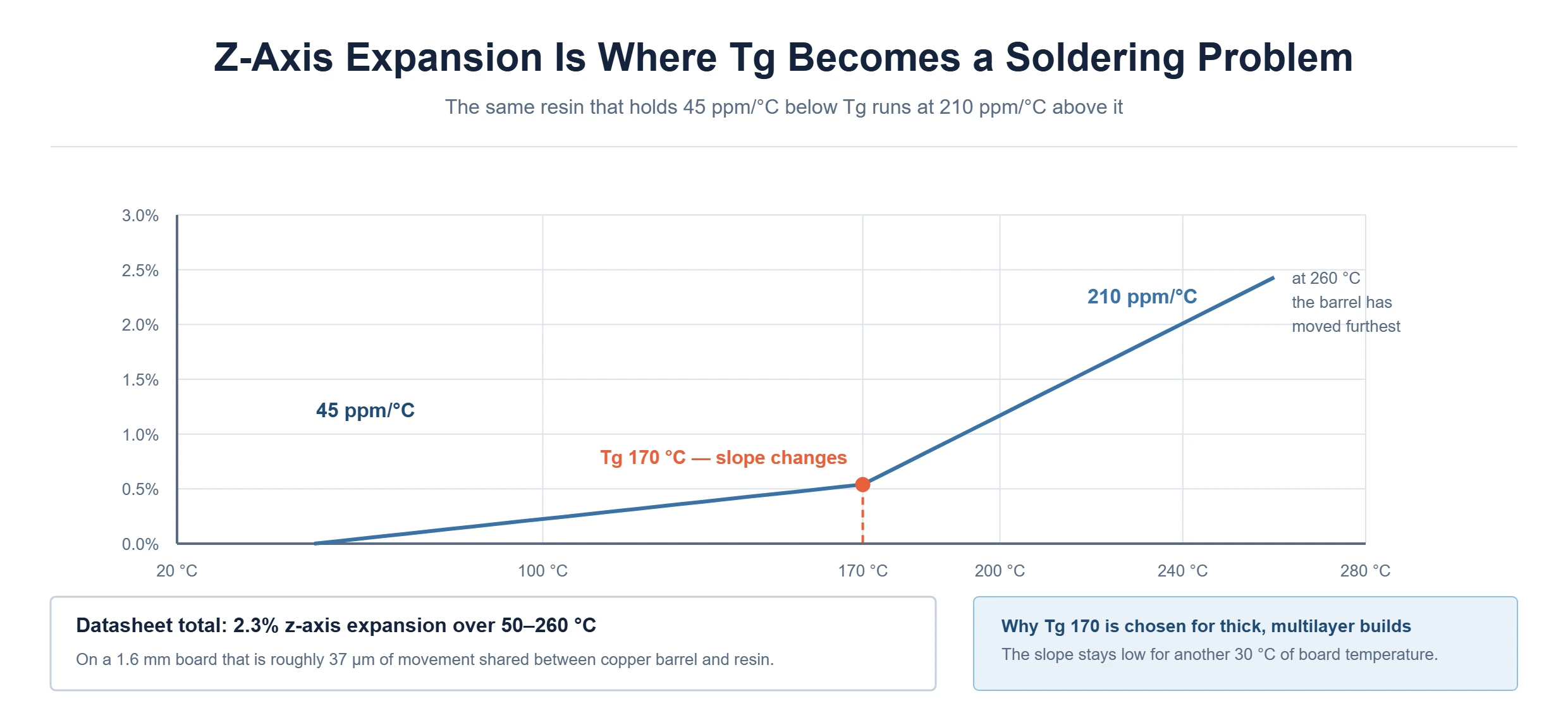
The practical reading: keeping more of the assembly’s temperature range below the transition slows the expansion the barrels experience, which is why the grade choice compounds with thickness and layer count. Reliability expectations for the finished board are set by standards such as IPC-6012 and IPC-A-600, and our incoming material checks follow the same envelope – the grade datasheet alone does not qualify a build. How the resin is consolidated around those barrels is a lamination question, covered in our press cycle explainer.
Reflow Margin, Moisture and the Bake Before Assembly
A lead-free profile peaks between 245 °C and 260 °C, comfortably below the 390 °C decomposition point but squarely above Tg – every reflow pass sends the whole board through its transition, and the barrels experience the fast-expansion regime for as long as the profile holds them there. With T288 at 60 minutes, the budget per pass is generous; the risk concentrates when moisture is in the room. Absorbed water flashing to steam inside the resin at reflow temperature is the mechanism behind the classic blistering and delamination complaints that get mislabeled as material defects.
The countermeasure is procedural, not chemical: a documented bake before assembly, storage in moisture-barrier packaging with humidity indicators, and floor-time rules that treat opened packages as a clock. On S1170G the 0.12% water absorption is unremarkable by FR-4 standards, which is exactly the point – moisture discipline, not the grade, separates clean reflow from field returns. Programs that skip the bake on a Tg 170 board and skip it on a Tg 130 board get the same lesson at different temperatures.
Choosing Between Tg 150, Tg 170 and Tg 180 Grades
Tier selection is easier when the tiers are compared on the criteria that actually differ: thermal margin, second-source cover, environmental positioning and cost. The table below lines up the four tiers we quote most often, including the halogen-free mid-Tg class described in our S1150G halogen-free laminate guide.
| Grade tier | Typical Tg | Natural fit | Trade-off |
|---|---|---|---|
| Standard FR-4 | 130–140 °C | Cost-driven builds, thin boards, single reflow | Least thermal and reflow margin |
| Halogen-free mid-Tg (S1150G class) | 155 °C (DSC) | Humid service, environmental declarations | Premium and fewer qualified equivalents |
| Tg 170 (S1170G class) | 170–180 °C | Thick multilayer, multiple reflow passes, hot service | Premium over mid-Tg tiers |
| Tg 180 (S1000-2M class) | 180 °C | Highest thermal demand, long hot service | Highest material cost in the FR-4 ladder |
Reading the table honestly: the Tg 170 tier is chosen when the assembly’s thermal history – board temperature in service, reflow count, rework likelihood, thickness – pushes against what a 155 °C resin holds comfortably. It is not chosen because 170 is a bigger number than 150. A four-layer consumer board on a Tg 170 resin burns money without moving a single reliability number, which is the next section’s subject.
When a Tg 170 PCB Laminate Is the Wrong Spend
The downgrade question deserves as much rigour as the upgrade. Three patterns show up repeatedly in quoting, and each one argues for staying on a cheaper tier:
- Thin boards with one reflow pass – a 1.0 mm four-layer assembly never spends its Tg 130 budget, let alone Tg 170.
- Field temperatures far below the transition – a product running at 60 °C keeps the entire low-expansion regime on any tier.
- Cost sheets that treat the grade as a quality badge – the premium buys thermal margin, not yield, and yield problems on those boards trace to design rules, not resin.
The counter-check is quick: list the assembly’s peak board temperature, its reflow count, its thickness and its rework policy. If all four sit comfortably inside what a mid-Tg grade datasheet allows, the Tg 170 PCB laminate is a specification habit rather than an engineering decision – and the cost difference is better spent on copper weight, finish quality or inspection coverage. Where a customer specification pins the grade by name, the habit argument is moot; the drawing rules.
Qualifying the Grade: Five Checks Before It Is Booked
A grade name on a quotation is not a qualified material. Five checks close the gap between “S1170G is on the AVL” and “S1170G will survive this stackup”, and every one of them is verifiable on paper before a panel is pressed:
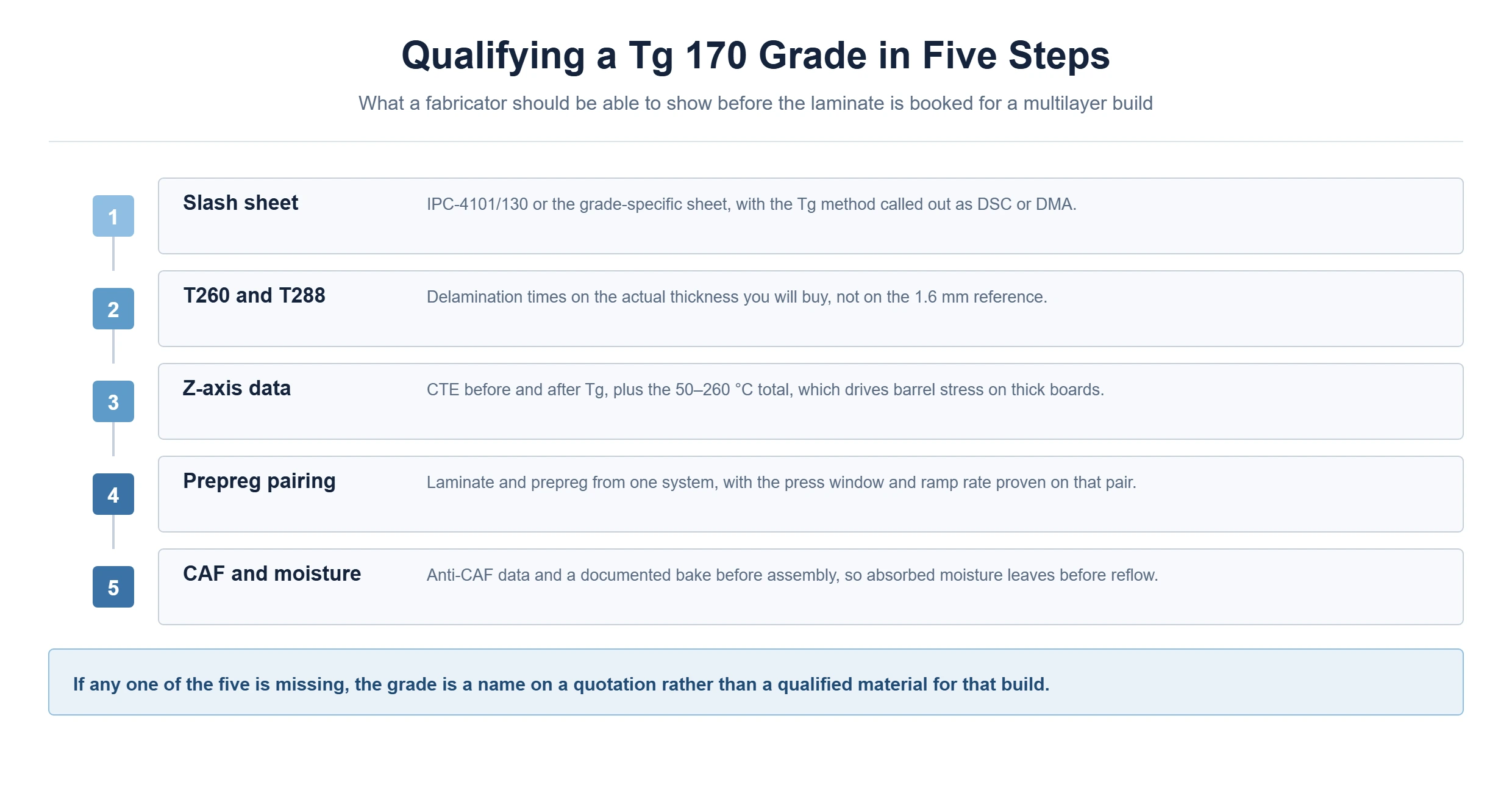
- Slash sheet: IPC-4101/130 or the grade-specific sheet, with the Tg method called out as DSC or DMA in the drawing note.
- Delamination clocks: T260 and T288 confirmed on the thickness you will buy, not only on the 1.6 mm reference specimen.
- Z-axis data: CTE below and above Tg plus the 50–260 °C total, checked against the barrel stress your thickness implies.
- Prepreg pairing: laminate and prepreg from one system, with the press window and ramp rate proven on that pair.
- Reliability data: anti-CAF performance and a documented bake, so the resin’s wet behaviour is managed rather than assumed.
Incoming inspection closes the loop on the material itself – resin content, volatility and the mechanical checks described in our laminate quality and incoming inspection article. A grade that passes all five checks is a qualified material for that build; anything less is a name on a quotation.
Layer Count, Press Cycles and Thick-Board Behaviour
Thickness and layer count change the grade conversation in two ways. Mechanically, a 14-layer stack consolidates more resin mass per press cycle, and each additional lamination cycle in a sequential build re-heats the whole panel – the thermal history a Tg 170 resin was chosen for. Electrically, thick boards with controlled impedance spend longer dielectric heights on ordinary FR-4 dielectrics, where the 4.4 Dk at 1 GHz keeps impedance calculations familiar; our article on hybrid stackups with mixed dielectrics covers the case where a high-speed layer set rides on a Tg 170 structural base.
In production terms, the grade appears most often on 10-to-20-layer builds with dense through-hole fields – backplanes, industrial controllers, test equipment and networking hardware. Two product pages show the class in production form: our 14-layer 2-stage HDI prototype and the 8-layer intelligent terminal PCB. Neither pins the resin by name on the public page, because the material call belongs to the stackup review – which is where the five qualification checks from the previous section get executed.
Cost Logic and Sourcing Discipline
In the FR-4 ladder, price rises with Tg, and the step from a mid-Tg tier to Tg 170 is real but modest compared with the jump to specialist low-loss materials. What moves the invoice more than the grade itself is sourcing discipline: a second qualified laminate source on the same slash sheet, prepreg ordered against the paired system rather than by glass style alone, and a drawing that pins the grade, thickness and copper in one line. Vague specifications force fabricators to protect themselves with stock conservatism, and that protection is priced.
The honest costing exercise is the same stackup quoted on both tiers, with the reliability argument attached to the difference. Where the Tg 170 premium buys measurable margin – thickness, reflow count, service temperature – it is one of the cheaper insurance purchases in electronics manufacturing. Where it does not, the money moves to copper weight or inspection and the board gets better for it. We confirm the material position per stackup at quotation rather than publishing figures that track resin markets.
Frequently Asked Questions
What does Tg 170 mean on a PCB laminate?
Tg is the glass transition temperature: below it the resin is stiff and expands slowly, above it the resin softens and z-axis expansion rises sharply. On a Tg 170 grade the transition is specified at a minimum of 170 °C – S1170G typically measures 175 °C by DSC and 180 °C by DMA. It is not the temperature the board can survive; it marks where the expansion behaviour changes.
Is a Tg 170 PCB laminate necessary for a 4-layer board?
Usually not. A thin four-layer assembly with one reflow pass never spends the thermal budget that separates Tg 170 from a 155 °C mid-Tg resin. The upgrade earns its keep on thick boards, high layer counts, multiple reflow cycles, hot service environments or a rework-heavy program. The quick check is peak board temperature, reflow count, thickness and rework policy against the mid-Tg datasheet.
How many reflow cycles can a Tg 170 laminate survive?
The datasheet expresses this as time, not cycles: S1170G holds over 60 minutes at 260 °C and 60 minutes at 288 °C before delaminating. A typical lead-free profile spends a few minutes above liquidus per pass, so three passes plus one rework sit well inside the budget – provided moisture discipline is respected, because absorbed water, not resin chemistry, causes most reflow delamination.
Why do DSC and DMA give different Tg values?
They measure different physical responses: DSC tracks heat flow, DMA tracks mechanical stiffness, and the resin’s stiffness change registers slightly later, so DMA reads higher – 180 °C versus 175 °C on this grade. Both are correct; the datasheet specification minimum of 170 °C sits under both methods. Name the method in the drawing note so incoming checks compare like with like.
Does Tg 170 affect impedance control?
Only through the dielectric properties, not the transition temperature itself. S1170G runs a Dk of 4.4 and a Df of 0.010 at 1 GHz – ordinary FR-4 territory, so impedance calculations and tolerances of ±10%, with ±8% or ±5% where specified, behave as they would on any standard dielectric. Designs needing genuinely low loss move to dedicated materials rather than to a higher Tg.
Can I mix Tg 170 cores with a mid-Tg prepreg?
It can be done on a qualified basis, but it is not the default. Laminate and prepreg from the same system share a proven press window and bonding behaviour; mixing tiers introduces a chemistry mismatch that shows up as delamination risk at reflow. The safe rule: pair the prepreg with the core system, and if a mixed build is genuinely required, prove it at engineering review with a coupon before production.
How does z-axis CTE affect through-hole reliability?
Every plated barrel stretches and relaxes with the board’s z-axis movement – 2.3% total on this grade from 50 °C to 260 °C, roughly 37 µm on a 1.6 mm board. A resin that stays in its low-expansion regime for more of that range, which is what Tg 170 buys, reduces the strain the copper must survive across thermal cycles. Thickness multiplies the effect, which is why thick, hole-dense boards are the natural home for this tier.
Get Your Tg Tier and Stackup Reviewed Together
Send us your Gerber data, the stackup intent and the service profile – peak board temperature, reflow count, thickness and rework policy. Our engineering team will run the five-point material check on your actual build, confirm the laminate and prepreg pairing, and come back with a grade recommendation that survives both the cost sheet and the field. Start through our PCB manufacturing services page or the PCB materials and laminates guide.