Book Appointment Now

A buyer's map of IPC standards for PCB work: what IPC-6012, IPC-A-600, IPC-4101 and IPC-A-610 each govern, and how Class 2 vs Class 3 changes acceptance.
IPC Standards for PCB: The Document Map and Class 2 vs Class 3

Sooner or later every PCB purchase order collides with a three-letter prefix. IPC stands for the Association Connecting Electronics Industries, the trade body that has published the industry’s consensus standards since 1957, when it was founded as the Institute for Printed Circuits. The acronym survived two later name changes, so today the documents are simply called IPC standards. They are drafted by member companies — fabricators, assemblers, equipment makers and material suppliers — and revised in cycles as processes evolve, which is why the revision letter on a standard matters as much as the number.
Two things matter to a buyer. First, IPC standards are voluntary until you cite them: the moment a purchase order references a standard and a class, that sentence becomes the acceptance basis your supplier is measured against. Second, the documents divide the build into stages, so no single standard covers everything — the map in this article shows which document owns which decision, and what Class 1, Class 2 and Class 3 actually change in inspection, process control and cost.
Table of Contents
- What IPC Standards Cover and Where the Name Comes From
- Which IPC Standard Governs Which Decision
- IPC-A-600 vs IPC-6012: How the Two Documents Divide the Work
- Class 1, Class 2 and Class 3: What the Levels Actually Change
- Why Class 2 Is the Working Default for Most Orders
- What Class 3 Compliance Adds in Process and Inspection
- How to Write IPC Standards Into a Purchase Order
- Pairing IPC Standards With UL, ISO 9001 and RoHS
- Auditing a Supplier’s IPC Compliance Before Volume
- FAQ
- Submit Your Gerbers for an IPC Class and Process Review
What IPC Standards Cover and Where the Name Comes From
IPC began in 1957 as the Institute for Printed Circuits, a consortium of printed-circuit manufacturers who needed common design rules and test methods. As the industry grew to include assembly, the body renamed itself the Association Connecting Electronics Industries, keeping the IPC acronym. Today its standards library covers design, base materials, fabrication, assembly, rework, cleaning and test — hundreds of documents that most of the world’s electronics supply chain cites by number.
For a hardware buyer, the practical takeaway is that IPC standards are consensus documents, not law. Nobody forces you to use them, but almost nobody can avoid them either: contract manufacturers quote to them, incoming inspection teams judge against them, and regulatory or customer audits expect them to be cited consistently. The skill worth building is knowing which document to cite for which feature of the board — and that is a much shorter list than the full library.
Which IPC Standard Governs Which Decision
The fastest way to use IPC standards is to treat them as a division of labor. Design rules live in one document, laminate specifications in another, board-level performance in a third, and visual acceptance criteria in a fourth. When a dispute happens after delivery, the document that governs the disputed feature is the one that decides who is right — so citing the wrong document is not a formality problem, it is an acceptance-basis problem.
| Build stage | Standard | What it governs |
|---|---|---|
| Design layout | IPC-2221 | Generic design rules: conductor spacing, annular ring, hole size, layout requirements |
| High-speed design | IPC-2226 | Design rules for high-speed interconnects and controlled-impedance structures |
| Base materials | IPC-4101 | Specification and qualification of laminates and prepregs by slash-sheet |
| Fabrication performance | IPC-6012 | Rigid board qualification: plated-hole copper, thermal, mechanical and electrical requirements |
| Bare board acceptance | IPC-A-600 | Illustrated visual acceptance criteria for finished bare boards |
| Assembly acceptance | IPC-A-610 | Visual acceptance criteria for solder joints and assembled components |
| Soldering process | J-STD-001 | Soldering materials, process requirements and process control |
| Rework and repair | IPC-7711/7721 | Procedures for reworking and repairing electronic assemblies |
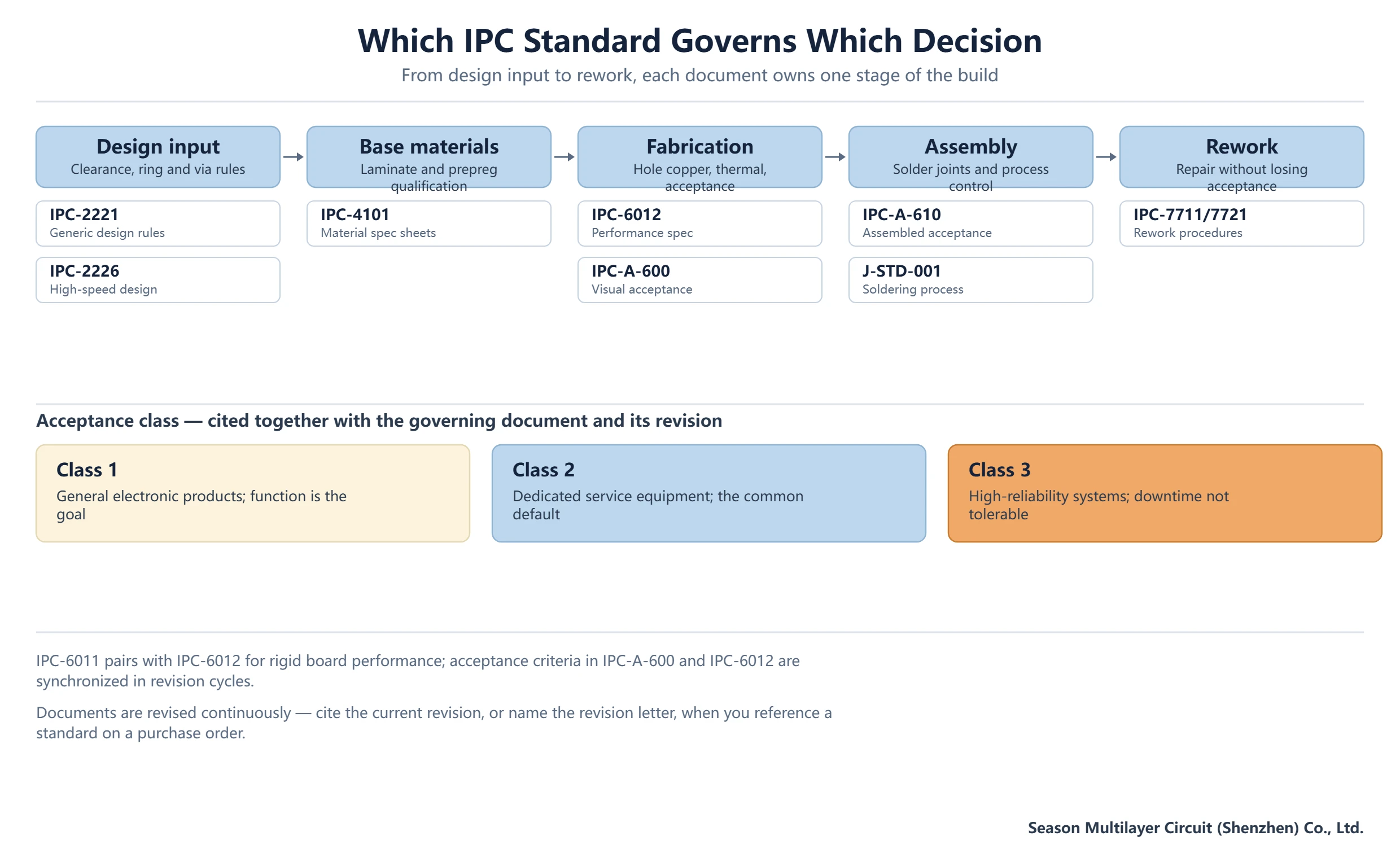
A practical consequence: citing IPC-A-610 on a bare-board order does nothing, because A-610 only evaluates assembled solder joints. Matching the document to the stage avoids that classic mismatch — the same logic that says a hole-copper argument belongs to IPC-6012, not to IPC-4101, even though both documents touch the same physical board.
IPC-A-600 vs IPC-6012: How the Two Documents Divide the Work
The pair most often confused is IPC-6012 and IPC-A-600. IPC-6012 is the qualification and performance specification for rigid printed boards: it sets minimum plated-hole copper thickness, thermal and electrical requirements, and the tests that prove them, working alongside IPC-6011 as the generic performance specification. IPC-A-600 is the illustrated companion: photographs of target, acceptable and nonconforming conditions that inspectors use at the bench to judge what they see.
The two documents are synchronized in revision cycles, so their acceptance criteria agree — a hole that passes A-600 also satisfies 6012. In practice buyers should cite both: 6012 defines what the board must achieve, A-600 defines how an inspector judges appearance. For a worked example of the strictest tier, the IPC-A-600 Class 3 acceptance walkthrough on this site compares target, acceptable and nonconforming conditions criterion by criterion.
Class 1, Class 2 and Class 3: What the Levels Actually Change
Within the fabrication and assembly standards, every acceptance criterion is written three times — once per class. The class number is not a marketing badge; it is a set of tightening screws applied to inspection intensity, process margins and documentation depth.
| Requirement area | Class 1 | Class 2 | Class 3 |
|---|---|---|---|
| Typical end use | General consumer products where function is the goal | Dedicated service equipment: industrial, communication, commercial | High-reliability systems where downtime cannot be tolerated |
| Inspection intensity | Basic acceptance, widest visual allowances | Standard criteria, the industry’s working default | Tightened criteria with more sampling and microsectioning |
| Plated-hole acceptance | Wider allowance on voids and plating | Restricted void acceptance | Minimal voids, thicker hole-copper minimums |
| Annular ring margins | Widest minimums | Standard minimums | Wider minimums for external connections |
| Documentation | Minimal certificates | Standard certificates of conformance | Expanded traceability, first-article and review records |
A correctly built Class 2 board is not a failed Class 3 board; it is a board accepted against different criteria. The mistake runs in both directions. Specifying Class 3 for a product that does not need it inflates inspection and process cost for no reliability gain, while letting a safety-relevant build ship under Class 2 criteria removes margin the design may quietly depend on.
Why Class 2 Is the Working Default for Most Orders
Ask fabricators what they quote by default and the answer is almost always Class 2, for a simple reason: most industrial controls, communication equipment and commercial devices are designed for dedicated service, which is exactly the Class 2 definition. Acceptance criteria are tight enough to catch process drift, but not so tight that every cosmetic irregularity becomes a concession conversation.
Class 3 earns its place when the consequence of failure is severe: systems where unplanned downtime is unacceptable, equipment operating in unusually harsh environments, and products with very long service lives where latent defects have years to surface. If that describes your product, put the class on the drawing — not in an email — and expect your fabricator to confirm the process impact at engineering review rather than discovering it at first-article inspection.
What Class 3 Compliance Adds in Process and Inspection
The cost of Class 3 shows up in process time and yield, not in a single line item. Thicker hole-copper minimums mean longer plating cycles. Wider annular ring minimums constrain drill-to-land registration, which matters more on dense boards. Tightened void criteria increase microsection sampling, and the documentation set grows: traceability records, first-article reports and review sign-offs all expand. On a dense multilayer build these effects compound, and yield loss concentrates exactly where the design is already hardest to build.
None of this is a reason to avoid Class 3 where it is warranted — a high-reliability security-system board is a legitimate Class 3 candidate. It is a reason to reserve the class for boards whose function justifies the tighter criteria: the class level should follow the consequence of failure, not the prestige of the project.
How to Write IPC Standards Into a Purchase Order
A purchase order that says only “high quality” gives both sides nothing to measure. The working format is three elements: the standard number, the current revision, and the class — for example, “fabricated and accepted per IPC-6012, current revision, Class 2”. Everything the class does not cover — finished thickness, impedance targets, surface finish, copper weights — belongs on the drawing or in the technical notes as separate line items. The prototype order checklist on this site walks through those parameters one by one.
| What buyers write | Why it fails | Write instead |
|---|---|---|
| “High quality” or “premium grade” | No acceptance basis, so inspection has no pass or fail | Cite the standard, revision and class explicitly |
| Class 3 with no revision letter | Revisions differ; an older revision may be applied | State the revision, or write “current revision” |
| IPC-A-610 cited on a bare-board order | A-610 governs assembled joints, not bare boards | Use IPC-A-600 / IPC-6012 for fabrication; A-610 for assembly |
| Class only, no special-feature notes | Class does not cover impedance, thickness or finish | List impedance, thickness and finish as separate items |
Pairing IPC Standards With UL, ISO 9001 and RoHS
IPC standards govern workmanship and performance, but they do not replace the other three documents a complete quality clause usually needs. Safety recognition of the finished board and its laminate belongs to UL Solutions, whose yellow card and E-file list the recognized constructions — this site’s guide to reading a UL yellow card explains how to match a construction to the file.
ISO 9001 sits at the management-system level: it says the factory has a quality system, not that a specific board meets a specific criterion. RoHS and REACH govern restricted substances in the finished article. A well-formed quality clause cites an IPC class for workmanship, a UL recognition for safety, and ISO 9001 for the system behind them — three different questions, three different documents.
Auditing a Supplier’s IPC Compliance Before Volume
Compliance is verifiable before volume production. Ask to see the acceptance criteria cards inspectors actually use at the bench, recent microsection reports with plated-hole copper measurements, first-article documentation, and revision control on customer drawings. A fabricator running to a cited class can produce these without scrambling; one that treats the class as a quote line will hesitate.
Outgoing shipments are the second checkpoint: the report package that travels with the goods should match what the order cited. This site’s outgoing inspection report guide lists the documents every buyer should receive, and the reliability test matrix shows which qualification tests back the performance claims in IPC-6012. For the capability questions behind those reports, the multilayer manufacturing capability guide covers layer counts, processes and verification capacity in one place.
Frequently Asked Questions
What does IPC stand for in PCB manufacturing?
IPC stands for the Association Connecting Electronics Industries, the trade body that publishes the industry’s consensus standards. It was founded in 1957 as the Institute for Printed Circuits and renamed twice, keeping the IPC acronym. Its documents cover design, base materials, fabrication, assembly and rework, and they are cited by number on purchase orders worldwide.
Is IPC-A-600 the same as IPC-6012?
No. IPC-6012 is the performance specification: it defines minimum plated-hole copper, thermal, mechanical and electrical requirements the board must meet. IPC-A-600 is the illustrated acceptance document: photographs of target, acceptable and nonconforming conditions inspectors use at the bench. Their acceptance criteria are synchronized by revision, and procurement documents normally cite both together.
Which IPC class should I specify for my product?
Match the class to the consequence of failure. Class 1 fits general consumer products where function is the goal. Class 2 fits dedicated service equipment — industrial, communication and commercial devices — and is the industry’s working default. Class 3 fits high-reliability systems where downtime cannot be tolerated, with tightened hole-copper, void and annular ring criteria and expanded documentation.
Is Class 3 always better than Class 2?
No. Class 3 is a different acceptance basis, not a quality upgrade. A correctly built Class 2 board is not defective; it meets the criteria written for its intended service. Specifying Class 3 where the product does not need it adds plating time, microsection sampling and documentation cost without reliability gain. Reserve Class 3 for builds where failure carries real consequences.
Do I need to cite the revision letter when ordering?
Yes, or write “current revision” explicitly. IPC documents are revised in cycles, and acceptance criteria can differ between revisions. Citing a standard number and class without a revision lets the supplier apply an older revision, which may be easier to pass. The safe format on a purchase order is standard number, revision, and class together.
Are IPC standards mandatory?
Not by law. IPC standards are voluntary industry consensus documents. They become binding through the contract: once a purchase order or drawing cites a standard, revision and class, that citation is the acceptance basis both parties are judged against. Inspections and disputes are then settled against the cited text, not against general notions of quality.
What is the difference between IPC-A-610 and J-STD-001?
IPC-A-610 is the acceptance document: it defines visually acceptable and nonconforming solder joints and assembly conditions. J-STD-001 is the process requirements document: it governs soldering materials, process parameters and process control. One judges the result, the other controls how the result is produced, and assembly orders typically cite both together.
Submit Your Gerbers for an IPC Class and Process Review
Put the class in writing and the rest of the quality clause follows. Send your Gerber package with finished thickness, copper weights, surface finish, expected class and quantities to the engineering team through the PCB manufacturing services page. Production spans 2 to 30 layers with prototype builds reviewed case by case up to 64 layers, and class-fit feedback comes back with the process review — the 10-layer 2-stage HDI prototype page shows a representative build.
998 PCB Group, founded in 2006, runs three plants in Shenzhen, Jiangxi and Anhui with an annual capacity of 3,000,000 m². Specify the standard, revision and class on the drawing; the engineering review confirms the acceptance basis before the first panel is etched.