Book Appointment Now

What a PCB flammability rating measures, how UL 94 vertical burn tests run, and how to read V-0, V-1 and V-2 on a yellow card before you release an order.
PCB Flammability Rating: UL 94 V-0, V-1 and V-2 Explained
A PCB flammability rating is the single line on a laminate data sheet that decides whether a board can be sold into most markets, and it is also the line buyers misread most often. A V-0 label does not mean the board will not burn. It means a specified specimen of that material, at a specified thickness, self-extinguished within a measured time when a small flame was applied in a laboratory.
This guide covers what the rating measures and what it does not, how the UL 94 vertical burn test is actually run, how V-0, V-1 and V-2 differ in numbers rather than adjectives, and how to read the rating on a UL yellow card beside the thermal and tracking data that matter just as much. It ends with a selection table by product context and the documents worth collecting before a purchase order goes out.
Table of Contents
- What a PCB Flammability Rating Actually Measures
- How the UL 94 Vertical Burn Test Is Run
- V-0 vs V-1 vs V-2: The Pass Criteria Side by Side
- Why 94V-0 Is the Default Grade on FR-4 Data Sheets
- Reading a PCB Flammability Rating on the UL Yellow Card
- Brominated vs Halogen-Free Flame Retardant Systems
- Glow Wire and Needle Flame: When UL 94 V-0 Is Not Enough
- Choosing a PCB Flammability Rating by Application
- What Buyers Should Ask for in the Documentation
- FAQ
- Get the Material and Rating Stack Checked Before Release
What a PCB Flammability Rating Actually Measures
The rating describes a material property of the cured laminate, not the fire performance of the finished assembly. It travels with the base material from the laminate supplier to the board shop, and it is independent of your components, your enclosure and your end product. That distinction matters because a PCB flammability rating is frequently quoted in design reviews as if it were a product-level certification.
Two separate UL recognitions sit behind a finished board. The laminate itself is recognized as a material, and the bare printed wiring board is recognized as a construction under UL 796, where layer count, copper weight, laminate type and thickness range are all part of the file. A board shop can only build within a construction that its own file covers, using laminates that carry a recognized rating. Our walkthrough of reading a UL yellow card and E-file number covers the construction side in detail.
In practice the marking you see printed on a board, something like 94V-0 next to a UL logo and an E-file number, is a claim that the laminate in that build is rated V-0 and that the construction is covered by the file. It is a traceable statement, not marketing text, and it can be audited against the laminate supplier’s card.
How the UL 94 Vertical Burn Test Is Run
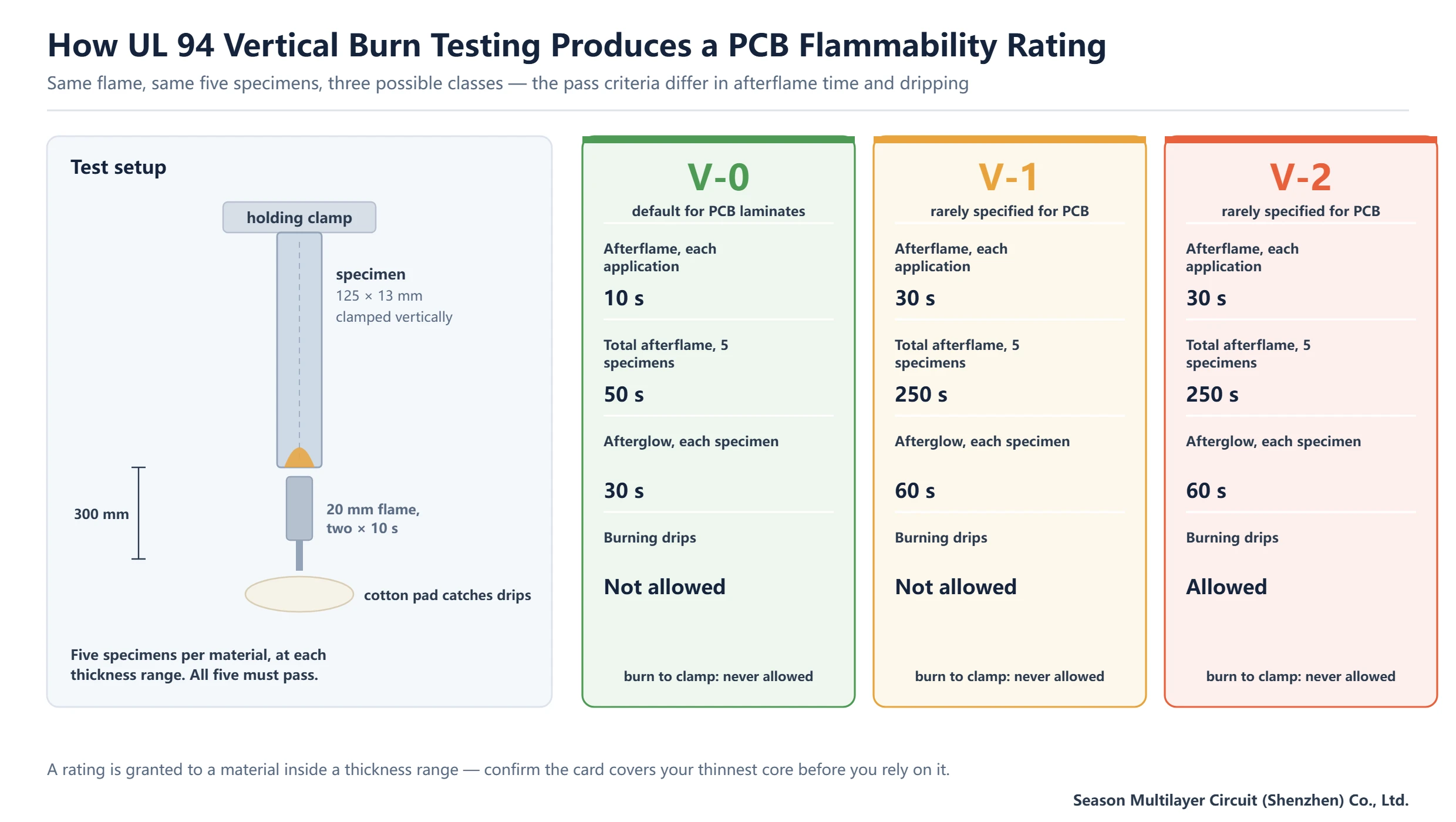
Five specimens are cut, typically 125 mm long and 13 mm wide, conditioned, then clamped vertically. A 20 mm flame from a calibrated burner is applied to the lower edge twice, each application lasting 10 seconds. The laboratory records the afterflame time after each application, the afterglow time, whether any burning material drips onto a cotton pad placed below, and whether the specimen burns up to the holding clamp.
The horizontal burn test produces the HB grade, which mainly captures how fast a flame front travels along a flat specimen. A separate family of tests using a 500 W flame produces the 5VA and 5VB grades, which are aimed at enclosure materials rather than at thin printed wiring boards. Most PCB laminate data sheets only quote the vertical result, because that is the test the industry buys against.
One detail is routinely skipped in procurement discussions: the rating is granted for a thickness range, not for a material in the abstract. A laminate recognized at 0.8 mm and above may not carry the same result at 0.4 mm, because thinner specimens heat through faster and distort earlier. If your stackup uses thin cores, confirm the recognized thickness on the card instead of assuming the rating applies to the whole range.
V-0 vs V-1 vs V-2: The Pass Criteria Side by Side
The three vertical grades differ in two measurable ways: how long the specimen keeps burning after the flame is removed, and whether dripping material is allowed to ignite the cotton below. Everything else about the test is identical, which is why a V-2 material and a V-0 material can look the same in a data sheet summary and behave very differently in a fault condition.
| Test criterion | V-0 | V-1 | V-2 |
|---|---|---|---|
| Afterflame per specimen, each application | ≤ 10 s | ≤ 30 s | ≤ 30 s |
| Total afterflame, five specimens | ≤ 50 s | ≤ 250 s | ≤ 250 s |
| Afterglow per specimen | ≤ 30 s | ≤ 60 s | ≤ 60 s |
| Burning drips that ignite the cotton | Not allowed | Not allowed | Allowed |
| Burn up to the holding clamp | Not allowed | Not allowed | Not allowed |
| Typical use in PCB work | Default for FR-4 builds | Rare in laminate specs | Rare in laminate specs |
For boards, V-0 is the grade that matters and the one nearly every general-purpose FR-4 grade carries. V-1 and V-2 exist in the standard and appear in material literature, but they are not a cost-saving option you should design around: the difference in laminate price between a V-0 grade and a looser grade is small, while the documentation and approval effort to justify a lower class is not.
The practical trap is reading V-0 as non-flammable. A V-0 result means the material stops burning within ten seconds per application and does not drip flaming material. It still burns, still produces smoke, and still contributes fuel. The rating sets a floor for material selection; it does not replace enclosure design, spacing rules or fault-current protection.
Why 94V-0 Is the Default Grade on FR-4 Data Sheets
Brominated FR-4 systems reach V-0 comfortably, and the additive package that gets them there has been tuned for decades. That is why the overwhelming majority of general-purpose FR-4 sold today is V-0 rated, and why a laminate quoted as HB only is a signal worth questioning rather than a normal baseline. If a supplier offers a low-cost FR-4 without a V-0 result, the difference is usually in the flame-retardant system or in the resin content, not in the glass.
The rating is also a convenient proxy for process control. A laminate that cannot hold V-0 at its rated thickness is often one with inconsistent resin flow or moisture uptake, and those same weaknesses show up later as delamination during reflow or as measling after thermal cycling. Checking the fire rating is therefore a cheap first filter on material quality, and it pairs naturally with incoming laminate inspection.
Where the default stops being enough is thin or unusual constructions. High-layer-count boards with thin cores, and builds that mix resin systems, both need the rating confirmed against the actual thickness and the actual laminate grade in the stackup. It is a five-minute check against the material card and it prevents the more expensive conversation later, when a safety reviewer asks for evidence and nobody has it.
Reading a PCB Flammability Rating on the UL Yellow Card
The yellow card is where a PCB flammability rating stops being a marketing line and becomes an auditable record. Each card is published under an E-file number and lists the material designations covered, the recognized ratings, the thickness ranges those ratings apply to, and a set of thermal and electrical indices that engineers tend to skip.
| Yellow card field | What it tells you | What to check against your design |
|---|---|---|
| E-file number | The unique UL file that covers the laminate or the board construction | Matches the number on the drawing, the CoC and the board marking |
| Material designation | The grade the laminate is recognized as, for example FR-4.0 or FR-4.1 | Same designation the fabricator intends to buy, not a generic FR-4 reference |
| Flammability rating | The UL 94 class granted to the material, usually 94V-0 | Grade and the thickness range it was granted for |
| Thickness range | Minimum and maximum thickness where the rating and indices apply | Covers your thinnest core and your finished board thickness |
| Relative thermal index | Long-term temperature capability for electrical and mechanical properties | Above your operating temperature with margin, not confused with Tg |
| Comparative tracking index | Tracking resistance class if listed on the card | Relevant for mains-adjacent spacing and pollution degree |
Two misreadings recur. The first is treating the relative thermal index as if it were the glass transition temperature; they measure different things, and a card can show a Tg of 170 with a much lower electrical index. The second is assuming that a recognized laminate automatically makes the board recognized. The construction still has to sit inside the fabricator’s own file, which is the part that capability documentation should answer directly.
Brominated vs Halogen-Free Flame Retardant Systems
Most V-0 FR-4 uses a brominated flame retardant with an antimony synergist. It is effective, well characterized and RoHS compliant, which surprises engineers who assume that halogen content and RoHS are in conflict. RoHS restricts specific substances such as polybrominated biphenyls and diphenyl ethers, not bromine as an element, so a standard brominated FR-4 with a Tg around 150 in the mid-Tg range remains a completely legitimate choice for general builds.
Halogen-free laminates get to V-0 through phosphorus and nitrogen chemistry instead. Our S1150G halogen-free grade sits at Tg ≥150 and is specified as free of halogen, antimony and red phosphorus; it meets V-0 while changing the smoke and combustion gas profile. That is the real driver for specifying it: customer mandates, smoke and toxicity requirements in enclosed equipment, and corporate material restrictions, not the presence of bromine alone.
Switching systems is not a drop-in change electrically. Halogen-free resins often differ in dielectric constant, loss tangent and moisture uptake, and some are more sensitive to baking before lamination. If a build moves to halogen-free for compliance reasons, re-check impedance targets and the press profile at the same time, because a material change that keeps the fire rating can still move the electrical result.
Glow Wire and Needle Flame: When UL 94 V-0 Is Not Enough
UL 94 applies a small flame for a short time. Some end-product standards apply a much hotter, longer thermal stress, and they ask for different evidence: glow wire testing under IEC 60695-2-11 for flammability temperature, IEC 60695-2-12 for ignition temperature and IEC 60695-2-13 for ignitability index, plus needle flame testing for small parts. Those results come from the end-product standard, not from the laminate card.
The practical consequence is a documentation gap. A team can hold a perfectly good V-0 laminate and still fail a safety review because the reviewer wanted a glow wire result at 750 °C or a needle flame result at a stated application time. Ask early which end-product standard applies, then confirm whether the laminate supplier has the data or whether the test has to be run on the assembly.
Tracking resistance is a separate axis that is often lumped in by mistake. Flammability asks how a material behaves in a flame; tracking asks how a surface resists forming a conductive carbon path under voltage and contamination, which is an IEC 60112 measurement and the subject of our CTI and creepage guide. A board can be excellent on one and marginal on the other, so both belong on the specification.
Choosing a PCB Flammability Rating by Application
In most projects the material decision reduces to a default plus one or two extra conditions. The table below maps common product contexts to the rating to write on the drawing and the additional evidence a reviewer is likely to request, so the specification survives the first safety review instead of being rewritten after it.
| Product context | Rating to specify | Additional evidence to request |
|---|---|---|
| Handheld consumer device, sealed enclosure | 94V-0 laminate, Tg 130–150 | Yellow card copy, thickness range covering the thinnest core |
| Industrial control board in a metal cabinet | 94V-0 laminate, Tg 150 or above | Relative thermal index against ambient, CTI class for mains spacing |
| Mains-adjacent power section on the same board | 94V-0 laminate plus defined CTI | IEC 60112 tracking data, creepage and clearance review |
| Equipment with a smoke or toxicity requirement | Halogen-free V-0 grade | Material declaration showing no halogen, antimony or red phosphorus |
| Multi-board assembly with connectors and cables | 94V-0 laminate for every board | Construction-level UL file covering each layer count used |
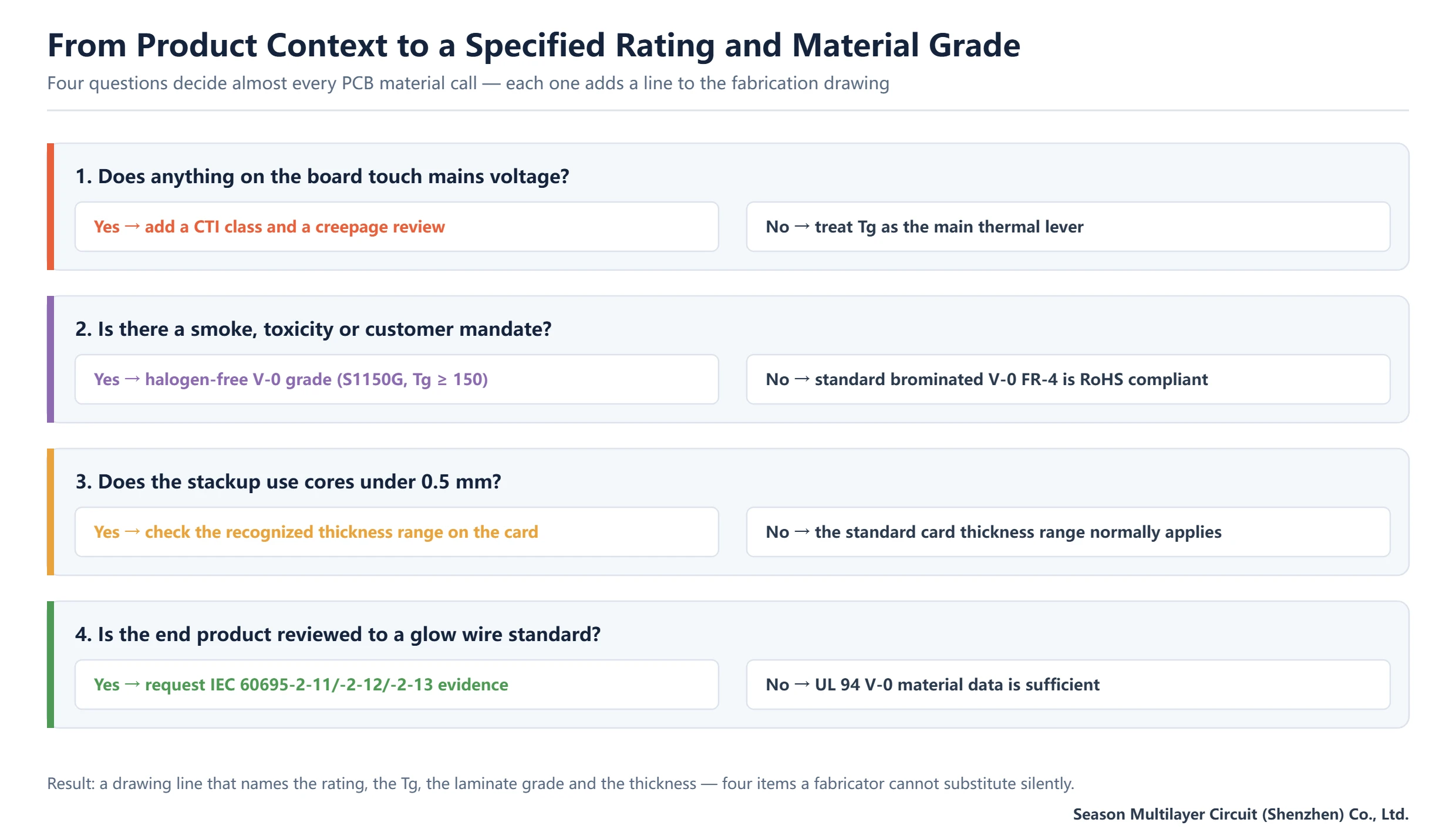
Two habits make this table work in practice. Write both the rating and the material grade on the fabrication drawing, so the fabricator cannot substitute a different system that happens to be V-0. Then state the thickness explicitly, because a stackup with 0.2 mm cores and a card recognized from 0.5 mm upward is a specification mismatch that only surfaces at the audit.
It is also worth deciding early whether the rating is a customer requirement or an internal preference. Requirements that arrive with a contract reference need the evidence trail, while preferences can be satisfied with a standard V-0 grade and a note on the drawing. Mixing the two is how teams end up paying for a halogen-free material to satisfy a requirement that never asked for one.
What Buyers Should Ask for in the Documentation
The evidence pack for a PCB flammability rating is short, and asking for all of it at the quotation stage is far cheaper than assembling it during an audit. The list below is what a competent fabricator can supply without a special project.
- Laminate yellow card with the E-file number and the recognized thickness range, not just a marketing PDF
- The fabricator’s own UL 796 construction file, showing that your layer count, copper weight and thickness are covered
- A statement of the exact laminate grade to be used, matched to the grade named on the drawing
- Lot-level certificate of compliance that repeats the grade and the rating
- A halogen content declaration if the project requires one, plus the CTI class if mains spacing depends on it
For incoming inspection, the fire rating itself is not something a receiving department can re-test, so the check is documentary plus a visual confirmation that the boards carry the expected marking where the drawing requires it. That is why the rating belongs in the same review as IPC class acceptance criteria and the inspection report package rather than in a separate material conversation nobody owns.
Frequently Asked Questions
What is a PCB flammability rating?
It is the UL 94 classification granted to a laminate after a standardized small-flame test, most often V-0 for PCB work. The result is specific to the material, its thickness range and the test conditions, and it describes how the cured laminate behaves in a flame rather than how the finished assembly performs in a fire.
Is 94V-0 the same as UL 94 V-0?
Yes. The marking printed on a board, 94V-0, is shorthand for a UL 94 vertical burn result at class 0. The 94 refers to the standard, the V to the vertical test orientation and the 0 to the strictest of the three vertical grades. It is a material claim that can be traced to the laminate supplier’s yellow card.
What is the difference between V-0 and V-1?
Both use the same vertical test, but V-0 limits afterflame to 10 seconds per application and 50 seconds total across five specimens, while V-1 allows 30 seconds per application and 250 seconds total. Both forbid dripping that ignites the cotton below. For PCB laminates, V-0 is the practical default and V-1 is rarely specified.
Does a V-0 laminate make my product fire safe?
No. It means the laminate self-extinguishes within the test limits and does not drip flaming material. The board still burns, still smokes and still adds fuel. Product safety depends on enclosure material, spacing, fault protection and the end-product standard, which is where glow wire or needle flame evidence may also be required.
Can a V-0 laminate fail at a thinner core?
The rating is granted for a thickness range, so a grade recognized from 0.5 mm upward is not automatically V-0 at 0.2 mm. Thin specimens heat through faster and distort earlier. If your stackup uses thin cores, check the recognized thickness on the yellow card and confirm that your construction sits inside the fabricator’s UL file.
Is halogen-free required to reach V-0?
No. Standard brominated FR-4 reaches V-0 routinely and is RoHS compliant, because RoHS restricts specific brominated substances rather than bromine as an element. Halogen-free grades use phosphorus and nitrogen chemistry instead, and are specified for smoke, toxicity or customer material mandates rather than for the fire rating itself.
Which rating should I write on a general industrial board drawing?
Specify a 94V-0 laminate with a stated Tg and a stated thickness, and name the laminate grade so substitution is not open. Add the CTI class if mains voltage shares the board. That combination covers most industrial work and gives a reviewer something concrete to check against the yellow card.
Get the Material and Rating Stack Checked Before Release
Send the stackup, the target rating and the product context, and our engineering team will confirm which laminate grade and thickness range carry the rating you need, plus the documentation that goes with it. Reviews are handled before quotation, so a mismatch is caught while it is still a drawing change. See how we handle material and construction review or submit your Gerber data for a first pass.