Book Appointment Now

Double-Sided Medical FPC
Medical-grade flexible PCBs (FPC) — custom medical FPC manufacturing for wearable medical devices, patient monitoring sensors, and implantable electronics. Ultra-thin, biocompatible, and engineered for the rigorous demands of medical applications.
Medical devices increasingly rely on flexible printed circuits (FPC) to achieve the compact, lightweight, and conformable form factors required for wearable health monitoring, surgical instruments, and implantable devices. At Season Multilayer Circuit, we manufacture double-sided medical FPCs with biocompatible materials, precision impedance control, and ISO 13485-aligned quality processes for the medical device industry.
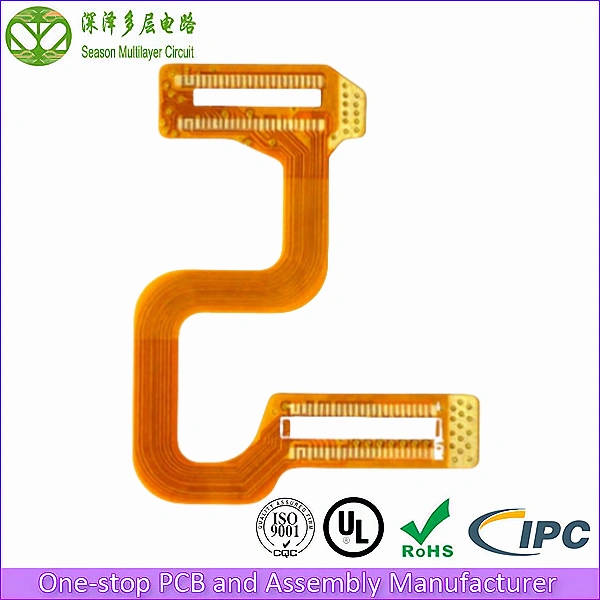
2
Layer Count
3/3 mil
Min. Trace/Space
0.10 mm
Min. Via Diameter
PI 25 µm
Polyimide Thickness
1–2 µ”
ENIG Gold Thickness
ISO 9001:2015
ISO 14001
UL (E305905)
IPC Class 2 / Class 3
RoHS
Double-Sided Medical FPC Stackup Diagram
Our double-sided medical FPC stackup uses medical-grade polyimide substrate with copper on both sides, providing flexible routing capability for compact medical device electronics that must conform to body contours or fit within miniature device housings.
- Top Layer (Copper): Component placement, sensor pads, electrode contacts
- Adhesive Layer: Medical-grade acrylic adhesive bonding copper to polyimide
- Polyimide Core (25 µm): Flexible insulating substrate providing mechanical support
- Adhesive Layer: Medical-grade acrylic adhesive bonding copper to polyimide
- Bottom Layer (Copper): Bottom routing, ground plane, shielding
- Coverlay (PI 12.5 µm): Protective polyimide coverlay with exposed pad openings
For implantable applications, we offer biocompatible polyimide substrates with proven ISO 10993 biocompatibility testing. Our engineering team can customize the stackup thickness, copper weight, and coverlay configuration for your specific medical device requirements.
Technical Capability & Specifications
| Parameter | Specification | Advanced Capabilities |
|---|---|---|
| Layer Count | 2 Layer FPC | 1-8L (Mass); 1-10L (Sample) |
| Base Material | Polyimide (PI) 25 µm | PI 12.5/25/50/75 µm, PET |
| Board Thickness | 0.10mm | 0.05-0.30mm (FPC) |
| Panel Size | 60x40mm/1 | 300x250mm (FPC Mass) |
| Copper Thickness | 1/2 oz (18 µm) | 1/3 oz (12 µm) to 2 oz (70 µm) |
| Min Drill Size | 0.10mm | 0.075mm (Sample) |
| Min Trace Width/Spacing | 3/3 mil | 2/2 mil (Sample) |
| Via Type | Through-hole (PTH) | Blind via, staggered microvia |
| Surface Finish | ENIG | ENIG, OSP, Immersion Silver, Tin |
| Coverlay | PI 12.5 µm | PI 12.5/25/50 µm, solder mask |
| Stiffener | PI/Stainless/FR4 | PI, Stainless steel 0.1-0.3mm, FR4 0.2-1.6mm |
| Flexibility | Dynamic/Static | Dynamic (100K+ cycles), Static |
Key Advantages of Our Medical FPC
- Medical-Grade Biocompatibility: Polyimide substrate and coverlay materials meet ISO 10993 biocompatibility testing requirements for skin contact and short-term implantable applications.
- Ultra-Thin Profile: 0.10mm total thickness enables integration into wearable patches, catheter-based devices, and miniature implantable electronics where rigid PCBs cannot fit.
- Dynamic Flexibility: Tested for 100,000+ flex cycles for wearable applications requiring repeated bending, such as wrist-worn monitors and smart clothing sensors.
- Precision Sensor Integration: 3/3 mil trace/space enables fine-pitch electrode arrays for ECG, EEG, and EMG sensing directly on the FPC substrate.
- EMI Shielding Option: Bottom-side copper plane provides EMI shielding for sensitive biopotential measurement circuits, reducing noise in critical patient monitoring signals.
Overcoming Critical Challenges in Medical FPC Design
When sourcing flexible PCBs for medical device applications, engineers encounter three critical challenges. Here is how our engineering team eliminates them:
1. Biocompatibility and Material Safety
The Problem: Medical devices that contact skin or are implanted require biocompatible materials. Standard FPC materials may leach chemicals or cause allergic reactions, failing FDA biocompatibility testing and delaying device approval.
Our Solution: We use medical-grade polyimide substrates and acrylic adhesives that have passed ISO 10993-5 (cytotoxicity), ISO 10993-10 (sensitization), and ISO 10993-23 (irritation) testing. For implantable applications, we offer USP Class VI certified materials with full traceability documentation.
2. Flex Fatigue in Wearable Applications
The Problem: Wearable medical devices are subject to repeated bending during daily wear. Standard FPCs develop cracks in copper traces after thousands of flex cycles, causing intermittent connections and device failure.
Our Solution: Our dynamic FPC design uses optimized copper grain structure, proper trace routing (per IPC-2223), and neutral axis placement to minimize flex stress. We test to 100,000+ flex cycles at specified bend radius. For critical applications, we offer rolled-annealed copper with superior flex fatigue resistance.
3. Miniaturization for Implantable Devices
The Problem: Implantable medical devices — pacemakers, neurostimulators, cochlear implants — require extremely small, lightweight FPCs that fit within hermetically sealed titanium housings. Standard PCB technology cannot achieve the required density.
Our Solution: Our 3/3 mil trace/space capability with 0.10mm microvias enables high-density routing on ultra-thin (0.05mm) polyimide substrates. Stiffeners are selectively applied only where components are mounted, keeping the rest of the FPC ultra-flexible for conformable routing within the device.
Where Our Medical FPCs Are Used
Our double-sided medical FPCs are deployed across a wide range of medical device applications:
- Wearable Patient Monitors: Continuous ECG, SpO2, and temperature monitoring patches with wireless connectivity for remote patient monitoring.
- Implantable Devices: Pacemaker lead connectors, neurostimulator arrays, and cochlear implant electrode arrays requiring biocompatible, ultra-thin FPCs.
- Medical Imaging Probes: Ultrasound transducer arrays and endoscope camera modules with high-density interconnects on flexible substrates.
- Surgical Instruments: Smart surgical tools with integrated force sensors, temperature monitoring, and LED illumination on conformable FPCs.
- Drug Delivery Systems: Micropump controllers and sensor arrays for wearable insulin delivery and transdermal drug delivery patches.
Our Quality Guarantee for Medical FPCs
Medical device electronics demand the highest levels of quality and traceability. We implement rigorous testing protocols on every board:
- 100% AOI Inspection: Automated Optical Inspection scans every FPC for trace breaks, shorts, and coverlay alignment errors.
- 100% Electrical Testing (E-Test): Flying probe or fixture-based testing verifies continuity and isolation.
- Flex Cycle Testing: Available dynamic flex testing per IPC-TM-650 to verify flex fatigue life.
- Material Traceability: Full material lot traceability with certificates of conformance for medical device documentation.
- Certifications: ISO 9001:2015, ISO 14001, UL (E305905), RoHS compliant. ISO 13485 alignment available. IPC Class 3 for critical medical applications.
Why Choose Season PCB for Your Medical FPC?
With nearly 20 years of experience in PCB manufacturing, Season Multilayer Circuit has served over 8,000 global clients in medical devices, wearable electronics, and consumer electronics. Our three manufacturing facilities provide capacity for both rapid prototyping and high-volume production.
We understand that medical device electronics demand biocompatibility, reliability, and full traceability. That is why every double-sided medical FPC we ship is backed by:
- Free DFM file checking before production
- 24/7 dedicated engineering support
- Guaranteed on-time delivery
- No minimum order quantity — from 1 prototype to 100,000+ units
- Engineering fee waivers on bulk production orders
Season PCB specializes in double-sided medical FPC manufacturing for wearable and implantable medical device applications. Our medical FPC products feature biocompatible polyimide substrates, dynamic flex capability, and precision sensor integration. Each medical FPC meets IPC and ISO 10993 standards.
For your medical FPC needs, Season PCB provides fast turnaround, competitive pricing, and ISO-certified quality. Contact us for medical FPC manufacturing today.
Our medical FPC boards comply with UL safety certifications and IPC manufacturing standards. Each medical FPC undergoes flex cycle testing and biocompatibility verification. The same build scales to high volumes on 998PCB Group’s FPC and rigid-flex PCB lines at the group’s Shenzhen campus.
Frequently Asked Questions
Are your medical FPCs biocompatible?
Yes, we use medical-grade polyimide substrates and adhesives that have passed ISO 10993 biocompatibility testing (cytotoxicity, irritation, sensitization). For implantable applications, we offer USP Class VI certified materials. Full biocompatibility test reports are available upon request.
What flex cycle life can your FPCs achieve?
For dynamic flex applications, our FPCs are tested to 100,000+ flex cycles at the specified bend radius. The actual flex life depends on copper type (rolled-annealed vs. electrodeposited), trace routing, bend radius, and FPC thickness. We provide flex life estimation based on your specific design parameters.
Can you provide material traceability for medical device documentation?
Yes, we provide full material lot traceability with certificates of conformance (CoC) for all materials used. This includes polyimide substrate, copper foil, adhesive, coverlay, and surface finish materials. Documentation is provided in formats suitable for FDA and CE medical device submissions.
Do you have a minimum order quantity, and what engineering support is included?
We have no minimum order quantity: you can start with a single prototype and scale to 100,000+ units. Every order includes free DFM file checking before production, so our engineers review your design for manufacturability, plus 24/7 dedicated engineering support. Engineering fees are waived on bulk production orders, and on-time delivery is guaranteed for prototyping and volume production alike.
Which materials and surface finishes can you use for medical FPCs?
Our standard base material is polyimide at 25 µm, available from 12.5 µm to 75 µm, with PET as a lower-cost option; coverlay is PI 12.5/25/50 µm or solder mask. Copper ranges from 1/3 oz (12 µm) to 2 oz (70 µm) depending on current-carrying requirements. ENIG is our standard surface finish, with OSP, immersion silver, and tin available to suit your assembly process. For implantable applications we supply USP Class VI certified materials with ISO 10993 biocompatibility testing.
Ready to start your Medical FPC project?
Whether you need 5 pieces for prototyping or 50,000 for mass production, our engineering team is ready to support your medical FPC project with DFM review, flex life analysis, and fast-turn fabrication.
Tel: (+86) 18681528532 (WhatsApp)
E-mail: roc@season-pcb.com