Book Appointment Now

Halogen-free PCB requirements explained: ppm limits, phosphorus-nitrogen laminates, process adjustments, verification paperwork and a decision table.
Halogen-Free PCB Requirements: Limits, Materials and When to Specify
Few material callouts generate as many quote questions as a halogen-free PCB requirement. The note on the drawing is short, but it touches laminate choice, prepreg, solder mask, verification paperwork and price — and buyers are rarely told which of those actually matters. This guide explains what the requirement specifies, why it exists, which materials qualify, and how to decide whether your build genuinely needs it.
Everything below reflects the way we run halogen-free builds in production: the FR-4 grades we stock, the process windows that change on the floor, and the documentation we issue with the shipment. If you already have a stackup in hand, the decision table in the middle of this article will tell you in one pass whether the requirement applies to your product at all.
Table of Contents
- What a Halogen-Free PCB Requirement Actually Specifies
- Why Halogen-Free PCB Requirements Exist
- How Halogen-Free Laminates Reach UL 94 V-0
- What Changes on the Production Floor
- Halogen-Free PCB Laminates vs Brominated FR-4
- When to Specify a Halogen-Free PCB
- Cost and Lead-Time Impact, Without the Hype
- How Buyers Verify Halogen-Free Compliance
- FAQ
- Get Your Halogen-Free Build Reviewed
What a Halogen-Free PCB Requirement Actually Specifies
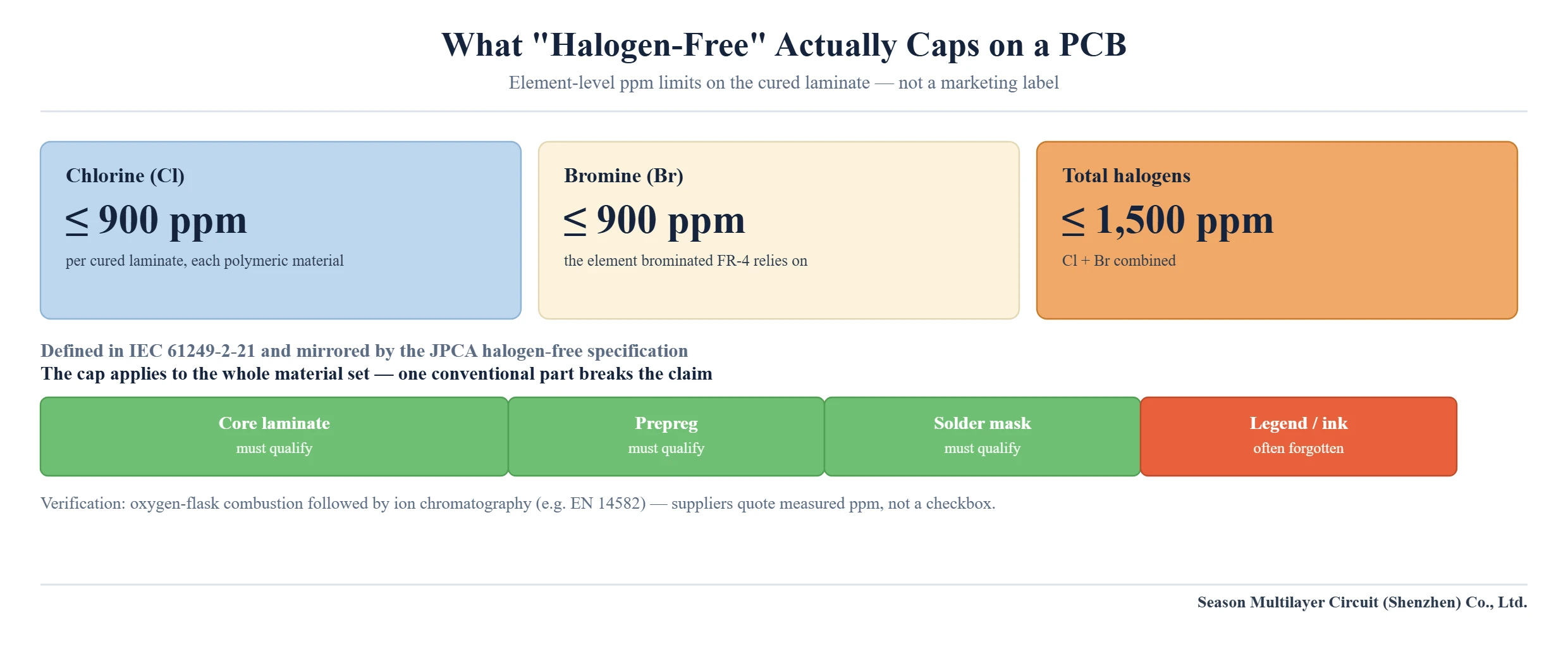
On a laminate data sheet, halogen-free is not a marketing label — it is a quantitative cap on chlorine and bromine content. The industry-standard limit, defined in IEC 61249-2-21 and mirrored in the JPCA halogen-free specification, allows no more than 900 ppm of chlorine, 900 ppm of bromine, and 1,500 ppm of halogens in total, measured on the cured material. Fluorine and iodine belong to the same chemical family but are not the practical concern; the capped elements are the two used in epoxy flame-retardant systems.
| Controlled element | Limit per IEC 61249-2-21 | How it is verified |
|---|---|---|
| Chlorine (Cl) | ≤ 900 ppm | Oxygen-flask combustion plus ion chromatography |
| Bromine (Br) | ≤ 900 ppm | Oxygen-flask combustion plus ion chromatography |
| Total halogens (Cl + Br) | ≤ 1,500 ppm | Sum of the two measured values |
Two details in that definition matter for purchasing. First, the cap applies to the resin system — core, prepreg and the solder mask must all qualify, not just the finished board taken as an average. Second, the number is verified analytically, most commonly by oxygen-flask combustion followed by ion chromatography (for example per EN 14582), which is why suppliers issue a laboratory test report rather than a self-declaration when you ask for evidence.
On a purchase document, the practical translation is simple: halogen-free means Cl and Br each below 900 ppm in every polymeric material of the stackup. A conventional brominated FR-4 grade runs several thousand ppm of bromine by design — roughly an order of magnitude above the cap — so the requirement genuinely changes the resin chemistry, not just the paperwork.
Why Halogen-Free PCB Requirements Exist
The driver is end-of-life chemistry. Brominated flame retardants work extremely well during the product’s service life, but in uncontrolled burning — landfill fires, informal recycling, open burning of electronic waste — brominated resins can release dioxins and furans, a class of persistent and toxic compounds. The same concern applies to chlorinated species. Regulators and large OEMs responded by pushing flame retardancy away from halogen chemistry, and customer standards followed.
It helps to separate the legal layer from the customer layer. RoHS restricts specific brominated flame retardants — PBB and PBDE — but it does not ban bromine as an element, and reactive tetrabromobisphenol-A in epoxy remains permitted. A board can be fully RoHS-compliant and still contain bromine. Halogen-free is therefore a stricter, customer-driven requirement that goes beyond regulation, and it typically arrives through green-procurement standards, corporate sustainability policies, or the expectations of the end market.
- A customer green-procurement standard that caps halogens explicitly, not only RoHS substances
- Products supplied to OEMs that enforce halogen-free across their entire supply base
- Equipment for enclosed or always-on environments where combustion toxicity is part of the risk assessment
- Corporate sustainability targets applied uniformly across product lines
None of these triggers cares which flame-retardant chemistry the laminate uses — they care about what happens at end of life. That framing is useful in negotiations, because it tells you the requirement rarely negotiates down to “a little less bromine”. Either the material qualifies or the claim does not exist.
How Halogen-Free Laminates Reach UL 94 V-0
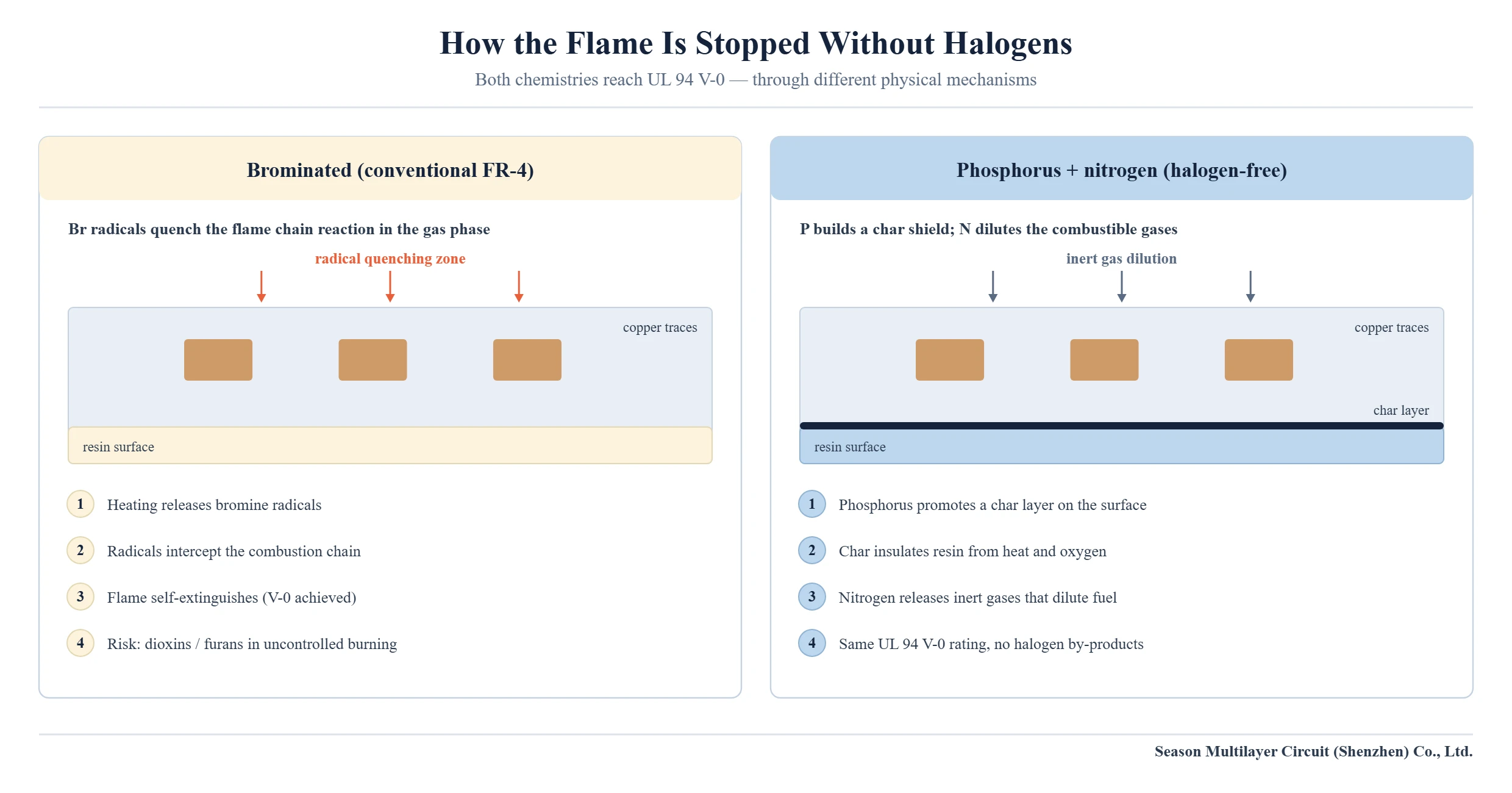
Removing bromine does not mean removing flame retardancy. Halogen-free laminates replace the halogen system with phosphorus- and nitrogen-based chemistry, and the two elements work through different physical mechanisms than bromine does.
- Phosphorus works mainly in the condensed phase: during heating it promotes char formation on the resin surface, which insulates the material underneath from heat and oxygen
- Nitrogen works mainly in the gas phase: it releases inert, non-flammable gases that dilute the combustible volatiles feeding the flame
- Together they reach UL 94 V-0 on standard laminate thicknesses — the same vertical-burn rating brominated FR-4 delivers, achieved without halogens
The practical consequence for buyers is reassurance rather than compromise: a halogen-free PCB still carries the UL 94 V-0 flame class, and our halogen-free FR-4 grade, S1150G with Tg ≥150 °C, is qualified on the same UL system as the brominated grades it replaces. The flame rating is not the trade-off — the process window is, as the next section explains. If you want the full datasheet treatment, our S1150G halogen-free laminate guide covers the grade in detail, and the S1170G Tg 170 laminate guide does the same for the higher-Tg halogen-free option.
What Changes on the Production Floor
From the fab’s side, a halogen-free PCB build changes several process windows. None of them are exotic, but all of them need to be set deliberately, which is why the requirement should be declared at quotation rather than discovered after drilling.
Lamination comes first: phosphorus-nitrogen resins flow and cure differently from brominated systems, so press temperature, pressure and dwell time are requalified on the halogen-free prepreg rather than copied from the brominated recipe. Drilling follows: the modified resin tends to be tougher, so feeds and speeds are tuned to protect the hole wall from excessive smear and burrs. Desmear and etch-back chemistries also need tighter time control, because the phosphorus-bearing resin can be more sensitive to over-treatment and show measling if the process runs long.
| Process step | What changes | Why it changes |
|---|---|---|
| Lamination | Press window requalified on the halogen-free prepreg | Different resin flow and cure behaviour |
| Drilling | Feeds and speeds tuned per grade | Tougher phosphorus-nitrogen resin; hole-wall quality |
| Desmear / etch-back | Tighter chemical treatment time control | Over-treatment can measle the resin surface |
| Solder mask | Dedicated halogen-free ink required | The mask must qualify together with the laminate |
One more point catches teams by surprise: the solder mask. If the laminate is halogen-free but the mask is a conventional brominated ink, the finished board no longer meets the requirement. A compliant build means the whole material set — core, prepreg and mask — qualifies. Mask suppliers now ship dedicated halogen-free inks that process almost identically to standard liquid photoimageable mask, so the cost of this step is qualification effort, not a capability gap.
Halogen-Free PCB Laminates vs Brominated FR-4
For most buyers the decision reduces to one comparison: what do you give up, and what do you pay, for the halogen-free version of a standard glass-epoxy build? The honest answer is that electrical performance is broadly comparable at mainstream speeds, and the differences concentrate in material premium and process qualification.
| Property | Brominated FR-4 | Halogen-free FR-4 (e.g. S1150G) |
|---|---|---|
| Flame rating | UL 94 V-0 | UL 94 V-0 — same system, phosphorus-nitrogen chemistry |
| Tg grades available | 150–180 °C range | Tg ≥150 °C (S1150G); Tg 170 (S1170G) |
| Electricals (Dk / Df) | Well characterised across vendors | Comparable at mainstream frequencies; confirm on the specific datasheet |
| Moisture absorption | Typically 0.08–0.10% | Comparable or slightly lower on phosphorus-nitrogen systems |
| Relative material cost | Baseline | Typically a low double-digit percentage premium |
| Stock availability | Standard stock | Qualified stock — declare at quotation |
A note on grades: the halogen-free FR-4 grade we run in volume, S1150G, carries Tg ≥150 °C and is detailed in the selection guide linked above, including its IPC-4101 slash-sheet and UL qualification. If your stackup was designed around a Tg 170 brominated grade, the equivalent halogen-free construction is chosen at engineering review rather than by dropping in a different core — dielectric thickness and resin content need to be re-checked against the new prepreg, not assumed. For a wider view of how grades sit together, see our laminate selection guide and the PCB materials and laminates overview.
When to Specify a Halogen-Free PCB
The requirement is sometimes applied by inertia — copied forward from an old specification into products where it buys nothing. The decision table below is how we recommend sorting a new build before the RFQ goes out.
| Situation | Specify halogen-free? | Rationale |
|---|---|---|
| Customer or OEM green-procurement standard names halogens | Yes — it is contractual | Non-compliance blocks qualification regardless of physics |
| Consumer or industrial product with no halogen clause | Optional | Standard brominated FR-4 is cheaper and fully RoHS-compliant |
| Product in a recycling-focused or ESG-led market | Usually yes | Market expectation has outpaced regulation |
| Enclosed, always-on or high-temperature equipment | Assess case by case | Combustion toxicity is a legitimate input; weigh against cost |
| Early prototype before a green standard is fixed | Hold off | Qualification effort is wasted if the standard changes |
If the table says yes, declare the requirement on the fabrication drawing and in the RFQ — one line naming the 900 / 1,500 ppm limits removes all ambiguity. If it says optional, resist copying the clause forward; halogen-free is a real material commitment, not a checkbox. Where the requirement does land, it lands most often on automotive programs: the 6-layer HDI automotive HUD PCB in our product line, for example, runs a halogen-free laminate end to end, and the same applies to our 4-layer automotive PCB builds specified by green-procurement standards.
Cost and Lead-Time Impact, Without the Hype
Two cost layers sit on top of a halogen-free PCB build, and neither is mysterious. The material premium is the visible one: phosphorus-nitrogen resin systems cost more than brominated epoxy, and the premium typically lands in the low double-digit percentage range at the laminate level. The finished-board impact is smaller than the raw-material number suggests, because laminate is only one slice of board cost — on a mainstream 4–6 layer build the price uplift is usually modest, and it shrinks further with good panel utilization.
The second layer is qualification. First builds on a halogen-free grade should expect one extra engineering-review cycle to lock the press window and drilling parameters, and small batches carry proportionally more of that fixed cost. Our standing guidance: commit to halogen-free when the requirement is contractual, and skip it when it is not — the premium buys compliance and end-of-life chemistry, not electrical performance. Exact figures are confirmed at engineering review once the stackup and volume are known.
How Buyers Verify Halogen-Free Compliance
Verification is where casual claims and real compliance separate. When we ship a halogen-free PCB build, the evidence package has three documents, and you should expect the same from any supplier you qualify. The IPC standards library is the reference point for the declaration format named below.
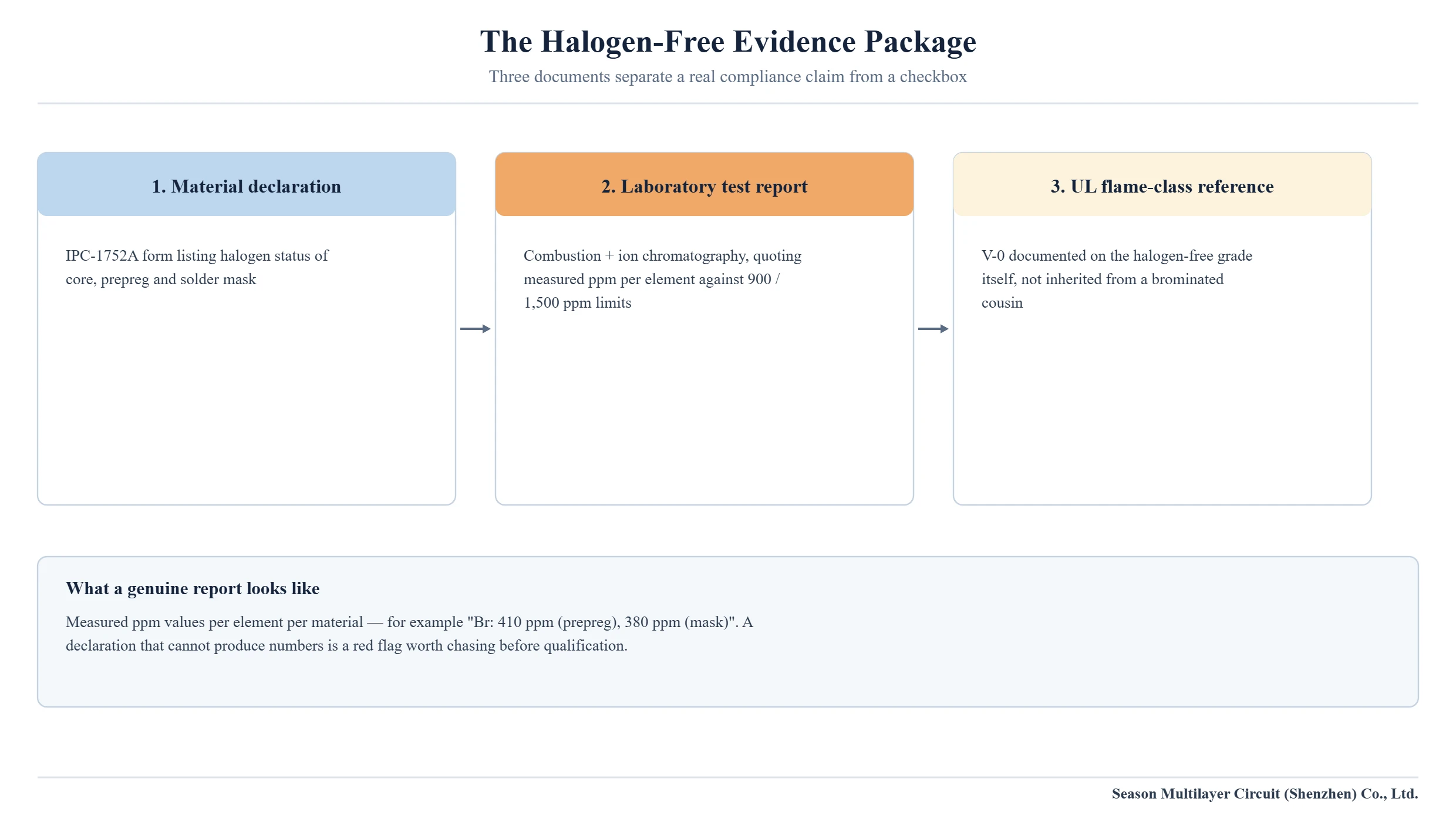
- A material declaration per IPC-1752A listing the halogen status of core, prepreg and solder mask
- A laboratory test report based on combustion and ion chromatography, quoting measured ppm values against the 900 / 1,500 ppm limits
- UL qualification references for the flame class, so V-0 is documented on the halogen-free grade itself
Ask for measured values, not just a “halogen-free: yes” checkbox. A genuine report quotes ppm numbers per element per material; a declaration that cannot produce one is a red flag worth chasing before qualification. The UL 94 flammability rating guide explains the V-0/V-1/V-2 ladder in detail, and UL Solutions maintains the public qualification database behind it.
Frequently Asked Questions
What does halogen-free mean on a PCB?
It caps chlorine at 900 ppm, bromine at 900 ppm, and total halogens at 1,500 ppm in the cured materials, per IEC 61249-2-21. The limit applies to the core laminate, the prepreg and the solder mask — one conventional component breaks the claim.
Is halogen-free the same as RoHS compliant?
No. RoHS restricts the brominated flame retardants PBB and PBDE but does not ban bromine as an element, so a brominated FR-4 board can be fully RoHS-compliant. Halogen-free is a stricter, customer-driven cap on the elements themselves.
Does halogen-free laminate still meet UL 94 V-0?
Yes. Halogen-free grades use phosphorus-nitrogen chemistry — phosphorus builds a protective char layer and nitrogen releases inert gases — and reach the same V-0 vertical-burn rating on standard laminate thicknesses.
How much more does a halogen-free PCB cost?
The laminate carries a low double-digit percentage material premium over brominated FR-4. The finished-board uplift is smaller on mainstream 4–6 layer builds because laminate is only one cost slice. Exact figures are confirmed at engineering review.
Which halogen-free laminate grades do you offer?
Our volume halogen-free FR-4 grade is S1150G with Tg ≥150 °C, and S1170G covers Tg 170 builds. Both are covered in dedicated selection guides on this site, alongside the brominated grades they replace.
Does the solder mask also need to be halogen-free?
Yes. A halogen-free laminate combined with a conventional brominated mask does not meet the requirement. Dedicated halogen-free mask inks process almost identically to standard liquid photoimageable mask.
How is halogen content tested?
Most commonly by oxygen-flask combustion followed by ion chromatography, for example per EN 14582, with the ppm result quoted per element per material. Ask suppliers for the measured values rather than a pass/fail checkbox.
Do halogen-free boards need special handling in assembly?
No special assembly handling is required — the finished board processes like any FR-4 build through SMT and reflow. The differences sit in board fabrication: lamination, drilling and mask qualification.
Get Your Halogen-Free Build Reviewed
If a drawing on your desk carries a halogen-free callout — or you are deciding whether to add one — send us the stackup and the requirement as written. Engineering review will confirm the grade, the process windows and the evidence package before anything is committed to production, and the PCB manufacturing services page lists what to include in an RFQ.
For builds where the requirement is optional, we will say so — the fastest way to a compliant, cost-effective stackup is to match the material commitment to the contract, not to the habit of the previous revision.
Tel: (+86) 18681528532 (WhatsApp)
E-mail: roc@season-pcb.com