Book Appointment Now

IATF 16949 Certified 4-Layer Automotive PCB Manufacturing
High-reliability 4-layer printed circuit boards engineered for automotive electronics. Built to withstand extreme thermal shock, heavy vibration, and harsh environments in EV, ADAS, and smart cockpit systems.
Every automotive PCB ships from an IATF 16949 certified facility using High-Tg, low-CTE laminates (Tg155/Tg170/Tg180) validated for −40°C to +125°C thermal cycling, vibration, and humidity. For tighter schedules, our fast PCB manufacturing services support expedited automotive builds.
✓ 5–7 Day Quick-Turn — IATF 16949 certified production line
✓ 1–100,000+ Pieces — from prototype validation to volume builds
✓ Free DFM Check — automotive-grade stackup and thermal review
✓ 24h Quotation — Gerber pricing within one business day
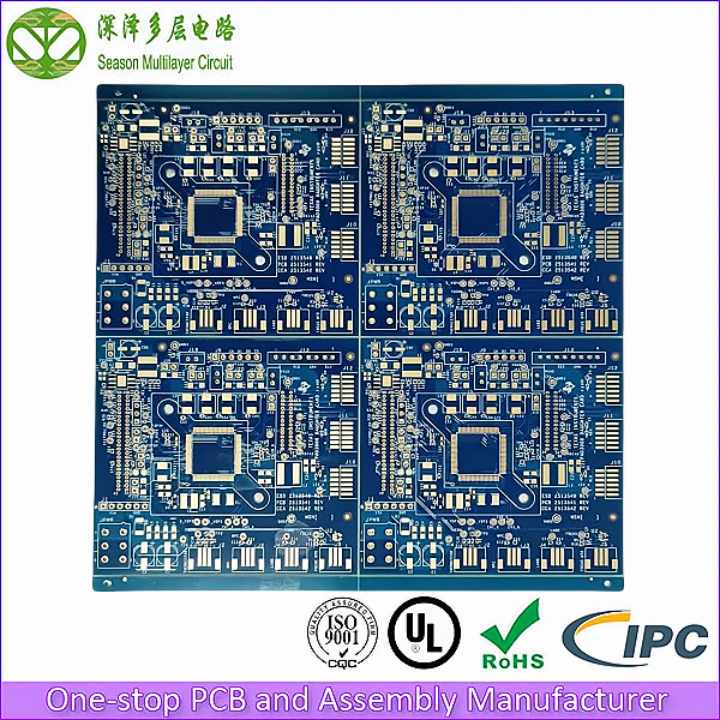
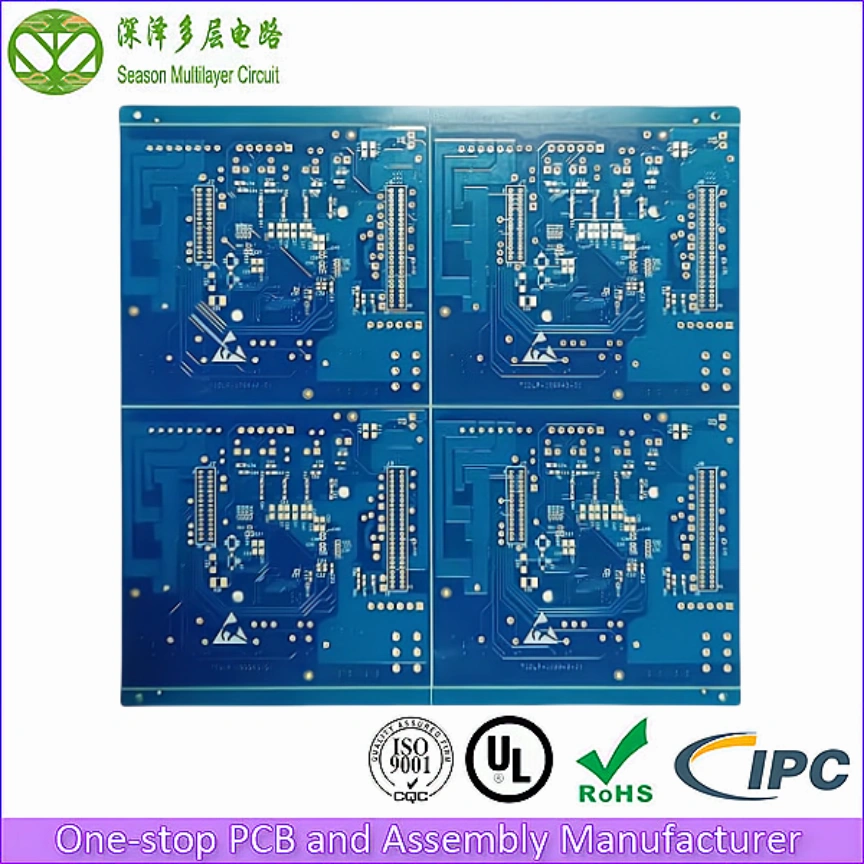
4
Layer Count
4/4 mil
Min. Trace / Space
0.20 mm
Min. Via Diameter
Tg 155
Glass Transition Temp
1-2 µ”
ENIG Gold Thickness
ISO9001-2004
ISO14001
UL (E305905)
IPC-Class 2/Class 3
IATF 16949
RoHS
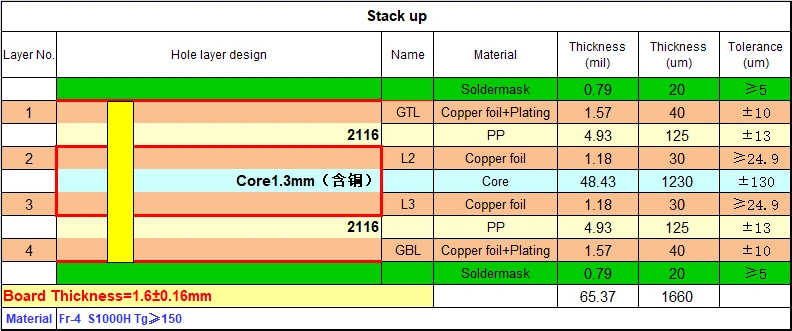
High-Reliability 4-Layer Automotive PCB Stackup
Engineered to meet stringent automotive standards (such as IATF 16949 and IPC-Class 3), proper layer ordering and strict impedance control are critical to ensure signal integrity and prevent electromagnetic interference (EMI) in harsh vehicle environments. Our standard 1.6mm thickness 4-layer automotive PCB stackup is optimized for thermal dissipation, mechanical robustness, and superior EMI shielding.
- Top Layer (Signal / High-Speed Components): Optimized for critical automotive component placement (MCUs, ADAS sensors, or EV powertrain controllers). This layer features high-speed differential pairs (e.g., CAN bus, Automotive Ethernet, Lin bus) and localized power routing.
- Layer 2 (Solid Ground Plane): A continuous, unbroken copper ground reference plane. This is vital for minimizing EMI, reducing cross-talk, and providing the shortest return path for high-speed signals.
- Layer 3 (Dedicated Power Plane): Split or solid power distribution layers catering to 5V, 3.3V, and core voltages for automotive processors, ensuring stable power delivery networks (PDN).
- Bottom Layer (Signal / Secondary Routing): Used for secondary signal routing, ground pours, and mounting non-critical discrete components.
Technical Capability & Specifications
| Parameter | Specification | Advanced Capabilities |
| Layer Count | 4Layer | 2-32L(Mass); 2-64L(Sample) |
| Base Material | Fr-4.0 S1000H Tg155 | SY, NY,TUC,ZY,EMC,KB,ITEQ, Rogers, Megtron , Nelco,Isola |
| Board Thickness | 1.6mm | 0.2-6.4mm(Mass);0.15-20mm(Sample) |
| Panel Size | 162.56*159.86mm/4 | 800*600mm(Mass);1050*610(Sample) |
| Copper Thickness | Outer: 1 OZ Inner: 1 OZ | Outer: 1/3-12 OZ Inner: 1/4-12 OZ |
| Min Drill Size | 0.2mm | 0.15mm(Mass);0.127mm(Sample) |
| Min Trace Width/Spacing | 4/4mil | 2.5/2.5mil(1OZ) 2/2mil(HOZ) |
| Min BGA Pad | No | 0.15mm |
| Surface Finish | ENIG1-2 µ” | OSP,ENIG,HASL,Electric Hard Gold, ENIG+OSP,ENEPIG,mmersion Silver & Tin |
| Solder Mask Color | Blue | Green, Blue,Black,White,Yellow,Red,Pruple, Matte Green,Matte Blue,Matte Black |
| Impedance Control | No | ±5% (Strict Tolerance) |
| Min Routing Tolerance | ±0.15mm | ±0.75mm |
| Quality Standard | IPC-Class 3,RoHS | IPC-Class 3,UL,Rohs,IATF16949,GJB |
| PCB Type | Multilayer | HDI,Multilayer,Rigid-Flex,High Frequency,High Speed,Hybrids & Mixed Dielectrics |
Robust 4-Layer PCBs for Next-Generation Vehicles
Modern automotive electronic control units (ECUs) demand flawless signal integrity and stable power distribution. A 4-layer automotive PCB stackup provides dedicated ground and power shielding layers, making it the most cost-effective and reliable choice for critical automotive components.
🚗
ADAS — Radar, LiDAR & Camera Modules
High-speed 4-layer layouts optimized for Advanced Driver Assistance Systems. Low signal loss, controlled impedance, and robust EMI shielding ensure reliable performance for radar, LiDAR, and automotive camera modules operating in real time.
⚡
EV Powertrain — BMS, OBC & Inverters
Heavy copper 4-layer boards (up to 12 oz) engineered for Battery Management Systems, on-board chargers, and traction inverters. Superior thermal management ensures safe operation under high continuous current loads in electric vehicles.
📱
Infotainment & Smart Cockpit
High-density 4-layer integration supporting Bluetooth, Wi-Fi, GPS, and complex processing chips. Dedicated ground plane eliminates EMI cross-talk, delivering crystal-clear audio/video and responsive touchscreen experiences.
🔧
Body Control Modules (BCM)
Highly durable PCBs for lighting control, power windows, central locking, and climate systems. Designed to survive continuous thermal stress — from cold starts at −40°C to engine-bay peaks at +150°C — without delamination.
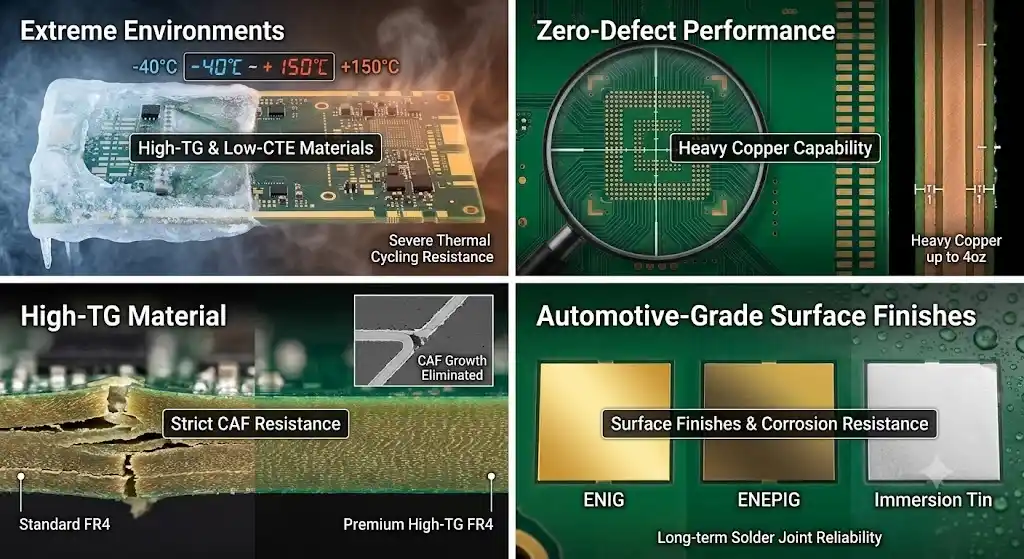
Engineered for Extreme Environments and Zero-Defect Performance
Automotive-grade PCBs demand more than standard manufacturing. Our material selection, process control, and testing protocols are purpose-built for the reliability requirements of automotive OEMs and Tier-1 suppliers.
🔥High-Tg & Low-CTE Materials
Premium High-Tg FR4 (Tg155 /Tg170 / Tg180) and halogen-free laminates from Shengyi, Rogers, Ventec, and others. Prevents delamination during severe thermal cycling from −40°C to +150°C and ensures long-term dimensional stability.
🔋Heavy Copper Capability — Up to 12 oz
Outer copper up to 12 oz and inner copper up to 12 oz to handle high currents in EV power electronics. Prevents overheating in DC-DC converters, traction inverters, and high-power distribution boards.
🛡️Automotive-Grade Surface Finishes
ENIG, ENEPIG, and Immersion Tin finishes ensure long-term solder joint reliability and prevent copper corrosion under exposure to humidity, salt spray, and aggressive automotive chemicals.
⚠️Strict CAF Resistance
Optimized resin-rich laminates combined with strict drill-to-copper spacing eliminate Conductive Anodic Filament (CAF) growth, preventing internal short circuits — a leading failure mode in high-humidity automotive environments.
Rigorous Automotive-Grade Testing and Quality Assurance
Every 4-layer automotive PCB undergoes a comprehensive quality validation process before shipment — from automated optical inspection to full PPAP documentation support.
100% AOI & Flying Probe / E-Test
Automated Optical Inspection at every production stage combined with complete electrical testing eliminates any potential open or short circuits before boards leave our facility.
Thermal Shock Testing
Simulates real-world vehicle environments — rapid temperature swings between extreme cold and engine-bay heat — to verify the integrity of via connections and laminate layers under thermal cycling stress.
X-Ray Plating Thickness Measurement
Precise, non-destructive measurement of ENIG gold and nickel plating thickness on every production lot to guarantee flawless soldering and long-term connection reliability.
Solderability & Peel Strength Testing
Verifies copper adhesion strength and terminal reliability under mechanical vibration — critical for solder joints that must survive years of vehicle operation on rough terrain.
PPAP Level 3 Documentation Support
Full Production Part Approval Process documentation package provided for automotive OEM qualification — including process flow diagrams, FMEA, control plans, and measurement system analysis.
Season PCB is your trusted automotive PCB manufacturer with IATF 16949 certification. Our automotive PCB products meet AEC-Q200 standards for temperature resistance and reliability. Each automotive PCB undergoes rigorous testing for automotive applications. For vehicle electronics destined for Canada, our guide to cUL certified PCB requirements covers the additional safety recognition Canadian buyers ask for.
For reliable automotive PCB manufacturing, contact Season PCB. We provide automotive PCB solutions with fast turnaround and competitive pricing.
Our automotive PCB manufacturing follows IATF 16949 automotive quality standards and AEC-Q200 reliability specifications. Each automotive PCB is tested for thermal cycling, vibration resistance, and long-term durability.
Frequently Asked Questions
Q1: Why is IATF 16949 certification mandatory for automotive PCB manufacturing?
A: IATF 16949 is a strict global quality management standard for the automotive supply chain. It focuses on defect prevention, reduction of variation, and waste management. Manufacturing automotive PCBs in an IATF 16949 certified facility guarantees that the boards meet the safety and reliability requirements of modern vehicles.
Q2: How does Season PCB prevent CAF (Conductive Anodic Filament) in 4-layer automotive boards?
A: CAF prevention is a multi-layer strategy: we use CAF-resistant base materials with high resin content, optimize both laser and mechanical drilling parameters to avoid micro-cracks in the fiberglass substrate, and enforce strict internal copper-to-hole spacing rules. These measures together eliminate the electrochemical migration pathway that causes internal short circuits in high-humidity, high-bias automotive environments.
Q3: Do you provide controlled impedance for 4-layer automotive PCBs?
Yes. For designs that require precise impedance control — such as high-speed CAN FD, Automotive Ethernet (100BASE-T1 / 1000BASE-T1), or SerDes links for cameras — we offer controlled impedance with ±5% strict tolerance. Our engineering team performs pre-production impedance simulations using Polar or Si8000 tools and validates results with TDR testing on finished boards.
Partner with an Experienced Automotive PCB Manufacturer
Upload your Gerber files and receive a professional DFM review and competitive quotation within 24 hours. Our engineering team evaluates every design for manufacturability, cost optimization, and automotive compliance before quoting.