Book Appointment Now

What the S1190 laminate is for, what its official datasheet promises, and when an inner heavy copper or 24-layer build actually needs it.
S1190 Laminate: Datasheet Specs, Heavy Copper and 24-Layer Use
Most FR-4 selection guides stop at Tg, and that is exactly where they mislead. If your stackup needs inner layers at 2 oz or heavier, or the build has grown past 24 layers, the question stops being “what Tg do I need” and becomes “which resin system survives dense via fields, repeated solder-dip excursions and high aspect-ratio drilling”. The S1190 laminate is Shengyi’s answer to that corner of the design space, and its datasheet says so explicitly: special for inner heavy copper or over 24-layer multilayer boards.
This guide walks through the official published values — Tg, Td, T288, Z-axis CTE, Dk and Df — explains what each one means for a 24-layer-plus build, and maps out when S1190 is genuinely the right grade and when a cheaper S1000-family sibling does the same job. Every number below comes from the Shengyi datasheet, not from marketing copy.
Table of Contents
- What the S1190 Laminate Is and How It Is Positioned
- S1190 Laminate Thermal Properties: Tg, Td and Delamination Times
- Electrical Properties: Dk 4.6, Df 0.015 and Insulation Values
- Anti-CAF Capability and Through-Hole Reliability
- Where S1190 Makes Sense: Inner Heavy Copper and 24-Layer Builds
- Matching S1190B Prepreg: Glass Styles and Cured Thickness
- Pressing Cycle, Storage and Assembly Behavior
- S1190 vs Other Shengyi FR-4 Grades: A Selection Table
- A DFM Checklist Before You Specify S1190
- FAQ
- Get an S1190 Stackup Review Before You Commit
What the S1190 Laminate Is and How It Is Positioned
S1190 is a glass-reinforced epoxy laminate from Shengyi Technology, UL-recognised under ANSI FR-4.0 and listed against the IPC-4101/126 specification sheet. Unlike the general-purpose grades that share the S1000 family tree, its datasheet names a specific territory: anti-CAF capability, excellent thermal reliability and excellent through-hole reliability, aimed at inner heavy copper or multilayer builds of 24 layers and above.
In practice it ships as a matched system with S1190B bonding prepreg, copper foil options from 12 µm to 105 µm, and standard sheet sizes including 1,020 × 1,220 mm and 915 × 1,220 mm. If you are mapping the family, it sits alongside the grades we have already profiled in our PCB materials and laminates guide — same base chemistry as a ruggedised FR-4, but tuned for reliability stress rather than for speed or for green credentials.
One caution for buyers: S1190 is not a low-loss or high-speed grade, and Shengyi does not claim it is. Its dissipation factor at 1 GHz is ordinary FR-4 territory, which we cover in the electrical section below. Choosing it because “it sounds more advanced” is the most common way to overspend; the decision belongs to the copper weight and the layer count.
S1190 Laminate Thermal Properties: Tg, Td and Delamination Times
The datasheet reports Tg at 170 °C by TMA and 200 °C by DMA. Td, the 5%-weight-loss decomposition point, is 350 °C — comfortably above any lead-free reflow profile. What separates this grade from ordinary Tg 170 material is what happens after repeated thermal excursions: 45 minutes at T288, more than 60 minutes at T260, and a solder-dip thermal stress test at 288 °C that it survives beyond 100 seconds without delamination.
| Property | Test method | Condition | Unit | Typical value |
|---|---|---|---|---|
| Tg | IPC-TM-650 2.4.24 | TMA | °C | 170 |
| Tg | IPC-TM-650 2.4.24.4 | DMA | °C | 200 |
| Td (5% wt loss) | IPC-TM-650 2.4.24.6 | TGA | °C | 350 |
| T288 | IPC-TM-650 2.4.24.1 | TMA | min | 45 |
| T260 | IPC-TM-650 2.4.24.1 | TMA | min | >60 |
| Thermal stress | IPC-TM-650 2.4.13.1 | 288 °C solder dip | s | >100 |
| Z-CTE before Tg | IPC-TM-650 2.4.24 | — | ppm/°C | 45 |
| Z-CTE after Tg | IPC-TM-650 2.4.24 | — | ppm/°C | 210 |
| Z-CTE 50–260 °C | IPC-TM-650 2.4.24 | — | % | 2.3 |
Read those numbers as a package. Z-axis expansion of 2.3% across the whole 50–260 °C range, combined with the 45-minute T288 figure, is what protects plated through-holes on a 24-layer build: the copper barrel is stretched once per reflow cycle, and low total expansion plus a long delamination runway is what stops barrel fatigue turning into field failures. All of these values are measured with IPC-TM-650 test methods, so they can be verified coupon-by-coupon rather than taken on trust.
Electrical Properties: Dk 4.6, Df 0.015 and Insulation Values
Electrically, S1190 behaves like a well-filled FR-4: Dk 4.6 and Df 0.015 at 1 GHz (4.8 and 0.009 at 1 MHz in the datasheet’s extended table). That is deliberately not exotic. The grade exists to survive thermal and CAF stress, not to hit a loss budget on a 28 Gbps serial link — if your constraint is insertion loss, you belong on a dedicated low-loss laminate, not here.
| Property | Condition | Unit | Typical value |
|---|---|---|---|
| Permittivity (Dk) | 1 GHz | — | 4.6 |
| Permittivity (Dk) | 1 MHz | — | 4.8 |
| Loss tangent (Df) | 1 GHz | — | 0.015 |
| Loss tangent (Df) | 1 MHz | — | 0.009 |
| Volume resistivity | C-96/35/90 | MΩ·cm | 2.5 × 10⁸ |
| Surface resistivity | C-96/35/90 | MΩ | 3.3 × 10⁷ |
| Arc resistance | D-48/50+D-0.5/23 | s | 146 |
| Dielectric breakdown | D-48/50+D-0.5/23 | kV | >45 |
| Water absorption | D-24/23 | % | 0.07 |
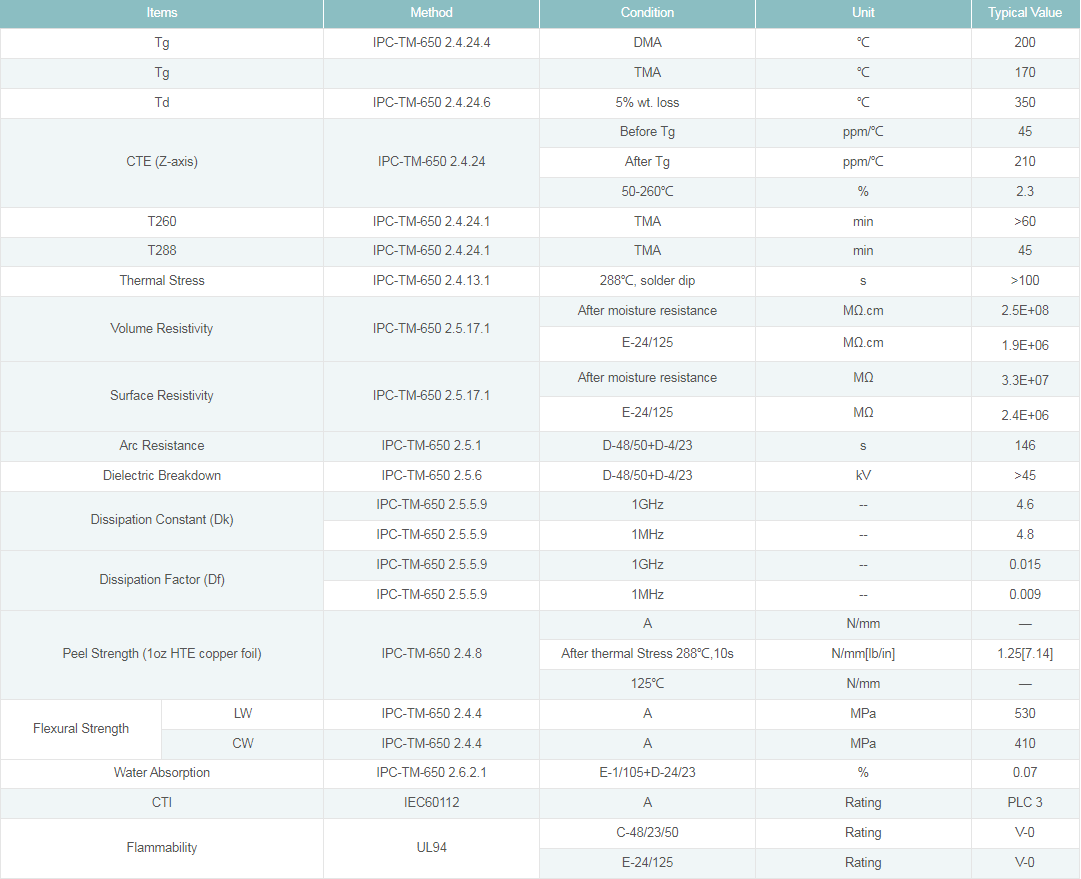
Two rows in this table matter more than they look. Water absorption of 0.07% keeps the dielectric stable in humid operating environments — important because CAF growth is accelerated by moisture under bias. And the dielectric breakdown above 45 kV gives headroom for backplane-style builds where power and signal layers stack up over many planes.
Anti-CAF Capability and Through-Hole Reliability
CAF — conductive anodic filament — is a copper migration mechanism that grows along the glass/resin interface under bias and humidity. Dense via fields, tightly spaced hole-to-hole clearances and thick-copper inner layers all raise the risk: more copper, more interfaces, and more mechanical stress opening micro-gaps for the filament to travel along. On a 24-layer board the failure shows up as an intermittent short between neighbouring vias, typically months after deployment.
Shengyi counters this at the resin level — the anti-CAF designation means the resin system wets and bonds the glass cloth tightly enough to close those migration paths. The datasheet pairs the claim with a peel-strength figure of 1.25 N/mm (7.14 lb/in) for 1 oz foil measured after thermal stress at 288 °C, which is the practical proof that adhesion survives reflow rather than degrading after it.
For the buyer, the takeaway is simple: on builds under roughly 16 layers with standard copper weights, anti-CAF resin is insurance you may not need. On 24-layer-plus boards or anything with 2 oz inner layers, it is the single most relevant line in the datasheet.
Where S1190 Makes Sense: Inner Heavy Copper and 24-Layer Builds
Two scenarios justify the grade. First, inner layers at 2 oz or heavier: thick copper changes the thermal mechanics of a board, holding heat longer and pulling on the surrounding dielectric as it expands. Our heavy copper PCB design rules cover the current-carrying side; the material side is exactly what S1190’s resin system was tuned for.
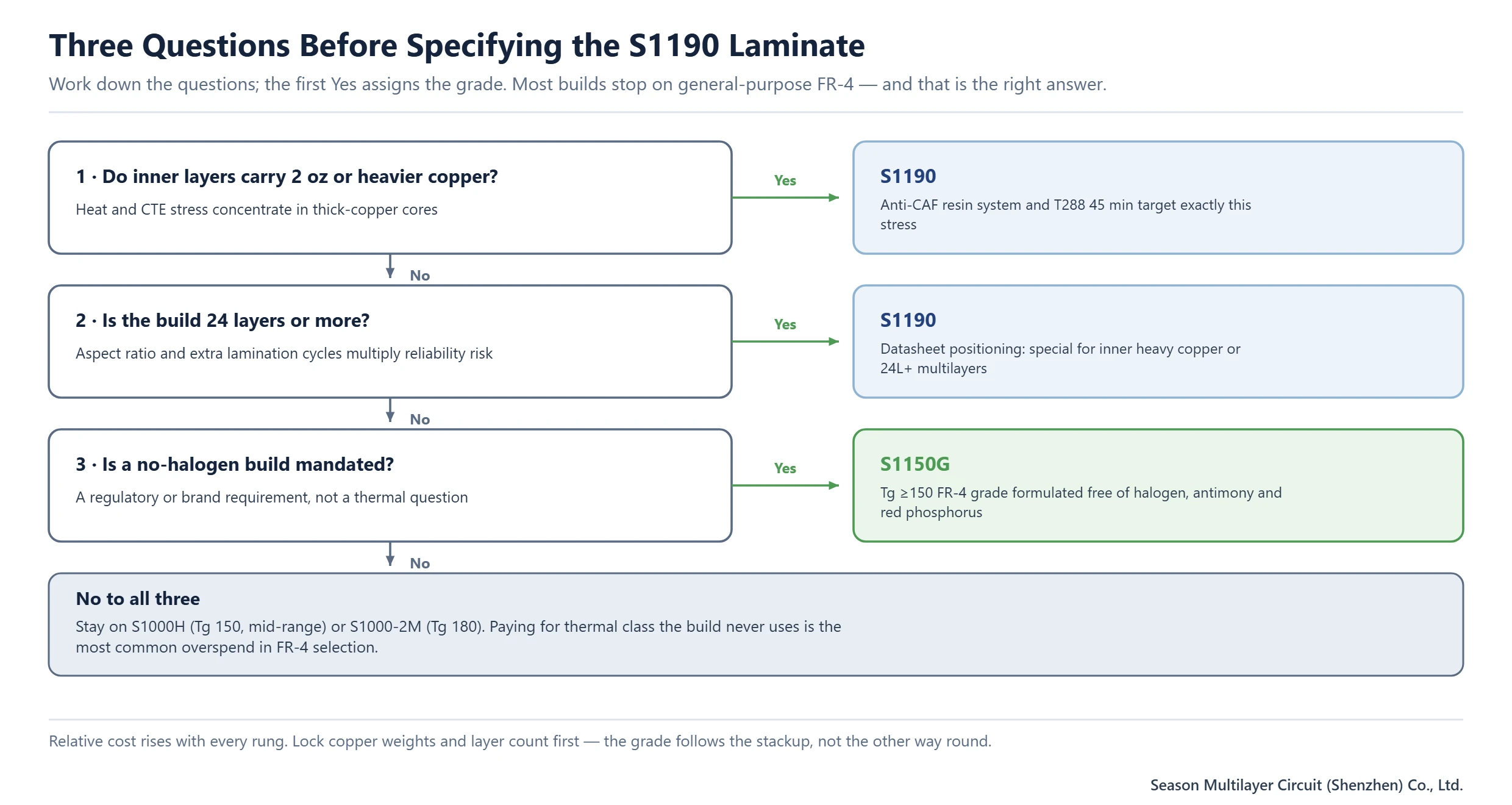
Second, layer counts of 24 and above. High layer counts multiply the number of lamination interfaces, push aspect ratios up, and mean more reflow exposures before the assembly is finished. The datasheet’s “over 24L” positioning is a direct answer to that stack of risks — through-hole reliability, not raw thermal class, is the differentiator.
Everything else in FR-4 selection — green mandates, general Tg headroom, cost — belongs to the sibling grades. Work the three questions in the diagram above in order; the first yes assigns the material, and if all three come back no, staying on a general grade is the correct engineering answer, not a compromise.
Matching S1190B Prepreg: Glass Styles and Cured Thickness
S1190 pairs with the S1190B prepreg line. The datasheet publishes seven glass-style options, which is enough to fill stackups from thin signal dielectrics to thick power-plane separations without leaving the resin system — an underrated detail, because mixing prepreg families inside one stackup reintroduces the kind of interface risk the grade is meant to remove.
| Glass fabric | Resin content (%) | Cured thickness (mm) |
|---|---|---|
| 106 | 72 | 0.050 |
| 76 | 72 | 0.060 |
| 1080 | 64 | 0.075 |
| 68 | 64 | 0.086 |
| 3313 | 56 | 0.100 |
| 2116 | 50 | 0.110 |
| 2116 | 56 | 0.125 |
The 106 and 76 styles with 72% resin content are the laser-fill workhorses for thin dielectrics; the 2116 options at 0.110–0.125 mm cover mainstream power/signal separation. Other resin contents and cloth types are available on request, so exotic stackups should be raised with the fabricator’s engineering team before the design freezes. For how these layers behave under heat and pressure, see our PCB lamination process guide.
Pressing Cycle, Storage and Assembly Behavior
The datasheet’s hot-pressing cycle calls for a cure of more than 90 minutes at 190–200 °C, with the heat-up rate set according to the inner copper weight and the stackup structure. Thick-copper cores need slower ramps — they act as heat sinks during press and can leave under-cured resin if the profile treats them like ordinary 1 oz builds. That is a fab-side parameter, but it is worth knowing so you can sanity-check a supplier’s press recipe.
Prepreg storage matters more than most buyers expect: three months at under 23 °C and 50% relative humidity, six months refrigerated at under 5 °C, with at least four hours of room-temperature normalisation before opening the bag. Moisture-absorbed prepreg loses bonding strength, and no post-press fix recovers it. Ask how your fabricator rotates prepreg stock if a build will sit between prototypes and production.
On the assembly line, the T288 and thermal-stress numbers from the thermal table are what buy margin: multiple lead-free reflow passes, selective soldering, and rework all draw on the same 45-minute reserve. The grade does not make poor thermal profiles safe, but it survives the realistic ones.
S1190 vs Other Shengyi FR-4 Grades: A Selection Table
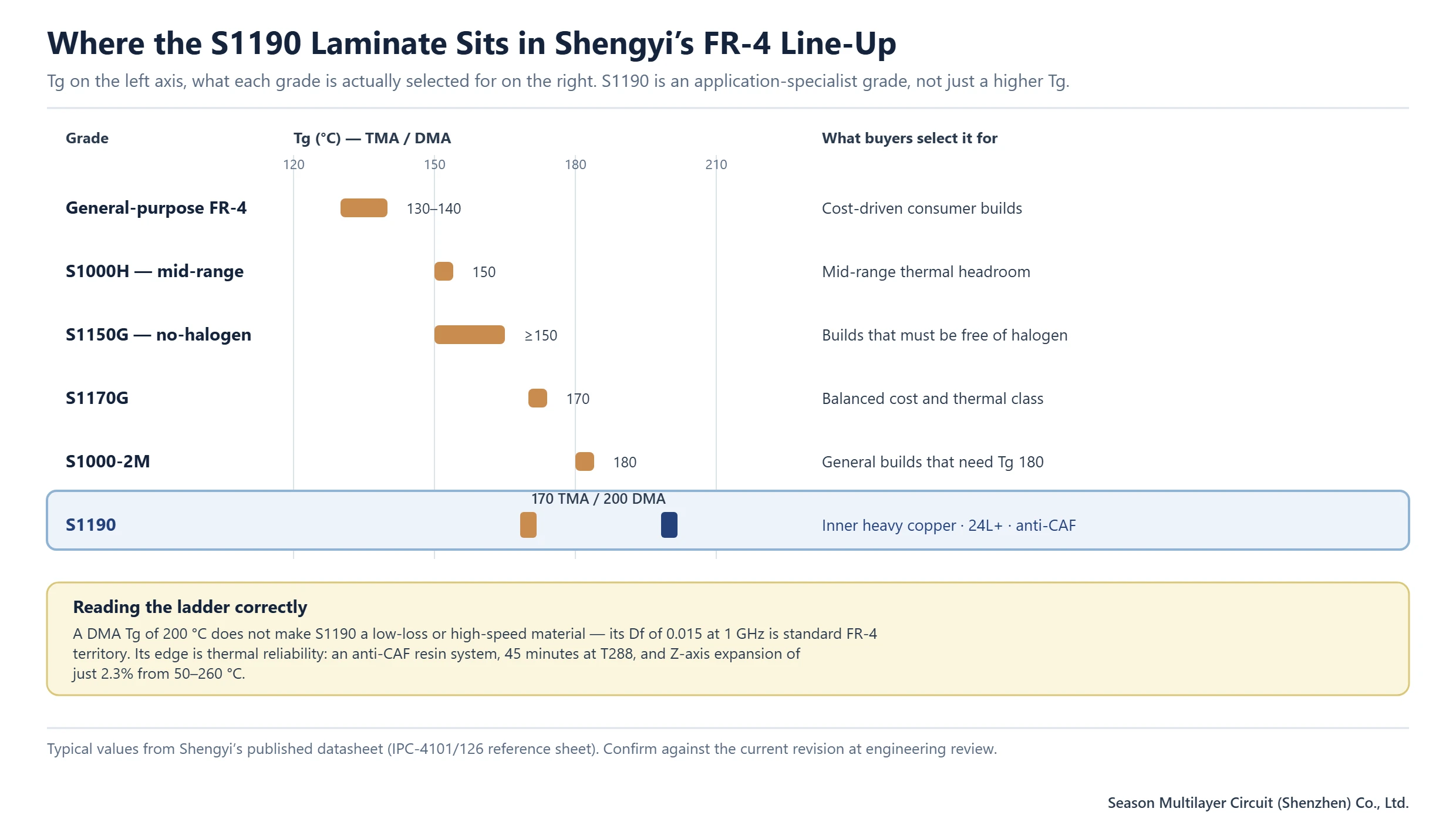
The S1190 laminate sits at the reliability end of a family we have profiled grade by grade. The table below lines them up on the axis that actually differs — what each was formulated to do — rather than on Tg alone, because two of these grades share a Tg class while serving opposite jobs.
| Grade | Tg (°C) | Formulation focus | Select it for |
|---|---|---|---|
| S1000H | 150 (mid-range) | Balanced general FR-4 | Mid-range builds needing modest thermal headroom |
| S1150G | ≥150 | Formulated free of halogen, antimony and red phosphorus | Builds with environmental or brand mandates |
| S1170G | 170 | Cost-balanced thermal class | Mainstream builds past Tg 150 |
| S1000-2M | 180 | Higher thermal class, general purpose | General builds needing Tg 180 |
| S1190 | 170 TMA / 200 DMA | Anti-CAF, thermal and through-hole reliability | Inner heavy copper · 24-layer-and-above builds |
Detailed profiles of the siblings are in our guides to the S1000H mid-range grade, the S1000-2M Tg 180 material, the S1170G Tg 170 laminate and the S1150G no-halogen option. Note that S1190’s DMA Tg of 200 °C does not outrank S1000-2M in the table — TMA and DMA measure differently, and the grades are separated by application, not by a thermal-class race.
A DFM Checklist Before You Specify S1190
Run this list before locking the grade into the drawing. It is short on purpose — each item either confirms the case for S1190 or kills it early, which is cheaper than discovering the mismatch after the stackup is frozen.
- Confirm inner-layer copper weights: 2 oz or heavier on any core is the primary trigger for the grade.
- Confirm the layer count is genuinely 24 or more — a 14-layer board gains nothing from anti-CAF resin it will never stress.
- Verify hole-to-hole clearances in dense via fields; if clearances are already generous, the CAF argument weakens.
- Fix the prepreg map early: choose S1190B glass styles from the datasheet table rather than defaulting to a mixed-prepreg stackup.
- Agree the press profile (cure above 90 minutes at 190–200 °C, ramp matched to copper weight) at engineering review.
- Plan coupon testing: T288 and thermal-stress verification per the IPC-TM-650 methods cited in the datasheet.
- Check prepreg freshness and storage conditions if the build will be split across prototype and production runs.
Items 1 and 2 settle most debates. If both pass, the grade earns its cost; if neither does, the honest answer is that a cheaper sibling will deliver the same field performance — and a fabricator who tells you that before you ask is worth keeping.
Frequently Asked Questions
What is the S1190 laminate used for?
Shengyi positions it for two specific jobs: inner layers with heavy copper (2 oz and above) and multilayer builds of 24 layers or more. Its anti-CAF resin system and through-hole reliability margins target the failure modes those builds face — filament growth in dense via fields and barrel fatigue from repeated thermal cycles.
What is the Tg of the S1190 laminate?
The datasheet lists Tg 170 °C by TMA and 200 °C by DMA. The two methods measure differently, so quote the method alongside the number in drawings and specifications. Decomposition temperature Td is 350 °C, well above any lead-free reflow profile.
Is S1190 a low-loss material for high-speed designs?
No. Df is 0.015 at 1 GHz — standard FR-4 territory. The grade optimises thermal and CAF reliability, not insertion loss. High-speed builds with a loss budget should specify a dedicated low-loss laminate and treat S1190 as the wrong tool for that requirement.
How does S1190 differ from S1000-2M?
S1000-2M is a general-purpose Tg 180 grade; S1190 is an application specialist with an anti-CAF resin system, 45-minute T288 and heavy-copper/24-layer positioning. On a 24-layer board with 2 oz inner copper, S1190’s margins matter; on an 8-layer general build, S1000-2M delivers the same field performance for less.
Which prepreg is used with S1190?
The S1190B prepreg line, published in seven glass styles: 106 and 76 at 72% resin content, 1080 and 68 at 64%, and 3313 and 2116 at 56–50%. Cured thicknesses run from 0.050 mm to 0.125 mm. Other resin contents and cloth types are available on request from Shengyi.
Can S1190 handle lead-free assembly?
Yes — that is the point of its thermal margins: T288 of 45 minutes, T260 beyond 60 minutes, and survival beyond 100 seconds in the 288 °C solder-dip stress test. Those figures cover multiple reflow passes, selective soldering and rework, though they do not excuse an abusive thermal profile.
Does Season Multilayer Circuit fabricate with S1190?
We build 2–30-layer production boards and regularly work with the Shengyi FR-4 family, including S1190 with its matched S1190B prepreg. Send your Gerber package and stackup and our engineering team will confirm material fit, press parameters and coupon testing at the DFM review stage.
Get an S1190 Stackup Review Before You Commit
Send your Gerber package and stackup drawing, and we will run the copper-weight and layer-count checks from this guide against your actual build — including whether S1190 is genuinely the right grade, or whether a sibling delivers the same reliability for less. Start from our PCB manufacturing services page, and you will have an engineering-reviewed answer before you lock the drawing.