Book Appointment Now

What does cUL certified mean for a PCB? Compare cUL, cULus and CSA, check UL 94 V-0 and IPC-A-600M criteria, and get a compliant build for Canada.
What Is cUL Certified? A cUL / cULus PCB Certification Guide for Engineers and Buyers
For hardware engineers and PCB buyers, the hardest part is rarely the design itself. It is having a finished shipment rejected in Canada by a customer or an electrical inspector. The cause is often simple: the board carries only a US UL mark, with no Canadian recognition. cUL certified is not a “higher grade” of UL. It is a separate certification result, issued by the same organization, for the Canadian market.
This guide to cUL certified boards is written for R&D and procurement teams working on automotive electronics, industrial control and communications equipment. It clarifies the boundaries between cUL, cULus and CSA, explains what UL 94 V-0 flammability ratings and IPC-A-600M acceptance criteria actually do inside a certification, and gives you a selection and design checklist you can apply directly.
After reading it you should be able to decide whether your product needs cUL or cULus, ask a fabricator for the right certification documents at quotation stage, and avoid rework and delays caused by a certification scope mismatch.
Table of Contents
1. cUL Certified Basics: What the Mark Actually Covers
1.1 cUL, UL and cULus: Same Body, Different Markets

cUL certification is the Canadian counterpart of UL certification and the origin of the cUL certified mark. cUL is the mark UL Solutions issues for the Canadian market, and the leading “c” stands for Canada. A product that passes cUL certification has been tested and evaluated against Canadian national standards, primarily the CSA standards series.
One common misconception about the cUL certified mark deserves attention. The ordinary UL mark without the “c” prefix covers the United States only and has no legal standing in Canada. Provincial electrical inspection authorities will not accept a product that carries only the US UL mark. If you are more familiar with the US-side process, start with our guide to what UL certification means for PCBs.
When a single certification covers both Canadian and US requirements, the mark is written cULus. It is the most economical option for a cUL certified PCB shipping into North America: one evaluation, two markets, with no duplicate sampling or factory audits.
1.2 Who Can Issue the Mark: SCC-Accredited Certification Bodies
The legal validity of a cUL certified board in Canada depends on whether the issuing body is accredited by the Standards Council of Canada (SCC). Only marks from SCC-accredited bodies are recognized by provincial authorities having jurisdiction (AHJs).
UL Solutions, CSA Group and Intertek are all SCC-accredited certification bodies, and their marks are legally equivalent for a cUL certified board. There is therefore no basis for the claim that “CSA is more authoritative than cUL”. The difference comes down to customer or retail-channel preference.
Canadian electrical safety requirements for a cUL certified board are enforced through provincial regulations, built on the Canadian Electrical Code CSA C22.1:24 (26th edition, published March 2024). Adoption dates vary by province. Ontario, for example, brought the 2024 code with provincial amendments into force on 1 May 2025.
1.3 Why PCBs Are Recognized Components, Not Listed Products
A bare board is not a complete end product, so a cUL certified PCB is normally certified as Recognized Components. The corresponding US standard is UL 796 (Printed Wiring Boards, 12th edition, 2022). Flexible and rigid-flex constructions fall under UL 796F.
In a cUL certified PCB programme, the difference between component recognition and end-product listing lies in where responsibility sits. The board shop guarantees that the laminate system and construction stay within the certified scope. The OEM then uses those recognized components to obtain cUL or cULus listing for the finished device, which lowers the testing burden for the end product.
For a cUL certified PCB, procurement must confirm two things at quotation stage: the scope the factory actually holds, and whether your specific stack-up falls inside that scope. A factory with a certificate does not make your board compliant if the board sits outside its scope.
Key distinction: like the UL mark, the cUL certified mark is a safety certification, not a quality mark. It confirms evaluation to Canadian safety standards. It does not grade performance attributes such as impedance consistency, yield or workmanship.
2. Key Parameters Behind a cUL Certified PCB
2.1 Laminate Flammability: What UL 94 V-0 Actually Means
UL 94 is the flammability test standard for plastic materials (6th edition, revised 2021), published by UL and applied to every cUL certified PCB laminate. Its test approach aligns with IEC 60695-11-10 and ASTM D3801. It evaluates the burning behaviour of the material itself under a small flame, not the performance of the finished board.
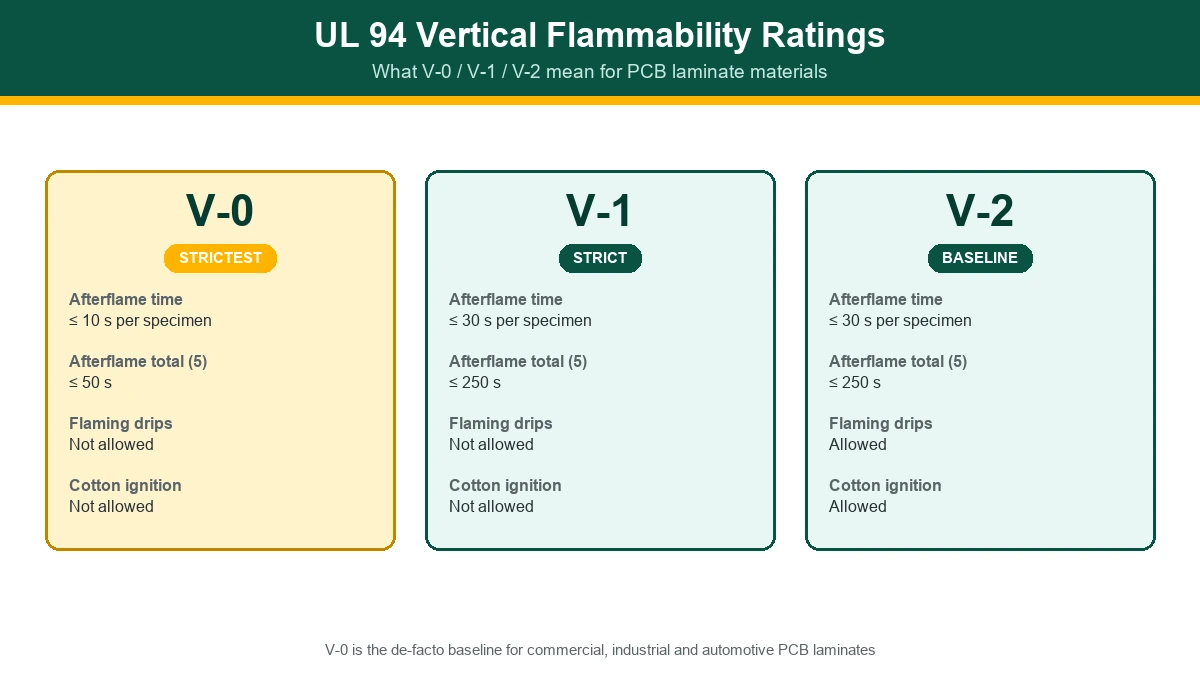
For a cUL certified PCB, a UL 94 V-0 flame retardant laminate is effectively the default threshold. The V-0 criteria include three conditions: after the flame is removed, individual specimens must self-extinguish within 10 seconds; total afterflame time for five specimens must not exceed 50 seconds; and no dripping that ignites the cotton below is permitted.
For a cUL certified PCB, V-1 relaxes this to 30 seconds per specimen and 250 seconds in total, still with no igniting drips. V-2 shares the V-1 time limits but permits drips that ignite the cotton. That is why automotive electronics and industrial power supplies, where the consequences of failure are severe, state V-0 directly in the specification rather than leaving the choice to the supplier.
2.2 Thermal Parameters: Tg, MOT and RTI Are Not Interchangeable
Tg (glass transition temperature) describes the range in which a laminate shifts from a rigid to a rubbery state. It is a material selection parameter for a cUL certified PCB, not a safety certification parameter. The “Tg 150” or “Tg 170” figures used in engineering refer to the order of magnitude of a laminate’s glass transition temperature.
What actually enters the cUL certified file is MOT (maximum operating temperature) and RTI (relative thermal index). RTI is assigned by the certification body from long-term thermal ageing data, and it represents the temperature at which the material can be used long term without significant degradation.
For a cUL certified PCB, the three cannot substitute for one another. A high Tg does not imply a high RTI, and customer audits look at the MOT and RTI values on the yellow card, not the Tg figure on a supplier’s marketing page. This is a frequent trap in design reviews.
2.3 Electrical and Structural Acceptance: IPC-A-600M and IPC-6012F
Certification answers “can this be sold”. Acceptance standards answer “can this lot be accepted”. Requiring a cUL certified PCB to meet IPC-A-600 is essentially a decision to write acceptability criteria into the purchase order and quality agreement. The clause text can be consulted in the IPC standards catalogue.
IPC-A-600M is the illustrated guide to bare board acceptability for a cUL certified PCB, published in May 2025 and superseding IPC-A-600K (July 2020). It defines externally and internally observable acceptance criteria using target, acceptable and nonconforming condition photographs.
A cUL certified PCB is supported by the performance specifications IPC-6012F for rigid boards and IPC-6013E for flexible and rigid-flex boards. IPC-A-600M criteria are synchronized with the acceptance requirements in those specifications, so procurement documents should state both the standard number and the revision.
Product class must also be stated for a cUL certified PCB. Class 1 covers general electronic products, Class 2 covers commercial and industrial control equipment, and Class 3 applies where failure has severe consequences. Class directly determines the acceptance limits for annular ring, plating and internal defects, and it directly affects price and lead time.
2.4 Surface Finish and Thermal Stress Validation
Surface finish on a cUL certified PCB affects solderability and long-term reliability. ENIG (electroless nickel immersion gold) is common in fine-pitch and BGA applications. Nickel and gold thickness should be specified in the purchase specification to avoid black pad risk.
Certification bodies are sensitive to temperature changes in cUL certified PCB manufacturing. Thermal stress testing under UL 796 is typically evaluated around the 260 °C lead-free reflow range. If a process change pushes board surface temperature or lamination conditions beyond what was recorded at certification, re-validation is often required.
The cUL certified PCB production route should therefore be fixed at the prototype stage. Prototyping with one process and switching to another for volume production is a common reason certification files need re-evaluation, and it puts lead times at risk as well.
2.5 Manufacturing Boundaries and Real Build Parameters
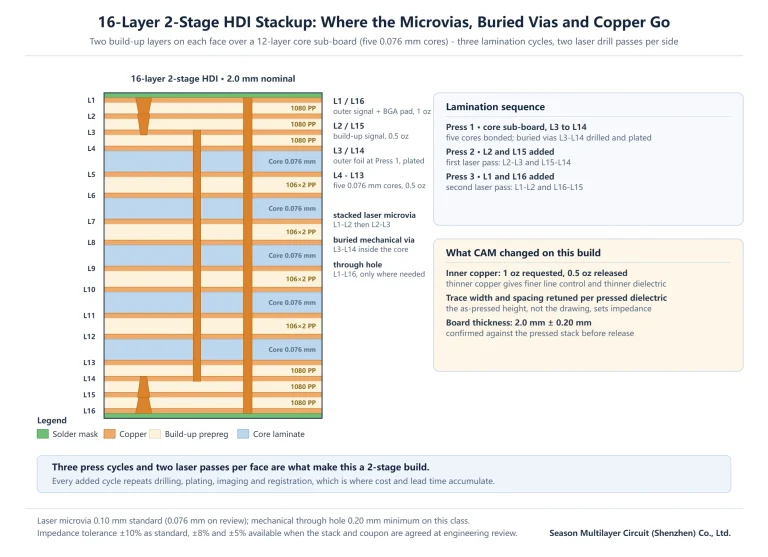
The two parameter sets below come from real volume production projects and can serve as reference baselines when you evaluate a cUL certified factory’s capability. They are not certification requirements themselves, but they indicate the level of process control typically found inside a certified scope.
Build A: 6-Layer SSD PCB
| Parameter | Specification |
|---|---|
| Layer count | 6 layers |
| Base material | FR-4 S1000H, Tg 150 °C |
| Board thickness | 1.0 mm |
| Panel size | 115.95 × 78 mm / 4-up |
| Outer / inner copper | 1 oz / 1 oz |
| Minimum through via | 0.20 mm |
| Line width / spacing | 3/3 mil |
| Minimum BGA pad | 0.3 mm |
| Surface finish | ENIG 1–2 µ” |
| Application | SM2259XT3 platform — desktop, industrial PC, security and telecom storage |
Build B: 8-Layer 1-Stage HDI Core Board
| Parameter | Specification |
|---|---|
| Layer count / HDI stage | 8-layer, 1-stage HDI (1+6+1) |
| Base material | FR-4 S1000-2M, Tg 170 °C |
| Board thickness | 1.6 mm |
| Panel size | 115 × 95 mm / 2-up |
| Outer / inner copper | 1 oz / H oz |
| Minimum through via | 0.20 mm |
| Minimum blind via | 0.10 mm |
| Line width / spacing | 2.36/2.36 mil |
| Minimum BGA pad | 0.2 mm |
| Surface finish | ENIG 1–2 µ” |
| Application | MTK-platform core board for smart terminal devices |
These two builds show that a factory producing cUL certified boards usually has both conventional multilayer and HDI manufacturing capability. If your project needs finer lines or higher HDI stage counts, confirm at quotation stage whether the certified scope covers them, rather than passing samples first and adding certification later.
2.6 Which Standards a Canadian Build Must Satisfy
A cUL certified Canadian build is governed by two standards at once, and they sit on different levels. The base material is evaluated under UL 746E, which is where the laminate’s relative thermal index and comparative tracking index actually come from. The finished board is evaluated under UL 796 for rigid boards or UL 796F for flexible boards, with flexible base films covered by UL 746F. On top of both, Canadian requirements are satisfied through CSA C22.2 No. 0.17, the Canadian standard for evaluating the properties of polymeric materials, also cited as CAN/CSA-C22.2 No. 0.17.
This is why a UL certificate lists two columns of standards rather than one. A certificate that reads “UL 796, Printed Wiring Boards” together with “CSA C22.2 No. 0.17” is what actually authorises a Canadian cUL mark. If only the US column is present, the board is recognised in the United States but not certified for Canada.
Two further standards appear regularly in procurement documents. IPC-4101 is the specification sheet a buyer checks when qualifying a laminate, and UL 969 governs marking and labelling, which is what determines how the cUL mark, the file number and the flammability rating are printed on the board.
3. Applications That Depend on cUL Certified Manufacturing
3.1 Automotive Electronics
Automotive electronics are the most certification-sensitive segment for cUL certified boards, because the consequences of failure relate directly to personal safety. Modules such as mirrors, instrument clusters and cockpit controllers typically require a V-0 laminate and complete material traceability documentation.
Note that automotive components entering the Canadian market are often asked for IATF 16949 system documentation and PPAP data in addition to cUL or cULus. Certification and quality systems are two separate tracks, and one cannot substitute for the other.
Validation cycles for automotive programmes are long, so the laminate system should be locked in at the concept design stage. Changing laminate mid-programme usually means repeating thermal ageing and certification evaluation, which costs far more than spending two extra weeks on material selection up front.
Which end-product standard applies determines whether a cUL recognised board is required at all. Information technology and audio/video equipment fall under UL 62368-1, medical devices under UL 60601, household appliances under UL 60335, industrial control equipment under UL 61010, and LED lighting products under UL 8750. Each of these carries a Canadian counterpart in the CSA C22.2 series, so the requirement reaches PCB buyers rather than only finished-goods manufacturers.
3.2 Industrial Control and Power
Industrial control equipment operates long term in high temperature, high humidity and vibration environments, so certification review focuses more on long-term thermal ageing and insulation reliability. These projects usually specify MOT and RTI data rather than looking at Tg alone.
Power products also often involve larger creepage distance requirements. The comparative tracking index (CTI) of the laminate should be brought into material selection during design to avoid a board revision later. CTI is defined by IEC 60112 and is an intrinsic material property.
3.3 Medical and Security
Medical devices and security hosts have a low tolerance for failure and typically specify IPC Class 3 acceptance. The tighter annular ring and plating requirements raise cost, but they significantly reduce field failure rates. How much of the final quotation those requirements actually carry is covered in our breakdown of the components of PCB prices.
Both product categories are also subject to Canadian electrical safety regulation, and cUL certification is a common prerequisite for entering hospital and public infrastructure procurement lists.
3.4 Communications and Data Centers
Communications and data centre equipment, often built on a cUL certified board, ships in high volumes and iterates quickly. The usual strategy is to complete cULus once at the system level and reuse recognized components at the board level, which shortens the system certification cycle.
For high-speed and high-frequency designs, material loss characteristics matter beyond the certification scope. We recommend confirming certification requirements and signal integrity requirements in the same specification document, so the two sets of requirements do not conflict.
4. cUL vs UL vs CSA vs ETL: Which Mark Does a Certified PCB Need?
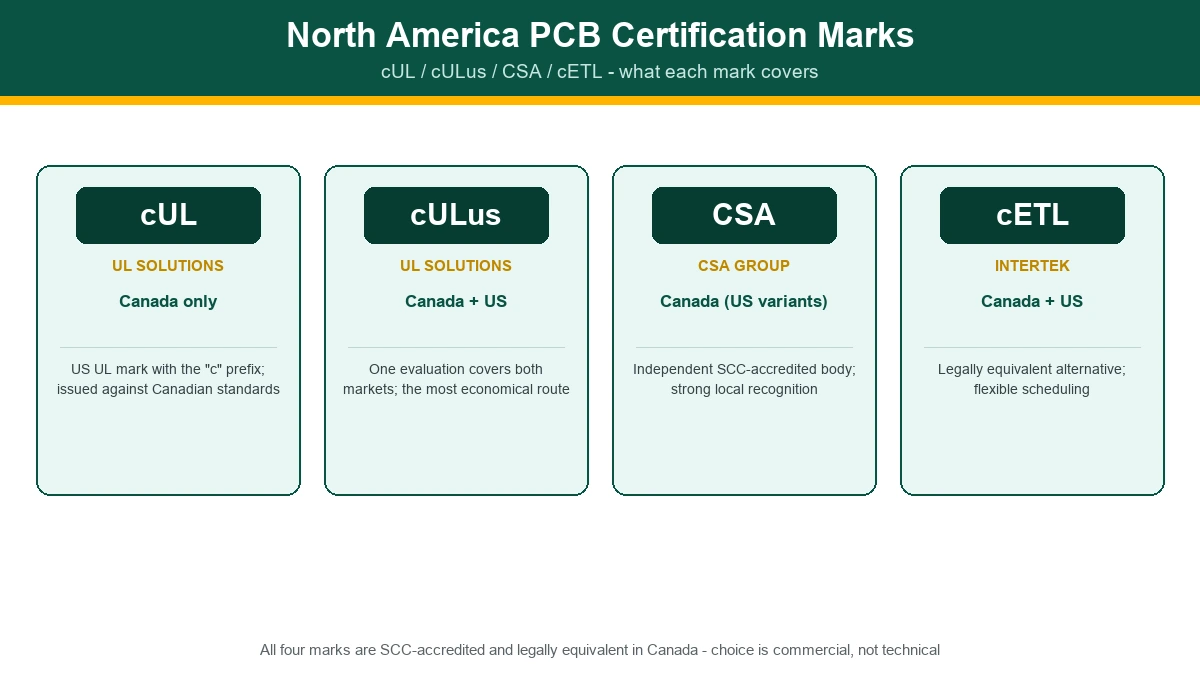
North American certification marks are easy to mix up. The table below shows how the four most common ones relate to each other.
| Comparison | cUL | cULus | CSA | cETL |
|---|---|---|---|---|
| Issuing body | UL Solutions | UL Solutions | CSA Group | Intertek |
| Market covered | Canada only | Canada + United States | Canada (US variants available) | Canada + United States |
| SCC accredited | Yes | Yes | Yes | Yes |
| Valid in Canada | Yes | Yes | Yes | Yes |
| Typical use | Canada-only shipments | Unified North American shipments | Customer-specified CSA | Customer-specified ETL |
| Main difference | Single market | One evaluation covers both countries | Strong local recognition | More flexible certification scheduling |
4.1 When You Must Choose a cULus Certified PCB
When a product ships to both the United States and Canada, a cULus certified PCB is the most efficient choice. It merges two evaluations into one, reducing sample quantities and factory audit frequency.
If a customer explicitly specifies the CSA mark, or a retail channel has a brand preference, that requirement should be respected. All three are legally equivalent, so the choice is a commercial one rather than a technical ranking.
A standalone cUL only makes cost sense when the product is certain to enter Canada alone. Once US market expansion follows, the time cost of a supplementary evaluation usually exceeds the cost of having chosen cULus from the start.
4.2 Certification Cost and Timeline: A Realistic View
Certification fees depend on product category, certification type and the number of constructions that must be evaluated, so quotations from the same factory differ from project to project. Asking “how much does certification cost” in general rarely produces a meaningful answer.
On timeline, the path from application to certificate is normally measured in months, and it extends further if corrective work and retesting are involved. Sourcing from a factory that already holds the relevant scope compresses this to almost nothing.
One caution: certification is granted per manufacturing site and per construction, and it cannot be transferred. A supplier claiming that “the group holds certification” does not automatically cover the specific factory producing your order.
5. How to Select and Specify a cUL Certified PCB
5.1 Confirm Certification Scope Before Discussing Price
When looking for a cULus certified printed circuit board manufacturer, or evaluating a cUL certified PCB supplier, the first step is not comparing prices. It is requesting the certificate and the yellow card. Confirm the certificate holder, the validity period, and the laminate systems and constructions covered.
The second step is verifying the production site. Certification is granted per manufacturing site, and different plants within the same group cannot substitute for each other. A mismatch between the certificate holder and the actual producer is a common nonconformity in audits.
The third step is cross-checking the issuing body’s public database. UL Solutions, CSA Group and Intertek all provide online lookups, and entering the file number verifies certificate status and covered models.
5.2 Laminate and Flammability Rating Selection
Confirm the UL 94 rating and the RTI of the laminate first, rather than looking at price first. V-0 is the default requirement for automotive and industrial programmes, and the cost difference is usually far smaller than the cost of a later board revision.
Where there are heat dissipation or high-reliability requirements, evaluate Tg, Td (decomposition temperature) and CTI together. Excellence in a single parameter does not mean the material is suitable overall, so judge against the actual operating temperature profile.
5.3 Canada-Market Design Checklist
- Confirm which mark type the product ultimately needs: cUL, cULus, or a customer-specified CSA
- Confirm that the stack-up falls within the factory’s certified scope
- State the IPC-A-600M (2025) and IPC-6012F revisions in drawings and procurement documents
- Specify IPC Class 1 / 2 / 3 and write it into the quality agreement
- Confirm the laminate’s UL 94 rating is V-0 and retain the material certificates
- Allow for thermal stress validation, typically evaluated around 260 °C lead-free reflow
- Agree on microsection ownership, retained quantities and retention period
- Confirm which party provides and retains the certification document package
5.4 Documentation and Traceability Requirements
Volume deliveries should be accompanied by material certificates, microsection reports and declarations of conformity. These documents are essential evidence during customer audits or market surveillance spot checks.
Certification is not a one-time action. The issuing body conducts scheduled and unscheduled factory inspections through its follow-up service. A factory’s quality system and lot traceability directly determine whether certification can be maintained long term.
5.5 Certification Process and Timeline Expectations
Component recognition generally follows five steps: application submission, technical review, sample testing, certificate issuance and follow-up inspection. The testing phase may require additional samples or documentation, and this is the main source of timeline variation.
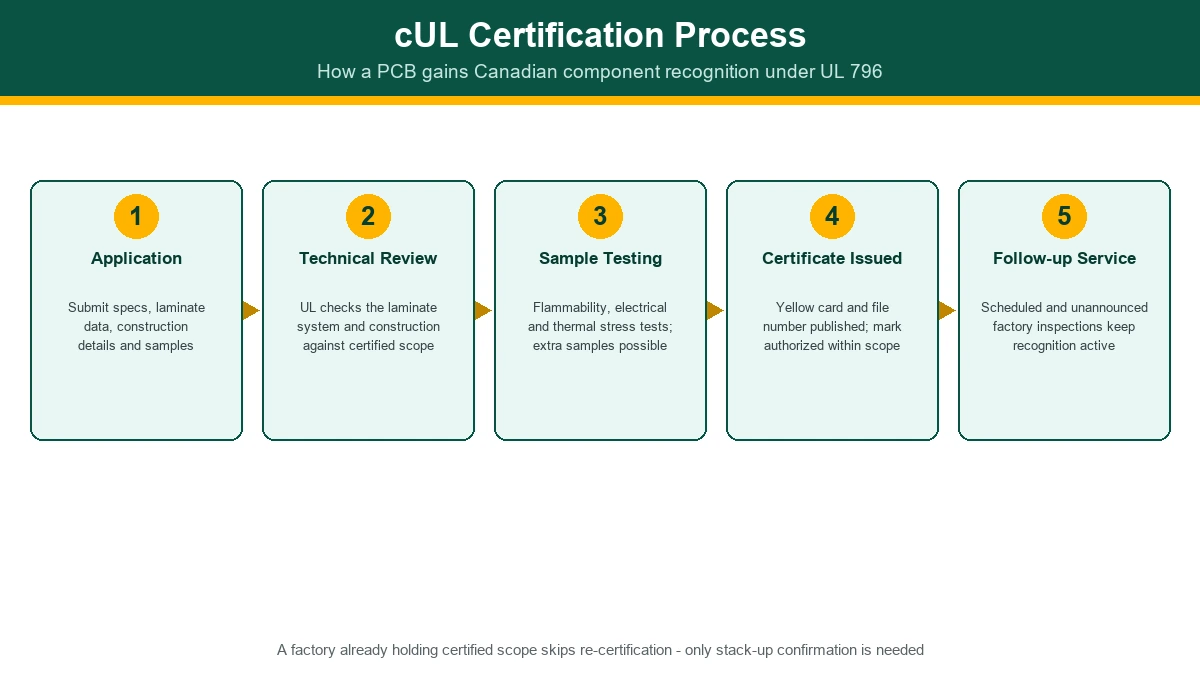
For a board shop that already holds a certified scope, customer projects usually require no re-certification — only confirmation that the stack-up falls inside the scope. That is the value of moving certification requirements forward into the selection stage.
998PCB Group (Season Multilayer Circuit (Shenzhen) Co., Ltd.) manufactures multilayer, HDI and high-frequency boards under UL, ISO 9001, ISO 14001, CQC and IATF 16949 systems, and can confirm certified scope and stack-up coverage during quotation. See our factory and equipment showcase for a closer look at the production lines, or request a fast-turn PCB prototype for your next project.
5.6 Common Pitfalls
- Seeing a UL mark and assuming the product can be sold in Canada, ignoring the “c” prefix
- Confirming the factory has a certificate without confirming the specific production site
- Confirming the laminate model without confirming whether the stack-up is inside the certified scope
- Writing only “IPC-A-600” in procurement documents, without revision or product class
- Prototyping with one process and switching to another for volume production, triggering re-validation
6. FAQ: cUL Certification
Q1. What is the difference between cUL and UL?
cUL is the certification mark for the Canadian market and UL is the mark for the United States market. Both are issued by UL Solutions. The UL mark without the “c” prefix has no legal standing in Canada.
Q2. What is a cULus certified PCB, and when do you need one?
cULus means a single certification covers both Canadian and US requirements. It is used when a product ships to both North American markets, and it avoids duplicate sampling and duplicate factory audits.
Q3. Does a cUL certified PCB need to meet IPC-A-600, and which revision?
Certification does not itself mandate an IPC acceptance revision, but purchase orders and quality agreements normally reference one. The current revision is IPC-A-600M, published May 2025, superseding IPC-A-600K and synchronized with IPC-6012F and IPC-6013E.
Q4. What does a UL 94 V-0 flammability rating mean for a PCB?
It means the laminate self-extinguishes within 10 seconds after the flame is removed in a vertical burn test, total afterflame time across five specimens stays under 50 seconds, and no dripping ignites the cotton below. This is the baseline build for a cUL certified PCB using a UL 94 V-0 flame-retardant laminate.
Q5. How do I find a reliable cULus certified printed circuit board manufacturer?
First check whether the certificate and yellow card cover your stack-up. Then verify that the certificate holder and the actual production site match. Finally, confirm the status in the issuing body’s public database. Factories holding UL, ISO 9001, ISO 14001, IATF 16949 and CQC systems can usually supply a complete document package in one pass. To verify a claim yourself, ask for the UL file number, which follows the E-number format of a letter E followed by six digits, then look it up in UL Prospector or Product iQ. Check four things: the certificate holder name, the manufacturing site address, the active status, and the product category code. For printed wiring boards the US category is ZPMV2 and the Canadian category is ZPMV8. A supplier who cannot produce a verifiable file number is not certified, regardless of what the website states.
Q6. Can certification lapse when the manufacturing process changes?
Yes. After a change to the material system, lamination conditions or a critical process, the certification body may require re-validation to confirm that volume production still matches the certified construction. Confirm with your fabricator and the certification body before making the change.
Q7. How much does cUL certification cost for a PCB project?
No fixed number applies. Fees depend on the product category, the certification type and the number of constructions that must be evaluated, so the same factory quotes different projects differently. The main lever is scope reuse: building with laminate systems already listed on the factory yellow card avoids duplicate material testing, and applying for UL and cUL together costs less than two separate evaluations. For a cUL certified PCB, confirm at quotation stage which constructions sit inside the existing scope.
Q8. How long does cUL certification take for a PCB?
The path from application to certificate is normally measured in months, and it extends further if corrective work or retesting is involved. Sourcing from a factory that already holds the relevant recognition compresses this to almost nothing, because the board simply falls inside an existing scope. Keep in mind that recognition is granted per manufacturing site and per construction, so confirm your specific stack-up early in the project instead of after the layout is frozen.