Book Appointment Now
What makes a PCB UL certified? Learn UL 796 & UL 94 V-0 standards, the certification process, and how UL-listed PCBs unlock global market access.
UL Certified PCB: Standards, Certification Process & Benefits Explained
In the printed circuit board industry, few marks carry as much weight as the UL listing. A UL certified PCB has been independently tested by Underwriters Laboratories (UL) — one of the world’s most recognized safety science organizations — and proven to meet strict requirements for flammability, electrical insulation and long-term reliability. In North America it is the reference PCB safety certification that procurement teams ask for by name, and the UL yellow card is the document they check first. For buyers in North America especially, working with a UL certified PCB manufacturer is not a nice-to-have: it is often a hard requirement for market entry. This guide explains what UL certification means, which standards apply to circuit boards, how the certification process works, and why it should factor into your next sourcing decision — whether you need a fast-turn prototype or volume production from a UL-recognized fabricator.
Table of Contents
- What Is UL Certification?
- Why UL Certification Matters for PCBs
- Key UL Standards Behind Every PCB Safety Certification
- The PCB UL Certification Process, Step by Step
- Case Study: UL-Certified 6-Layer HDI Automotive PCB
- Choosing a UL Certified PCB Manufacturer: Checking the Yellow Card
- 7. Common Reasons PCB Designs Fail UL Testing
- 8. FAQ: UL Certification for PCBs
1. What Is UL Certification?
UL (Underwriters Laboratories) was founded in 1894 and is today one of the largest independent safety testing and certification organizations in the world. The organization evaluates equipment, systems and materials against recognized requirements covering fire hazard, electrical safety, mechanical risk, hygiene and environmental impact. Its certifications are widely accepted by regulators, insurers and retailers as evidence that a product is safe for its intended use.
Important distinction: the UL mark is a safety certification, not a quality mark. It confirms that a product has passed UL’s safety evaluation — it does not grade performance attributes such as impedance consistency, yield or workmanship. Consumers often assume the UL mark is the “highest quality label”; in reality, it addresses safety compliance only.
For a UL certified PCB, this safety certification focuses on the board material system and construction: base laminate flammability, conductor insulation, thermal endurance and the maximum operating temperature at which the board remains safe.
2. Why UL Certification Matters for PCBs
2.1 Product safety assurance
The UL certified PCB process subjects materials, components and the manufacturing method to rigorous testing and evaluation, and the result is recorded on a public UL yellow card. It verifies that the finished board will not become an ignition source or insulation failure point during normal operation — reducing safety risks in end products ranging from household appliances to medical devices.
2.2 International market access
UL is one of the most widely recognized safety authorities internationally, and many countries either require or strongly prefer imported electronic products built on UL-certified boards. For North American buyers in particular, sourcing a UL certified PCB from a certified fabricator removes a major compliance barrier and shortens the certification path for the finished device — because the board’s flammability and insulation data is already on file with UL.
2.3 Greater end-customer trust
When a circuit board carries UL recognition, OEMs and their customers know the product has been audited against UL’s safety standards by a neutral third party. For a UL certified PCB, that trust translates directly into smoother design-in conversations, easier insurance approval and stronger brand credibility. Buyers who also ship to Canada should pair this with the separate cUL certification requirements.
3. Key UL Standards Behind Every PCB Safety Certification
A UL certified PCB is not the product of one test but of a set of standards applied at two levels — the base material and the finished board — and the UL yellow card records both:
| Standard | Applies to | What it governs |
|---|---|---|
| UL 796 | Rigid printed wiring boards | The core PCB standard. Covers construction, conductor spacing, dielectric withstanding voltage and thermal evaluation for rigid boards |
| UL 796F | Flexible interconnect constructions | The flexible and rigid-flex counterpart to UL 796, applied to flex circuits and flexible film materials |
| UL 746E | Polymeric materials — industrial laminates | The standard behind the laminate data on a yellow card. Establishes RTI (Relative Thermal Index) and CTI for every approved base material |
| UL 746F | Polymeric materials — flexible films | Covers the flexible dielectric film materials used in flex and rigid-flex constructions |
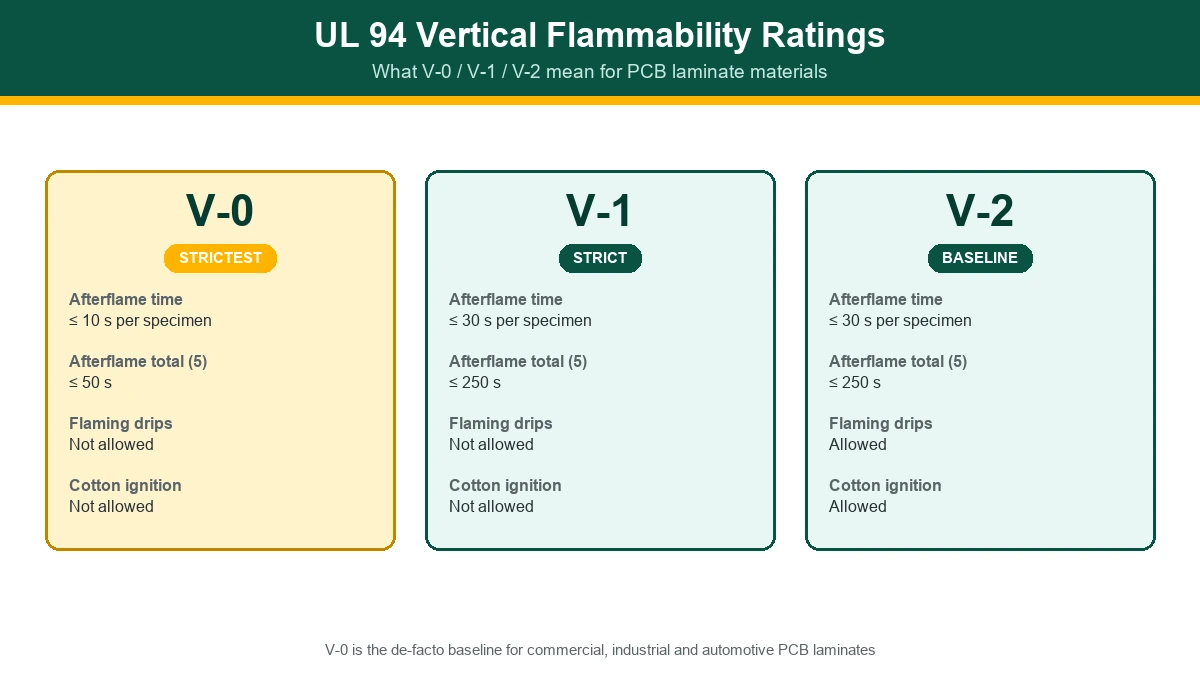
| UL 94 | Flammability of plastic materials | Defines the V-0 / V-1 / V-2 / 5VA flammability ratings. UL 94 V-0 laminate is the de-facto baseline for commercial and industrial PCBs |
| UL 969 | Marking and labeling systems | Sets durability and legibility requirements for the UL mark and file number printed on the finished board |
When evaluating suppliers of a UL certified PCB, always ask for their UL yellow card — it lists the exact laminate systems, constructions and operating parameters the factory is licensed to build. A board built outside the yellow card’s scope is not a genuinely certified board, even if the factory itself holds recognition.
Whether a board needs to be a UL certified PCB at all is decided by the standard the finished product must meet. Information technology and audio/video equipment fall under UL 62368-1, medical devices under UL 60601, household appliances under UL 60335, industrial control equipment under UL 61010, and LED lighting products under UL 8750. In each case the end-product standard requires a UL-recognized board, which is why the requirement reaches PCB buyers rather than only finished-goods manufacturers.
Two material properties of a UL certified PCB decide most high-voltage and thermal questions, and both appear on the yellow card:
| CTI class | Comparative Tracking Index | Typical use |
|---|---|---|
| Class I | 600 V and above | High-voltage industrial and power equipment |
| Class II | 400 V – 599 V | Mains-connected power supplies and motor drives |
| Class IIIa | 175 V – 399 V | Standard FR-4 used on most consumer and commercial boards |
| Class IIIb | 100 V – 174 V | Low-voltage, low-pollution-degree designs |
RTI is the other number to check on a UL certified PCB. It states the maximum continuous operating temperature at which the laminate retains its electrical and mechanical properties, and it is set per property — electrical, mechanical with impact, and mechanical without impact. A design that runs above the electrical RTI shortens insulation life even if the board never visibly fails in the field.
4. The PCB UL Certification Process, Step by Step
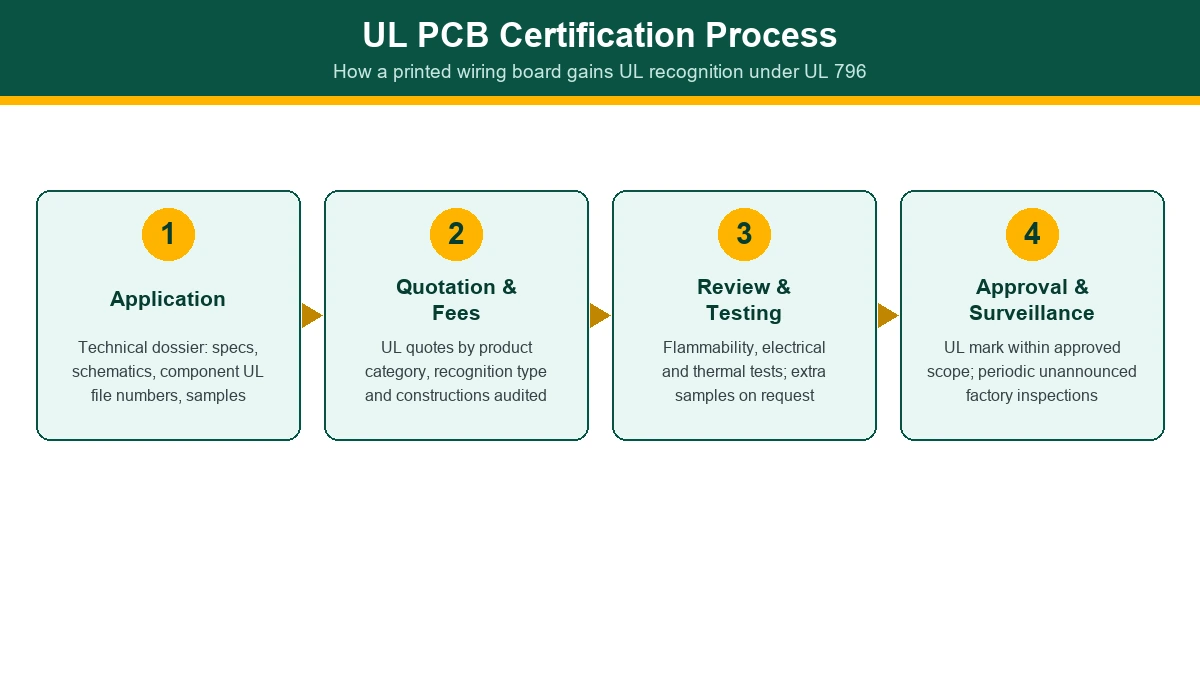
Step 1: Application
The manufacturer applies to the agency for UL certified PCB recognition and submits the technical dossier that will eventually support its UL yellow card: product specifications and technical documentation, circuit schematics and artwork, a list of critical components together with their UL file numbers, and production samples for testing.
Step 2: Quotation and fees
After accepting the application, the agency quotes a fee based on product category, the type of recognition sought and the number of constructions to be audited. That fee is only one line in the total build cost — the rest sits in the material, structure and process choices of a UL certified PCB, which are set out in our breakdown of the components of PCB prices.
Step 3: Document review and testing
Certification engineers review the submitted files and put the samples through flammability, electrical and thermal testing. During this phase the testing body may request additional information or fresh samples for deeper verification.
Step 4: Approval and ongoing surveillance
Once approval is granted, the manufacturer is issued a UL yellow card covering the approved constructions and may use the recognized mark within that scope — subject to the follow-up service program, which includes periodic unannounced factory inspections to confirm that volume production continues to match the certified construction.
Practical takeaway for buyers: UL recognition is granted per manufacturing site and per construction. When you qualify a supplier, confirm that the specific factory building your boards holds the recognition and that your stack-up falls inside its yellow card scope.
5. Case Study: UL-Certified 6-Layer HDI Automotive PCB
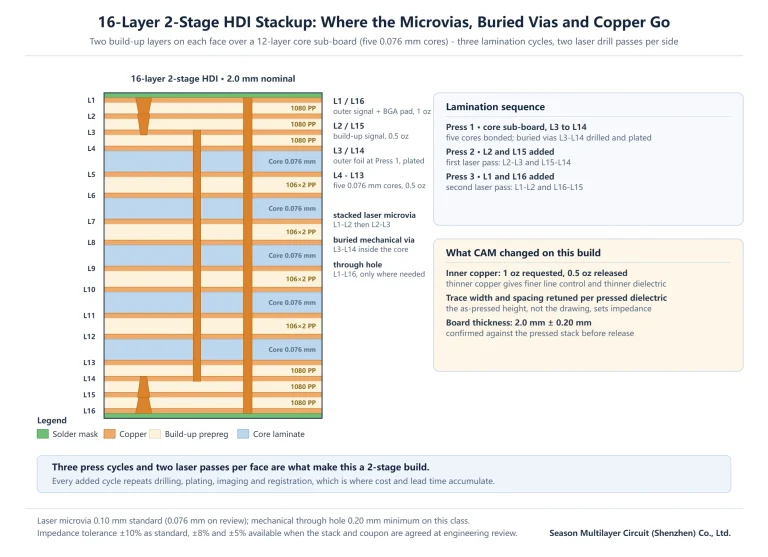
To show what a compliant, certification-ready UL certified PCB looks like in practice, below is a real 6-layer 1-stage HDI PCB produced for automotive rearview mirror systems (Intel Sofia 3G-R platform, front and rear installation applications) and tablet devices — the same platform behind our 6-layer automotive PCB prototype.
| Parameter | Specification |
|---|---|
| Layer count / HDI stage | 6-layer, 1-stage HDI (1+4+1) |
| Base material | FR-4, Tg 170 °C (UL 94 V-0 laminate system) |
| Finished board thickness | 1.6 mm |
| Panel size | 138 × 162 mm / 2 |
| Outer / inner copper thickness | 35 µm / 30 µm |
| Minimum through via | 0.20 mm |
| Minimum blind via | 0.20 mm |
| Line width / spacing | 3/3 mil |
| Minimum BGA pitch | 0.2 mm |
| Surface finish | ENIG 1–2 µ” |
Builds like this sit at the intersection of everything a UL certified PCB yellow card documents: a V-0 rated laminate, controlled dielectric spacing and an ENIG finish suitable for fine-pitch assembly. The same factory platform supports 2–30 layer multilayer PCB production, high-speed high-frequency PCB materials and flex and rigid-flex PCB constructions under the same quality system — review the full PCB manufacturing capability and typical PCB lead times before you schedule a certified build.
6. Choosing a UL Certified PCB Manufacturer: Checking the Yellow Card
Before committing an order for a UL certified PCB, ask the supplier to walk you through their UL yellow card and verify the following:
- Valid UL file number and yellow card for the exact production site, covering the laminate system and construction you need
- Complementary certifications — ISO 9001 and ISO 14001 for the quality and environmental system, IATF 16949 for automotive programs
- Engineering support for certified builds — the ability to match your stack-up to an approved construction, or to run a new UL application on your behalf
- Prototype-to-mass-production consistency — the certified construction must be reproducible in volume, not just in the lab
998PCB Group (Season Multilayer Circuit (Shenzhen) Co., Ltd.) is a professional circuit board manufacturer specializing in high-stage HDI, multilayer PCB, high-frequency and high-speed boards, FPC, rigid-flex, SMT assembly and turnkey one-stop PCBA services. The company holds UL certified PCB recognition, along with ISO 9001, ISO 14001, CQC and IATF 16949, and supports both certified production and fast-turn PCB prototype runs under the same process control system — see our factory and equipment showcase for a closer look at the production lines, or read the full 998 PCB Group company profile.
Need a UL-certified PCB quote? Season PCB — the international brand of 998PCB Group — delivers UL-recognized HDI, multilayer and high-frequency boards from Shenzhen with English-speaking engineering support and fast-turn prototyping. Send us your stackup and we will confirm whether it falls inside our UL certified PCB scope before you commit. Get a quote →
7. Common Reasons PCB Designs Fail UL Testing
UL certified PCB failures at the construction stage are rarely about workmanship — it almost always traces back to a design or material decision made before the Gerbers were released. Knowing the usual offenders lets you fix them at layout review instead of paying for a re-test. The most common causes we see on customer builds are:
- Laminate outside the approved construction. The cheapest FR-4 on the market may not sit on any UL-recognized construction. Switching laminate brand or grade after certification silently voids the yellow card coverage.
- CTI rating too low for the application. Comparative Tracking Index describes how well the base material resists surface tracking. High-voltage and industrial designs often need a higher CTI grade than a generic V-0 laminate provides.
- Insufficient conductor spacing. Creepage and clearance distances that satisfy IPC may still fall short of UL insulation requirements once mains voltage or reinforced insulation is involved.
- Operating temperature above the laminate rating. Power-dense boards that run hot need a material whose maximum operating temperature covers the real thermal rise, not just the ambient specification.
- Unrecognized critical components. Fuses, connectors and optocouplers must themselves carry UL recognition for a UL certified PCB; a single unrecognized part can hold up the whole submission.
- Construction changes between prototype and production. Altering layer count, dielectric thickness or copper weight after approval is granted means the certified construction no longer matches what ships.
Avoiding all six is mostly documentation discipline: lock the stackup early, keep the laminate and critical-component list under version control, and re-confirm with your fabricator before any construction change. Working with a manufacturer that already builds a UL certified PCB shortens this loop considerably — the recognized constructions are on file, so a design review can flag a likely UL problem in days rather than after a failed test round.
8. FAQ: UL Certification for PCBs
Is a UL mark a quality mark?
No. The UL mark is a safety certification. It confirms the board passed UL’s safety evaluation (flammability, insulation, thermal endurance) but does not grade the manufacturing quality of a UL certified PCB or performance attributes such as yield or impedance tolerance.
What does UL 94 V-0 mean on a PCB?
UL 94 V-0 is the strictest vertical flammability rating for plastic materials, and the one most UL certified PCB laminates carry: a test specimen extinguishes within 10 seconds after flame removal, with no flaming drips. Most commercial and automotive laminates today are V-0 rated, and buyers should specify it as the baseline.
How long does PCB UL certification take?
A typical UL certified PCB recognition project runs several months from application through testing and approval, depending on product category and how many constructions are included. Buying from an already-certified fabricator lets you skip this timeline entirely.
Does every PCB need UL certification?
Not legally everywhere — but if your end product ships to North America, or carries a UL/ETL listing of its own, the PCB inside generally must come from a UL certified PCB construction. Insurers and major retailers also routinely require it.
What is a UL yellow card?
The UL yellow card is the public record of a manufacturer’s recognized constructions, issued by UL and searchable online. For a UL certified PCB, it lists the UL file number, the laminate systems and the construction limits covered — layer counts, copper weights, maximum operating temperature and flammability rating. When a buyer says a board must be UL recognized, the yellow card is the document that proves it.
How do I verify a manufacturer’s UL file number?
To verify a UL certified PCB claim, look the file number up in UL’s online product database and confirm three things: the company name matches your supplier, the recognized construction covers your stackup (layer count, copper weight, laminate and operating temperature), and the file is still active rather than archived. A UL mark on the invoice is not proof by itself — the database entry is.
Need a certified production partner? Review Season PCB’s PCB manufacturing services — 2-30 layer PCB, 1-5 Stage HDI, and turnkey PCBA.