Book Appointment Now

UL recognition on a bare board is a construction approval, not a quality grade. How to read the yellow card, verify the E-file and keep the paperwork intact.
UL Recognition for PCB: Reading the Yellow Card and E-File
A request for quotation comes back stamped with a UL mark, the capability deck shows the logo in a footer, and everyone relaxes. Then the customer’s compliance team asks for the E-file number behind that mark, and the answer has to survive a two-minute lookup in a public database. UL recognition for PCB work is not a marketing badge on a brochure; it is a construction-level approval that names a legal entity, a set of materials and a manufacturing location, and any one of those three going unstated is where the problem starts.
This guide is written for the buyer and the hardware engineer who has to confirm a claim rather than make one. It separates material recognition from board recognition, walks through the fields on a yellow card, shows what a file number lookup can and cannot prove, and lists the points where the paper trail usually breaks between a trading company, a fab and an assembly house. If you are choosing a stackup at the same time, the laminate and material selection guide covers the dielectric side in more depth.
Table of Contents
- UL Is a Safety Certification, Not a Quality Grade
- What UL Recognition Actually Covers on a Bare Board
- Two Separate Recognitions: Laminate and Finished Board
- How to Read a Yellow Card
- Verifying the File Number in Two Minutes
- UL, cUL and cULus: Which Mark Applies to Your Destination
- Marking and Traceability on the Panel
- Temperature Rating, Tg and the Mistake Buyers Make
- Where UL Recognition Usually Breaks in a Supply Chain
- An RFQ Checklist for UL-Recognised Boards
- FAQ
- Send the Stackup Before the Compliance Question Gets Urgent
UL Is a Safety Certification, Not a Quality Grade
Underwriters Laboratories has been testing products for fire, shock and personal-injury risk since the late nineteenth century, and that scope defines what a UL mark can and cannot tell you. It says the product was evaluated against a safety standard. It says nothing about impedance control, copper adhesion, registration accuracy or how the board will behave after five years of thermal cycling.
That distinction matters because buyers routinely read the mark as a quality endorsement and then stop asking engineering questions. A board shop can hold a perfectly valid recognition and still deliver a panel with poor hole wall plating. Conversely, a shop with excellent process control can be outside recognition for the exact construction you need, because the recognition covers a defined envelope rather than everything the factory can physically build.
The useful way to read the mark is as a constraint on substitution. A recognised shop has committed to a material set, a construction and a traceability system, and has agreed to notify UL before changing them. For a buyer, that constraint is the actual value: it makes silent laminate swaps and quiet process shortcuts a compliance event rather than a commercial decision. Our own process capability page lists the layer counts, copper weights and finishes the factory is set up for, which is the first thing to compare against the recognition record.
What UL Recognition Actually Covers on a Bare Board
The board standard is UL 796, Printed-Wiring Boards. It evaluates the finished board as a component: the laminate system, the copper weights, the layer count range, the overall thickness, the surface finish and the solder mask type all sit inside a tested construction. Change one of those outside the recorded limits and the part is no longer the part that was evaluated, even if it looks identical and performs the same in the lab.
This is why a capability statement such as 2 to 30 layers is not the same as a recognition scope. A shop may be able to build 22 layers, but if the highest construction on its card is 16 layers with a specific laminate family, the 22-layer job is outside the approval. During a supplier audit, ask for the construction table rather than the certificate image, and read the rows.
UL recognition also differs from listing. Recognised components carry the reverse-UR mark and are intended to be built into something else. Listed products carry the UL mark in a circle and are end products evaluated to an end-product standard such as UL 62368-1 for information technology equipment. A bare board is almost always a recognised component; the assembly or the enclosure is what gets listed.
Two Separate Recognitions: Laminate and Finished Board
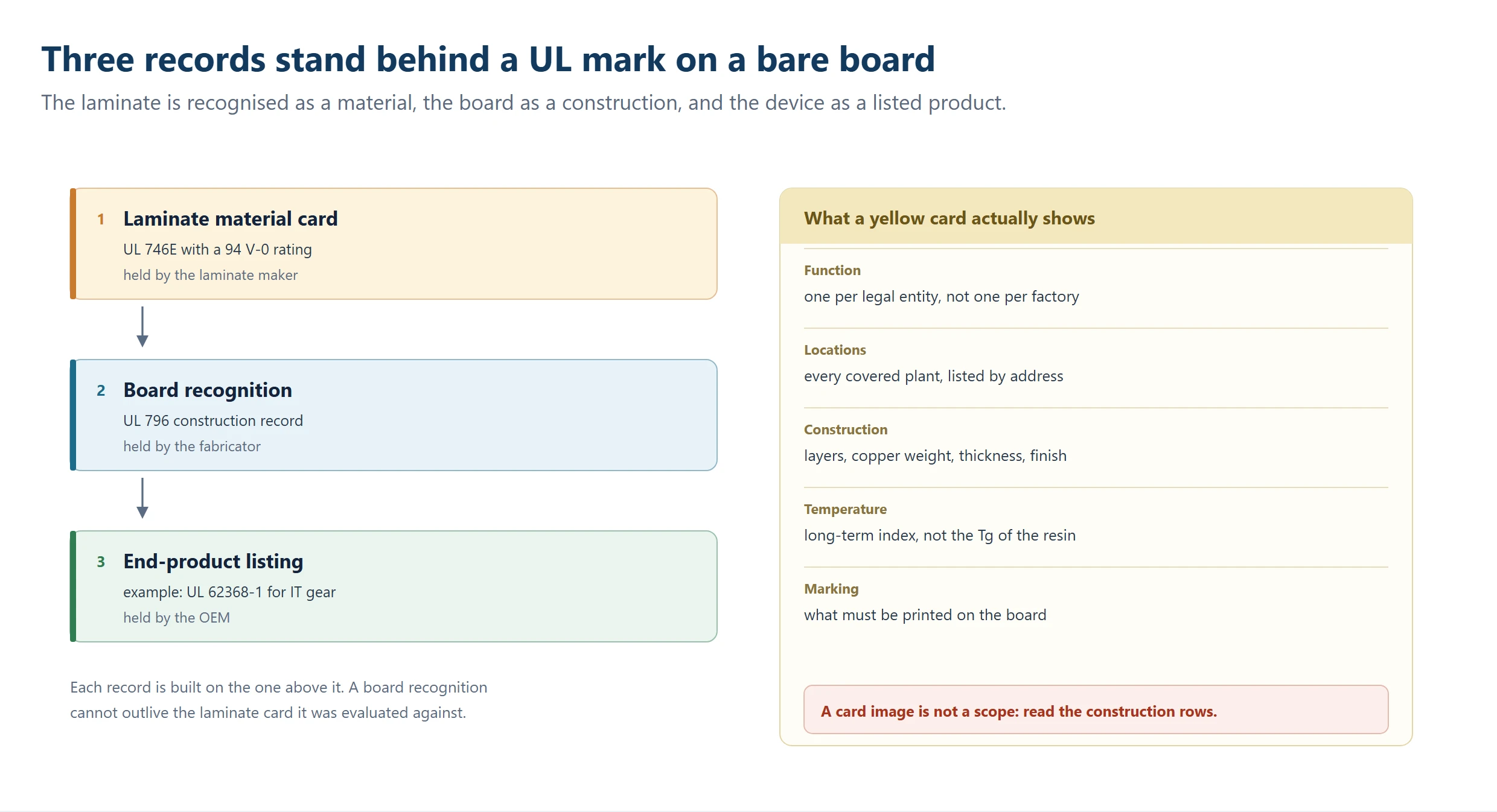
The most common misunderstanding is treating UL as a single certificate. There are at least three layers, and they depend on each other in one direction only: a board recognition is built on recognised laminate, never the other way round.
| Record | Held by | What it covers | What it does not cover |
|---|---|---|---|
| UL 94 V-0 flammability rating | Laminate manufacturer | Burning behaviour of the cured laminate in a vertical test | Electrical performance, thermal endurance of a finished board |
| UL 746E material card | Laminate manufacturer | The polymer system, temperature index and thickness range of a laminate family | Any specific board construction built from it |
| UL 796 board recognition | PCB fabricator | A defined construction: laminate, copper weights, layer range, thickness, finish, mask | Assemblies, end products, or constructions outside the table |
| End-product listing | OEM or assembler | The finished device against an end-product safety standard | How any single board inside it was built |
The dependency runs downward. If a fabricator moves to a laminate whose material card does not exist, or whose temperature index is lower than the construction recorded, the board recognition no longer describes what is being shipped. A shortage-driven substitution of one Tg 170 grade for another looks harmless on the factory floor and is exactly the kind of change that breaks the chain.
How to Read a Yellow Card
The yellow card is the public summary of what a company is allowed to make and mark. Cards are structured the same way across companies, which makes them quick to compare once you know which fields carry the decisions.
| Field on the card | What it tells you | What to check against your build |
|---|---|---|
| File number (E followed by digits) | The unique identifier for this company’s recognition record | Search it and confirm it resolves to the entity named on your purchase order |
| Company and location list | Every manufacturing site covered by the file | The plant that will actually run your panel must appear in the list |
| Construction or ratings table | Layer counts, laminate designations, copper weights, thickness ranges | Your stackup must fall inside a row, not between two rows |
| Flammability rating | Usually V-0 for board constructions | The rating belongs to the construction, not to the factory’s marketing |
| Maximum operating temperature | The temperature index assigned to that construction | Compare with your continuous operating temperature, not with reflow peak |
| Marking requirement | What must be printed on the board or panel so the part stays traceable | Ask where the mark will physically sit on a 10 mm wide board |
| Status wording | Recognised component rather than listed product | A bare board should be recognised; a listing claim on a bare board is a red flag |
Cards are also revised. Take the edition date from the copy you were given and check it against the current public record before an audit, because a card that is two years old may still be on file in a supplier’s quality folder while the underlying construction has already been updated.
Verifying the File Number in Two Minutes
UL publishes its component records in a public database, so a file number is verifiable without asking anyone’s permission. Open UL Product iQ from the UL Solutions site, enter the E-number, and read three things: the legal entity, the manufacturing locations, and the construction rows. Save a dated screenshot into the project folder; it is the cheapest audit evidence you will ever produce.
Watch the entity name carefully. Groups frequently hold a file under the parent company while the quotation is issued by a trading arm and the panel is built at a third site. That arrangement can be perfectly legitimate, but only if the building site is listed. If the address on the shipping documents does not appear in the location list, the board is outside the recognition regardless of what the certificate image says.
A file number also does not tell you whether the shop is any good. It tells you the paperwork is real. Keep the engineering evaluation and the compliance verification in separate conversations, because a supplier that is strong on one and weak on the other will usually steer the discussion towards whichever one it wins.
UL, cUL and cULus: Which Mark Applies to Your Destination
The base UL mark covers the United States. A mark with a lowercase c prefix, written cUL, covers Canada under Canadian requirements, and cULus combines both. The lowercase c is part of the mark, not a typographic detail: a capital letter there is not a UL mark at all, and a supplier document that writes it that way has usually retyped the mark rather than read it.
Destination decides what you need. A board going into a product sold only in the United States can sit inside a US-only listing. A product sold into Canada needs the Canadian side recognised, either through a c-marked component or a listing that covers Canadian requirements. Ask the question at the quotation stage, because retrofitting a Canadian-recognised construction late in a programme usually means a new stackup review and a new first article.
Where the requirement lands is also worth clarifying. The obligation sits primarily on the end product listing, so a US-only board inside a product that is exported to Canada is a real exposure even if every individual component is legitimate for its own market.
Marking and Traceability on the Panel
Recognition is not just a document; the part has to be identifiable. In practice a recognised panel carries the laminate maker’s mark, the fabricator’s identification, the flammability rating and a date or lot code, either on the board itself or on the array frame when the finished board is too small to hold it. On a 6 mm wide wearable board, expecting a full mark on every piece is unrealistic, so the mark lives on the rail and the piece keeps only a date code.
Traceability is what turns the mark into evidence. The fabricator should be able to take a date code from a shipped panel back to a laminate lot and a production traveller. When you audit, ask for one worked example rather than a policy document, and follow the number yourself. A shop that can produce the trace in ten minutes has a system; a shop that needs a day has a folder.
Workmanship acceptance is a separate question from recognition, but the two are checked together in practice. The requirements for mask integrity, plating thickness and marking legibility come from the acceptance standard you specify, for example the criteria summarised in our IPC-A-600 Class 3 overview, while the recognition record tells you whether the construction itself is approved.
Temperature Rating, Tg and the Mistake Buyers Make
Three different numbers get mixed up in specification reviews: the glass transition temperature of the laminate, the maximum operating temperature on the UL card, and the peak temperature of the assembly reflow profile. They describe different things and none of them substitutes for another.
Tg is a physical property of the cured resin, typically 150, 170 or 180 degrees Celsius depending on the grade. The UL temperature index is an assigned limit for the recognised construction under long-term thermal ageing, and many standard FR-4 constructions carry 130 degrees Celsius. A Tg 170 board therefore does not automatically carry a higher index; read the card row for your construction rather than inferring from the laminate datasheet.
Reflow is a process event measured in seconds, and the card does not describe it. Assembly capability is validated through thermal cycling and process qualification, which is a different evidence set. If your product runs continuously near the card limit, specify a construction whose recorded index has margin and confirm the incoming material against its own records, as described in this laminate incoming inspection guide.
Where UL Recognition Usually Breaks in a Supply Chain
Almost every failure I have seen is administrative rather than technical. The board was fine; the story around it was not. Four patterns account for most of them.
- The file belongs to one plant and the panel is built at another, often after a capacity overflow.
- A laminate substitution is made during a shortage using the same Tg class but a different material family that is not on the card.
- The solder mask or surface finish changes as a process improvement, moving the build outside the recorded construction.
- The mark is dropped to save space on a small board, so the shipped part cannot be traced back to any lot.
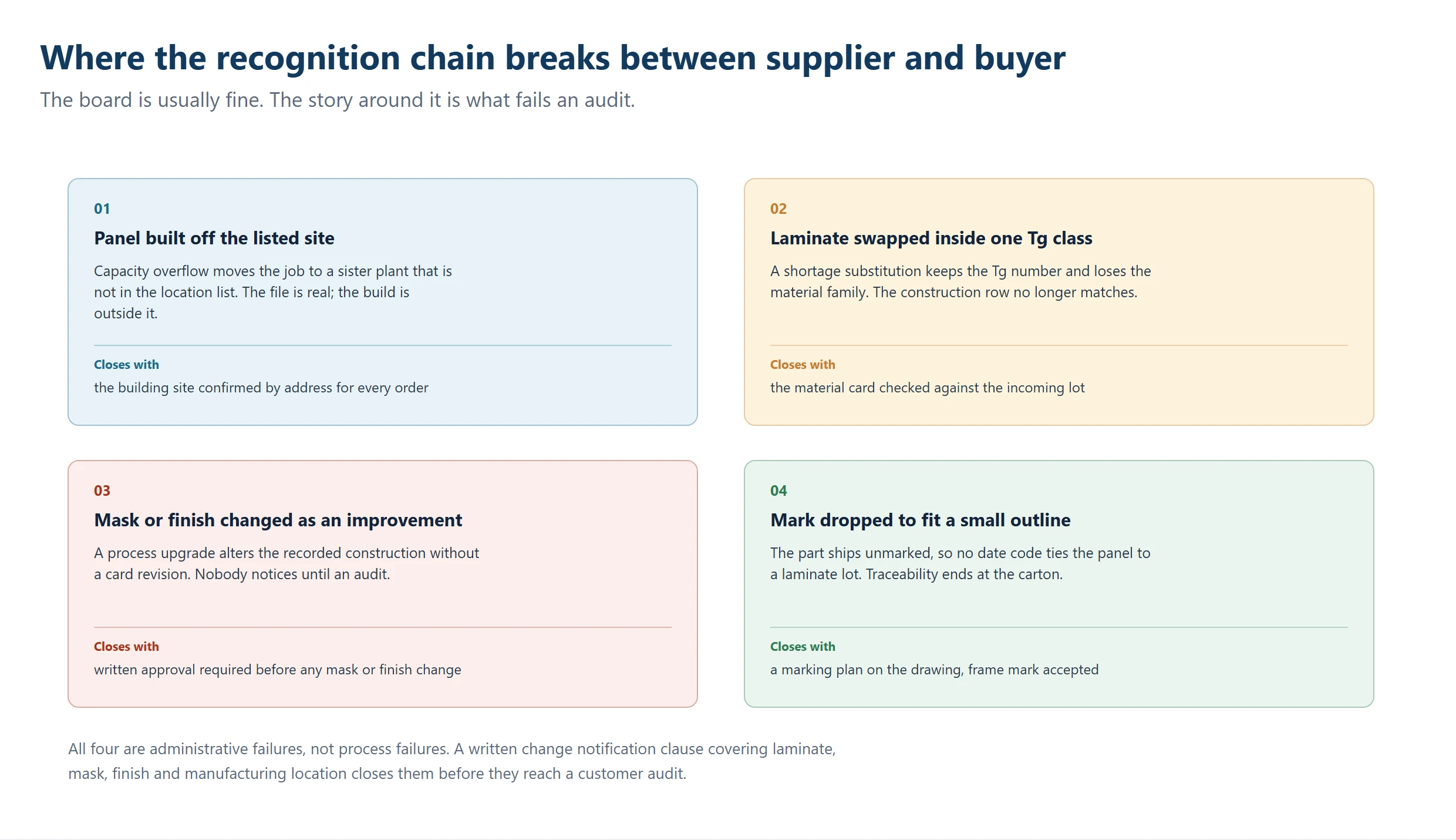
Each of these is cheap to prevent and expensive to discover at a customer audit. The prevention is a written change notification requirement in the purchase agreement: any laminate, mask, finish or manufacturing location change requires your approval before shipment, with an updated card extract attached. Fabricators accept that clause far more often than buyers expect, and the ones who resist it are telling you something useful.
An RFQ Checklist for UL-Recognised Boards
Put the compliance questions in the same message as the technical ones. Separating them into a later email is how they get answered by a salesperson instead of an engineer.
| Item to request | Why it matters | What an acceptable answer looks like |
|---|---|---|
| File number and legal entity name | Links the claim to a verifiable record | An E-number that resolves to the entity on your purchase order |
| Construction extract covering your build | Confirms layer count, laminate, copper and thickness are inside a row | A card row that brackets your stackup, not a general capability statement |
| Manufacturing location list | Confirms the plant that will build the panel is covered | Your site appears by address, not just by company group |
| Laminate material card | Confirms the dielectric system is itself recognised | Material card with a flammability rating and temperature index |
| Marking plan | Confirms the shipped part is traceable | A drawing note showing where the mark and date code sit |
| Change notification clause | Prevents silent substitution | Written approval required before any material or location change |
Two of these answers, the construction extract and the location list, catch the majority of problems. If a supplier can produce both without escalation, the rest of the conversation is usually straightforward. If either one takes a week, that delay is the finding.
Frequently Asked Questions
Is UL certification the same as UL recognition?
Not quite, and the difference is useful. A bare printed circuit board is normally a recognised component under UL 796, carrying the reverse-UR mark and intended to be built into something else. Certification in everyday speech usually refers to that recognition, while a listed product is an end device evaluated to an end-product safety standard. Ask a supplier which of the two it holds before accepting a certificate image.
Does a UL-recognised board mean the PCB is high quality?
No. The mark confirms that the construction was evaluated for safety against a standard covering fire and shock risk. It says nothing about impedance tolerance, registration, copper adhesion or long-term reliability in your environment. Treat the mark as a compliance floor and evaluate workmanship, process control and test data separately.
What does a UL file number actually prove?
It proves that a recognition record exists for a named legal entity, covering defined constructions at listed locations. It does not prove that your specific panel was built inside that record. The proof comes from matching three things: the entity, the location and a construction row that brackets your stackup.
Can a supplier lose UL recognition by changing the laminate?
The recognition can stop applying to the parts being shipped, even if the file itself stays open. Substituting a laminate family that is not recorded, or one with a lower temperature index than the registered construction, puts the build outside the approval. The practical consequence is that the end-product listing can be challenged at audit, which is far more expensive than the substitution saved.
Do boards shipped to Canada need a separate mark?
Canada is covered by the c-prefix mark, so a board intended for a Canadian-listed product needs Canadian recognition, usually as cUL or as part of a cULus record. The c is always lowercase. Confirm this at quotation, because adding a Canadian-recognised construction later usually forces a new stackup review.
Where should the UL mark appear on a small PCB?
On the board if there is room, otherwise on the panel rail or array frame, with a date or lot code that remains on the finished piece. On boards a few millimetres wide, the full mark physically cannot fit per piece, and a supplier that promises otherwise is likely to be describing a stencil rather than a controlled process.
What should I ask for during a supplier audit?
Three things: a current card extract with its edition date, the location list, and one worked traceability example following a shipped date code back to a laminate lot. Ask to see the trace being performed rather than a written procedure. It takes ten minutes when the system is real and exposes the gap when it is not.
Send the Stackup Before the Compliance Question Gets Urgent
Recognition questions are cheapest to answer at the quotation stage, when the stackup, the finish and the operating temperature are still fluid. Send the drawing or the Gerber set with the target layer count and the market you are shipping into, and the engineering team will confirm which construction applies and what documentation ships with the first article.
If you are still choosing between material grades, the manufacturing services overview explains how lamination, drilling and finish selection interact before the file is committed.