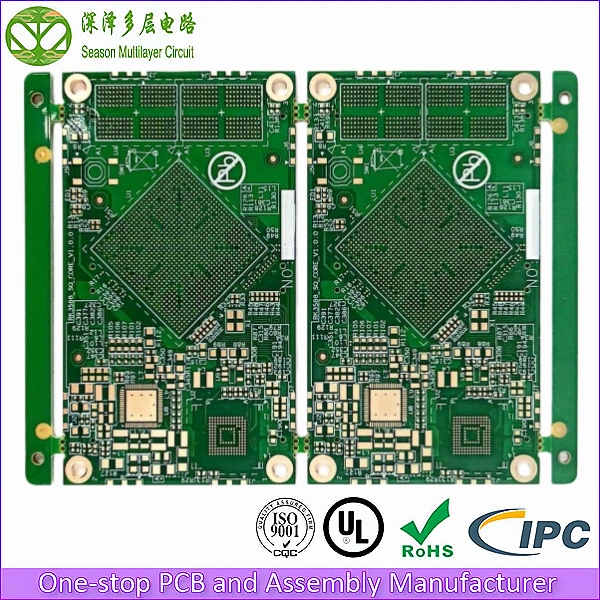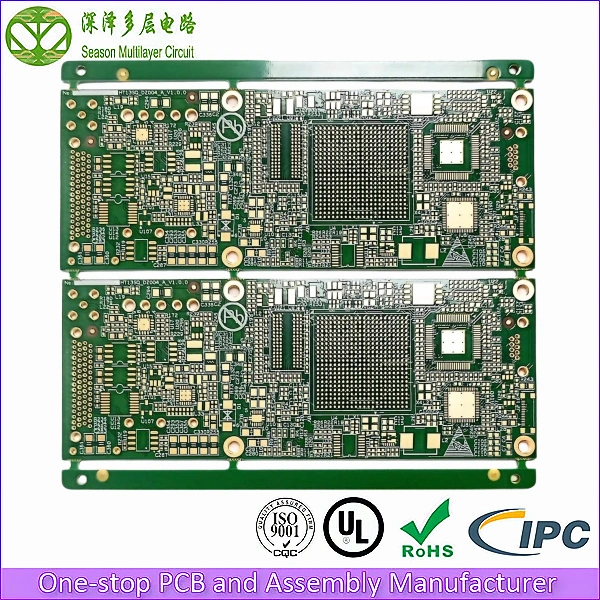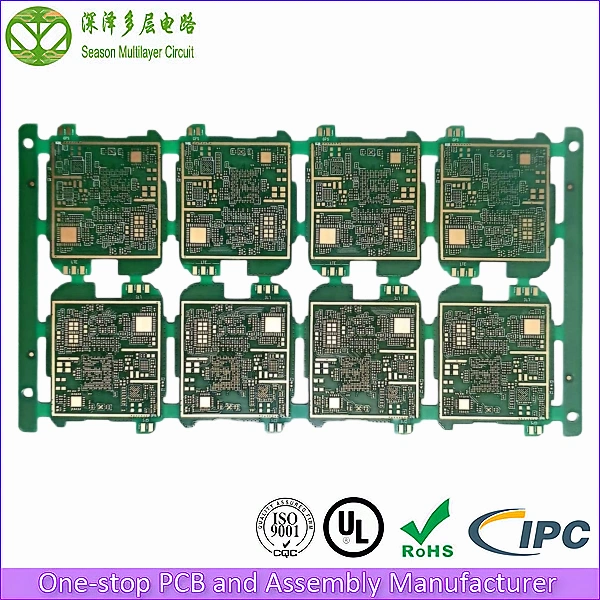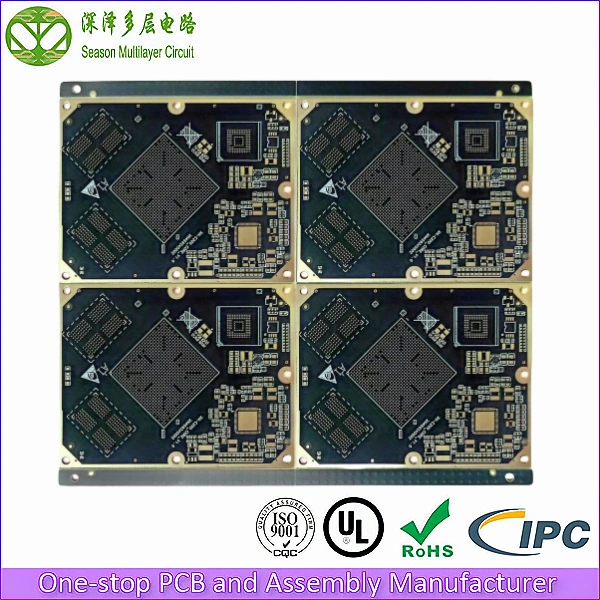
12L 2nd-order HDI Cockpit Domain Controller Mainboard

12L 2nd-order HDI
Layer Count: 12L(2+8+2)
Material: FR4 Tg170
Board Thickness: 1.6mm
Panel Size: 120*102mm/1
Outer Layer Copper Thickness: 1OZ
Inner Layer Copper Thickness: HOZ
Min Via Diameter: 0.20mm
Microvia Hole Size: 0.1mm
Trace Width/Spacing: 2.5/2.5mil
Min BGA Pad: 0.25mm
Surface Finish: ENIG1-2U’’
12l 2nd-Order HDI Core Board PCB, featuring resin-plugged vias (via-in-pad). The copper thickness for layers L6 & L7 is 2OZ. Primarily utilized in automotive intelligent cockpits and automotive central control systems, this board represents a high-difficulty PCB design with exceptionally strict manufacturing requirements.

12L 2nd-Order HDI refers to a specific specification of an HDI PCB. It indicates that the board utilizes a 12-layer stack-up structure, while “2nd-order” signifies that the HDI board is manufactured using two sequential lamination cycles. The architecture of an HDI board is typically achieved through multiple lamination processes; generally, a single laser-drilling process defines a 1st-order HDI, two laser-drilling processes define a 2nd-order HDI, and so forth. Each subsequent lamination cycle increases the routing density and complexity of the circuitry. (The figure below illustrates the stack-up structure of this 12l 2nd-order HDI board.)
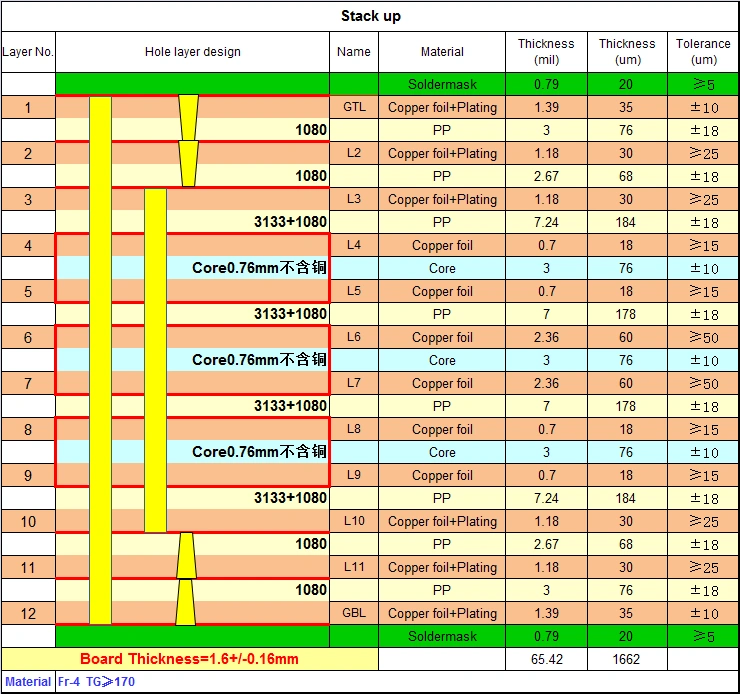
As illustrated in the diagram above, this 2nd-order HDI PCB requires three sequential lamination cycles.
- The First Lamination: Layers 3 through 10 (L3-L10) are laminated first, followed by mechanical drilling for buried vias; at this stage, it can be viewed as a standard 8-layer through-hole board. Once the buried vias undergo copper metallization and resin plugging, the inner-layer circuitry for L3 and L10 is fabricated.
- The Second Lamination: After the circuit fabrication, the second lamination cycle is performed to add L2 and L11. Laser drilling is then executed to create microvias Drl2-3 and Drl11-10, followed by via-filling electroplating. At this point, the stack-up is equivalent to a 10-layer 1st-order HDI board with blind and buried vias. Following the via-filling plating, the outer-layer circuits for L2 and L11 are processed.
- The Third Lamination: Once these circuits are completed, the third lamination cycle is conducted to form the final and complete 12-layer HDI PCB structure.
Afterward, the subsequent manufacturing steps are repeated: laser drilling for the final blind vias, via-filling electroplating, outer-layer circuit fabrication, solder mask application, silkscreen (legend), surface finish, routing (contouring), electrical testing, final inspection (FQC), packaging, and shipping.
The Definitive Guide to Cockpit Domain Controller Mainboards: Architecture, Features, and Future Trends
The automotive industry is undergoing a massive paradigm shift driven by electrification and intelligence. At the heart of this transformation is the smart cabin. Today’s consumers no longer view a vehicle as just a transportation tool; they expect a “third living space” filled with seamless interactivity. To power this complex digital experience, automotive architectures are consolidating from scattered Electronic Control Units (ECUs) into a centralized brain.
Enter the Cockpit Domain Controller Mainboard—the foundational hardware that orchestrates the entire intelligent cabin experience. This comprehensive guide explores its architecture, key technical features, diverse application scenarios, and next-generation development trends.
1. What is a Cockpit Domain Controller Mainboard?
A Cockpit Domain Controller Mainboard (also commonly referred to as the smart cabin core board) is a highly integrated, automotive-grade electronic control heart. Historically, a car required separate, isolated ECUs to manage individual cabin functions like adjustable seats, climate control, or the radio.
The modern domain controller mainboard revolutionizes this by achieving centralized control. Utilizing high-speed communication protocols such as CAN (Controller Area Network), LIN (Local Interconnect Network), and Automotive Ethernet, the mainboard constantly communicates with dozens of sensors and actuators throughout the vehicle.
Core Hardware Architecture:
- High-Performance Microprocessors (SoC/MCU): The absolute brain of the board. It processes multi-threaded input signals and runs complex operating systems (like QNX, Android Automotive, or Linux) to output real-time control commands.
- High-Capacity Storage & Memory: Employs automotive-grade LPDDR memory and eMMC/UFS storage to cache massive OS code, user profiles, and real-time navigation mapping data.
- Advanced Interface Circuits: Houses high-speed interfaces (LVDS, PCIe, USB, MIPI CSI/DSI) to connect high-definition displays, surround-view cameras, microphones, and other peripheral hardware.
- Robust Power Management Integrated Circuit (PMIC): Dynamically regulates voltage and ensures stable power delivery, safeguarding the mainboard against voltage spikes and thermal runaways.
2. Key Features and Technical Advantages
As the nervous system of the intelligent cabin, the Cockpit Domain Controller Mainboard is engineered with stringent technical benchmarks to deliver five distinct advantages:
🚀 Ultra-High Integration
By integrating multiple electronic components and processing chips onto a single multi-layer board (often utilizing advanced HDI technology), it reduces the sheer volume and complexity of in-vehicle wire harnesses. This minimizes signal attenuation and drastically improves overall system reliability.
🎮 Multi-Functional Versatility
A single mainboard simultaneously manages and distributes processing power to diverse sub-systems, including the In-Vehicle Infotainment (IVI), digital instrument clusters, climate control (HVAC), electronic mirrors, and power seat configurations—elevating the user experience to new heights.
🧩 Scalability & Flexibility
Designed with a modular and scalable topology, tier-1 suppliers and OEMs can easily customize or expand the mainboard’s firmware and hardware peripheral configurations to fit different vehicle models or localized market requirements without redesigning the entire system architecture.
🛡️ Rugged Automotive Reliability
Built using premium components (such as FR4 Tg170 substrates and ENIG surface finishes), these mainboards pass strict automotive reliability tests. They offer exceptional thermal stability and mechanical shock resistance, ensuring flawless operations for over a decade.
🔒 Mission-Critical Safety
Equipped with sophisticated hardware-level fault diagnostics, watchdogs, and redundant backup systems, the mainboard guarantees that even if an entertainment feature fails, critical driving data (like speedometer or warning lights) remains perfectly functional.
3. Diverse Application Scenarios
The versatility of the Cockpit Domain Controller Mainboard enables it to scale across all segments of the modern transportation market:
- Sedans (Luxury & Economy): In premium luxury sedans, the mainboard drives triple-screen setups, immersive ambient lighting, and multi-zone climate/seat adjustments. In economy cars, it offers an affordable, space-saving way to bring sleek digital infotainment to budget-conscious buyers.
- SUVs and MPVs: Larger family vehicles or multi-purpose vehicles feature spacious cabins that host numerous rear-seat entertainment screens, zone-isolated audio systems, and extensive comfort electronics. Centralized control via a high-performance mainboard is essential to orchestrate these multi-device ecosystems seamlessly.
- Commercial Vehicles (Trucks & Buses): In long-haul trucks and fleet buses, the mainboard integrates logistics telemetry, fleet communication, driver fatigue monitoring (DMS), climate control, and cabin lighting into one centralized hub, streamlining fleet management and driver safety.
- New Energy Vehicles (NEVs): For Electric Vehicles (EVs) and Hybrid Electric Vehicles (HEVs), the mainboard interfaces closely with battery and motor status displays, calculating and optimizing thermal management and power distribution graphics to improve total energy efficiency.
4. Future Development Trends: What’s Next?
The road ahead for smart mobility demands continuous innovation. Over the next decade, the design and manufacturing of the Cockpit Domain Controller Mainboard will evolve along the following trajectories:
1. Extreme Density & Single-Chip Consolidation
Future mainboards will move toward higher-density interconnects (HDI) with line widths breaking into ultra-fine 2/2mil boundaries. Silicon vendors will continue pushing “One-Chip-Multi-Screen” capabilities, integrating instrument clusters, IVI, and HUD control onto a single powerful SoC on the mainboard.
2. Next-Gen Human-Machine Interaction (HMI)
Tomorrow’s cabins will rely on advanced multi-modal interactions like multi-lingual voice recognition, gesture control, eye-tracking, and facial biometrics. The mainboard will incorporate dedicated AI accelerators (NPUs) to handle these compute-heavy algorithms with zero latency.
3. Ironclad Cybersecurity & Redundancy
As cars become connected nodes, they become targets for hackers. Future mainboards will embed advanced hardware security modules (HSM), secure boot features, and cutting-edge over-the-air (OTA) update backup loops to safeguard personal privacy and prevent remote vehicular hijacking.
4. Cross-Domain Fusion (Cockpit + ADAS)
The boundary between driving and infotainment is blurring. We are moving toward a centralized vehicle computer architecture where the cockpit mainboard will fuse with Advanced Driver Assistance Systems (ADAS)—enabling real-time rendering of automated driving surroundings onto AR-HUD displays.
5. Eco-Friendly and Ultra-Low Power Consumption
With EV range anxiety remaining a core consumer concern, mainboards will adapt optimized dynamic power management topologies. By utilizing low-power idle states and eco-friendly, fully recyclable halogen-free PCB laminates, manufacturers are driving toward carbon-neutral sustainability.
6. Seamless V2X (Vehicle-to-Everything) Connectivity
The mainboard will serve as the gateway for the Internet of Vehicles (IoV). Enhanced 5G and V2X communication protocol integration will ensure lightning-fast, ultra-reliable data transmission between the cabin, smart grids, and infrastructure.
Conclusion
The Cockpit Domain Controller Mainboard is no longer just a rigid circuit board; it is the ultimate cornerstone of the software-defined vehicle era. For automotive electronics manufacturers and tier-1 suppliers, staying ahead of market trends means investing heavily in high-density multi-layer engineering, thermal resilience, and ecosystem collaboration. By pushing the boundaries of integration, intelligence, and safety, these core mainboards will continue to redefine how we interact with our cars, paving the way for the ultimate autonomous lounge on wheels.
FAQs
Q1: What differentiates a Cockpit Domain Controller Mainboard from a traditional automotive ECU?
Traditional automotive ECUs follow a “one function, one box” architecture, meaning individual modules operate independently for seats, air conditioning, or radio, causing massive wiring clutter. A Cockpit Domain Controller Mainboard utilizes high-performance multi-core processors to centralize these workloads onto a single board, dramatically reducing weight, wiring complexity, and manufacturing costs while allowing cross-system data sharing.
Q2: How does the Cockpit Domain Controller Mainboard handle the high thermal stress inside a vehicle?
Because automotive cabins are often subjected to extreme temperatures (e.g., parking under direct sunlight), these mainboards are built using premium high-temperature materials like FR4 Tg170 or Tg180 substrates. They are paired with robust ENIG (chemical gold) finishes for superior heat dissipation, and use advanced PCB layouts featuring thick thermal copper vias and dedicated heatsink contact pads to prevent component overheating.
Q3: Can the same Cockpit Domain Controller Mainboard be used across different car models?
Yes, due to its inherent modularity and high flexibility. While the base hardware layout of the mainboard remains standardized to control essential I/O, sensors, and power routing, it can be scaled or configured via software/firmware parameters. This allows automakers to deploy the exact same mainboard across luxury SUVs, budget sedans, or electric vehicles, reducing development cycles and capitalizing on economies of scale.