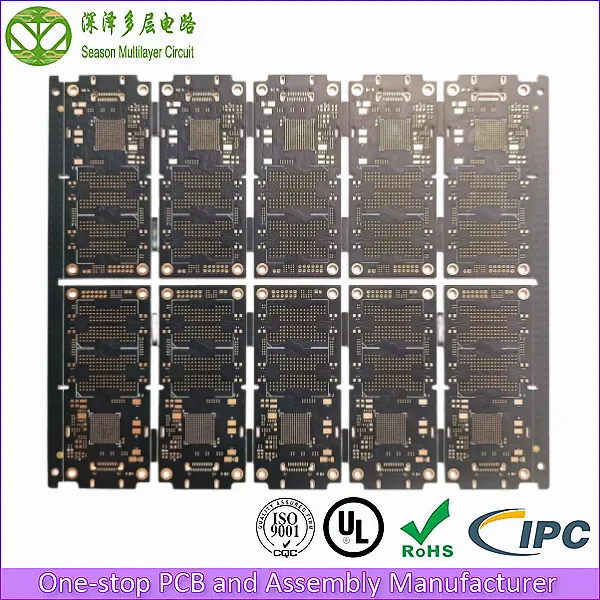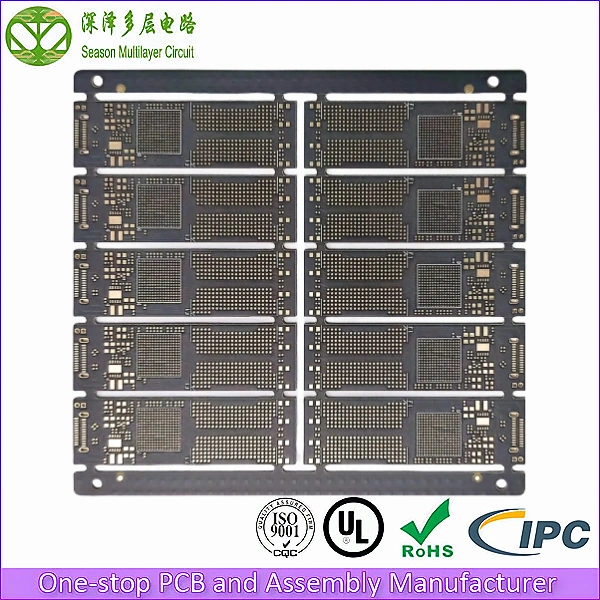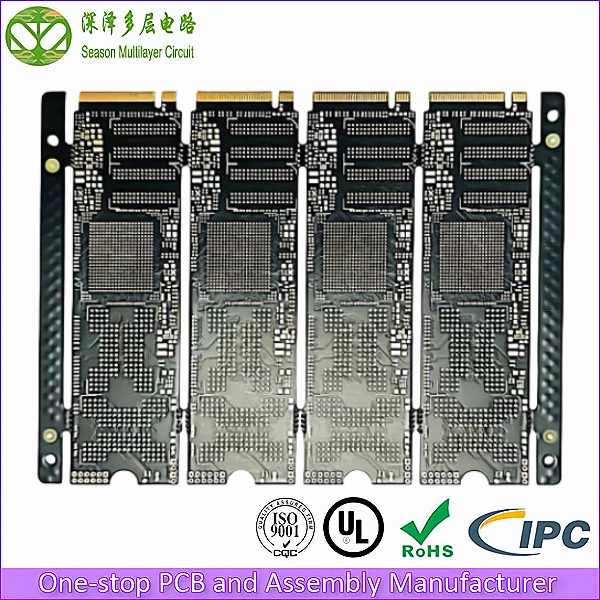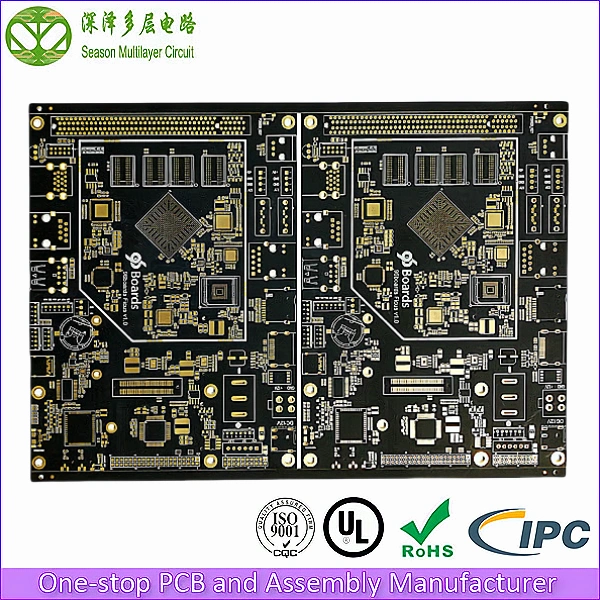

High-Reliability 6-Layer Automotive PCB
IATF 16949 Certified Factory supplying high-performance automotive PCBs. We combine competitive factory-direct pricing with fast delivery and premium end-to-end service to ensure your automotive components are built to last.
In the modern automotive industry, electronic components face some of the harshest environments on earth—ranging from extreme thermal fluctuations and constant mechanical vibrations to rigorous electromagnetic interference. Failure is simply not an option.
Our High-Reliability 6-Layer Automotive PCB is engineered specifically to meet these uncompromising demands. Manufactured in our state-of-the-art, IATF 16949 certified facility, this 6-layer printed circuit board offers the optimal balance of advanced signal routing, superior thermal management, and robust mechanical strength. By choosing our factory-direct solution, you get the perfect combination of premium quality, competitive pricing, and rapid delivery to ensure your automotive components are built to last.nents.
High-Reliability 6-Layer PCB|IATF 16949 Automotive PCB Factory|Factory-Direct Automotive PCB|Harsh Environment Automotive PCB
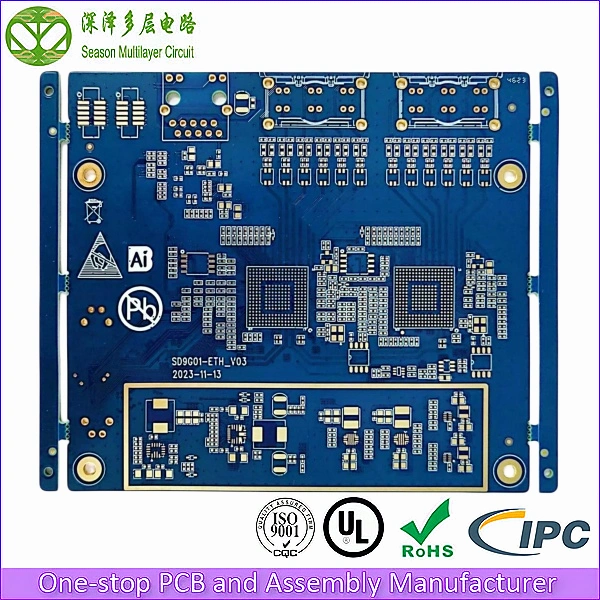
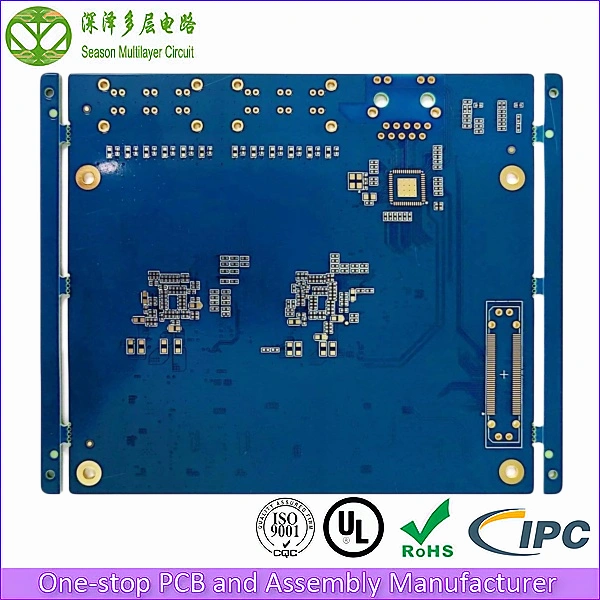
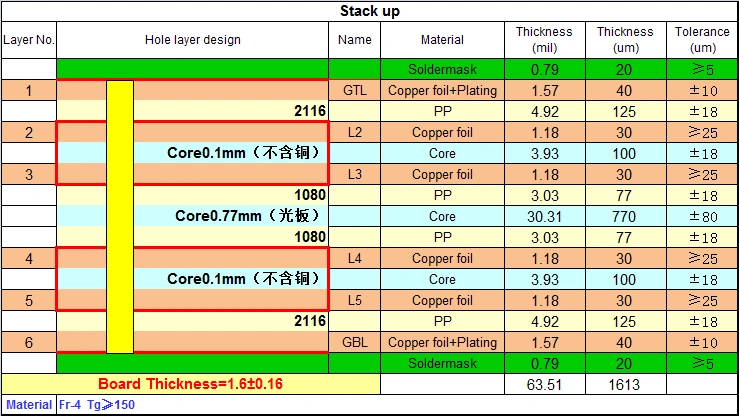
This 6-layer automotive PCB features a pseudo 8-layer stackup explicitly designed to eliminate signal interference. Given the stringent signal integrity requirements in automotive electronics, this pseudo 8-layer structure was adopted to prevent mutual interference between the L3 and L4 signal layers. Additionally, this cross-ply lamination structure is sometimes utilized to resolve complex impedance control challenges.
From a manufacturing perspective, the fabrication process of this board is nearly identical to a standard 8-layer PCB, showing minimal difference in both lamination difficulty and raw material costs. The only distinction is that the dummy layers require no circuitry routing, thereby saving the corresponding circuit forming costs; instead, a 0.8mm core can be directly etched into a copper-free, blank layer.
However, from a cost-benefit perspective, this pseudo 8-layer configuration is highly discouraged. It incurs higher overall expenses, extends lead times, and unnecessarily escalates production complexity. For a more efficient approach, please refer to “Design and Optimization of standard 6-Layer PCB Lamination Structures.”
Mastering 6-Layer Automotive PCB Design and Manufacturing for High Reliability
The rapid evolution of automotive electronics—driven by electric vehicles (EVs), autonomous driving, and advanced driver-assistance systems (ADAS)—has drastically increased the demand for advanced printed circuit boards. Unlike consumer electronics, an 6-layer automotive PCB must withstand extreme and harsh environmental conditions, including thermal shocks, continuous vibrations, and mechanical impacts.
Designing and manufacturing a highly reliable, durable 6-layer automotive PCB requires strict adherence to specialized engineering standards. This article explores the critical design rules and manufacturing techniques necessary to produce automotive-grade multilayer PCBs.
Part 1: Critical Design Considerations for a 6-Layer Automotive PCB
The stackup and layout design of a 6-layer automotive PCB form the foundation of its electrical performance and structural integrity. A typical automotive 6-layer stackup alternates signal layers with dedicated ground and power planes to minimize electromagnetic interference (EMI).
1. Advanced Layout Design and Component Placement
Component placement in automotive applications must follow the core principle of “logical zoning and localized processing.” * High-power components (like motor drivers) must be isolated from sensitive analog and digital signals.
- Heavy components must be strategically placed away from areas prone to mechanical bending or high vibration to prevent solder joint fatigue.
2. Guarding Signal Integrity (SI)
With high-speed data buses (such as CAN-FD, Automotive Ethernet, and radar signals) becoming standard, maintaining signal integrity is paramount.
- Controlled Impedance: Trace widths and spacings on the signal layers must be precisely calculated against the dielectric material.
- Crosstalk Mitigation: Perpendicular routing between adjacent signal layers and proper shielding using ground planes are mandatory to avoid signal distortion, propagation delays, and reflections.
3. Robust Power Integrity (PI)
Fluctuations in power supply can cause microcontrollers to reset or sensors to misread data. Achieving solid power integrity involves:
- Dedicated Planes: Utilizing solid power and ground planes to reduce loop inductance.
- Decoupling Network: Placing high-quality decoupling capacitors as close as possible to the power pins of ICs to suppress voltage ripples and maintain a stable power delivery network (PDN).
4. High-Efficiency Thermal Design
Automotive electronics routinely operate in high-temperature environments (e.g., under the hood). Effective thermal management ensures long-term durability:
- Thermal Vias: Incorporating stitched thermal vias under heat-generating components to transfer heat to inner copper planes.
- Thicker Copper: Utilizing heavier copper weights (e.g., 2 oz or 3 oz) on inner layers to spread heat efficiently across the entire 6-layer automotive PCB.
Part 2: Manufacturing Challenges and Techniques
Transitioning an automotive design from software to a physical board requires advanced fabrication capabilities and stringent quality control.
1. Specialized Material Selection
Standard FR4 is often insufficient for automotive applications. Manufacturers must prioritize materials with specific properties:
- High-Tg (Glass Transition Temperature): Materials with a Tg≥170℃ ensure the board maintains its mechanical structure under extreme heat.
- Low CTE (Coefficient of Thermal Expansion): Minimizes the expansion and contraction rates in the Z-axis, protecting vias from cracking.
- Advanced Substrates: Depending on the specific application, high-density FR4 or heavy copper aluminum-clad substrates are selected.
2. Precision Manufacturing Processes
Fabricating a reliable 6-layer automotive PCB relies on state-of-the-art production lines:
- Mechanical & Laser Drilling: Ensuring precise hole alignment and clean hole walls to guarantee robust via plating.
- Copper Plating: Uniform copper deposition in vias prevents early failure caused by thermal cycling.
- Multilayer Lamination: Tight control over temperature and pressure cycles during lamination prevents internal delamination and resin voids.
3. Zero-Defect Quality Inspection
Automotive electronics leave zero room for error. A comprehensive inspection workflow must comply with automotive standards like IATF 16949:
- AOI & Automated X-Ray Inspection (AXI): For checking inner layer alignment and blind/buried via integrity.
- Hipot Testing: Verifying dielectric breakdown voltage and electrical insulation resistance.
- Cross-Sectional Analysis: Destructive testing on coupon samples to inspect hole wall copper thickness and inter-layer registration.
Conclusion
The success of modern automotive electronics relies heavily on the underlying hardware. Developing a 6-layer automotive PCB demands a holistic approach that seamlessly bridges rigorous layout design with high-precision manufacturing. By prioritizing signal/power integrity, aggressive thermal management, High-Tg materials, and zero-defect quality control, manufacturers can deliver the rugged reliability required to drive the future of automotive technology forward.
FAQs
Q1: Why is a 6-layer stackup preferred over a 4-layer stackup for automotive applications?
A 6-layer stackup provides two additional inner layers, allowing engineers to dedicate entire planes to Ground (GND) and Power (PWR). This drastically improves electromagnetic compatibility (EMC), reduces EMI, provides better shield casing for high-speed signals, and offers superior thermal dissipation paths compared to a 4-layer board.
Q2: What is the significance of High-Tg materials in a 6-layer automotive PCB?
High-Tg (Glass Transition Temperature) materials remain rigid and stable at much higher temperatures. Because automotive PCBs are subjected to extreme thermal environments (ranging from below freezing to over 125℃ in engine compartments), High-Tg materials prevent the board from warping, delaminating, or putting mechanical stress on copper traces and vias.
Q3: What quality standards must a 6-layer automotive PCB meet?
Automotive PCBs must adhere to strict international quality management standards. The most critical include IATF 16949 (Automotive Quality Management System), IPC-6012DA (Qualification and Performance Specification for Rigid Printed Boards, Automotive Supplement), and AEC-Q100/Q200 for stress-test qualification of the components used on the board.